- What forklift fleet management actually buys you
- The reporting, and what it is for
- Web based access to your own records
- Certification and compliance, tracked rather than chased
- Maintenance contracts for one site or many
- Controlling what the fleet costs
- Predictive maintenance and cost per hour
- Owned, contract hire or a mix
- Outsourcing the operation
- Resident engineers and on-site parts
- Your account manager and fleet reviews
- Telematics and monitoring
What forklift fleet management actually buys you
Once a business runs more than a handful of trucks, the expensive problems stop being mechanical and start being administrative. Nobody is quite sure how many machines there are.
Two of them are on contracts that have already ended. One is costing four times what the others cost and nobody has noticed, because the invoices arrive separately.
Three are due a thorough examination and the certificates are in a filing cabinet at a site that closed.
Forklift fleet management is the service that replaces that with facts. We have been supplying, servicing and operating materials handling equipment since 1982, and we manage fleets ranging from a few units on one site to national networks across many.
The reporting, and what it is for
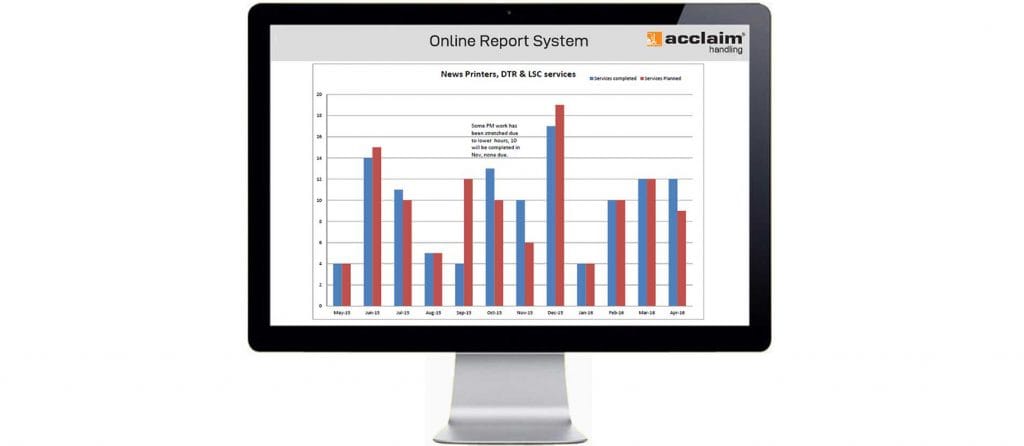
All servicing schedules, job data and key performance indicators run through our service reporting system, and come back to you as charts, tables and reports rather than as raw data. Reports are produced on a schedule and can be generated on request. What they cover:
- Machinery uptime, by machine and across the fleet.
- First fix data: how often a fault was fixed on the first visit, which is the single best measure of whether your service provider is any good.
- Operating usage, so a truck doing 200 hours a year can be told apart from one doing 2,000.
- Damage reporting, which is usually the one that pays for the exercise.
- Over contract costs, so what was supposed to be included and what is being charged on top are visible in the same place.
- Service completion schedule, so nothing quietly slips.
Damage is rarely random. It clusters around a shift, a location, a doorway or an individual, and once it is on a chart it can be fixed.
Damage costs are worth singling out, because once the pattern is visible it can be corrected with training or a change to the layout. That is the difference between a repair bill and a fixable problem.
Web based access to your own records
We give customers web based access to all their forklift fleet records, so every job and service we carry out is visible without anyone having to ask for it. Records can be filtered to whichever indicators matter to you, when you want them, and it means you have a watching brief on how the fleet is being looked after rather than a report once a quarter.
This is free of charge to our customers.
Certification and compliance, tracked rather than chased
Every lifting machine on your site needs a current thorough examination under LOLER, at least every 12 months for a standard counterbalance truck and at least every 6 months where a machine lifts people. Across a mixed fleet on several sites, with different in-service dates, that is an administrative job that goes wrong quietly and is only discovered when something goes wrong loudly.
Managed fleets have those dates tracked centrally, with the examinations scheduled before they fall due rather than after. See LOLER regulations and thorough examinations for what the examination itself covers, and health, safety and compliance for the wider picture.
Most fleets have two or three machines distorting the whole cost. The reporting is how you find them.
Maintenance contracts for one site or many
Fleet management starts with the maintenance contract. Planned servicing, thorough examinations, breakdown repairs and replacement cover sit on one agreement, for the forklifts and for the rest of the equipment on site: pallet trucks, access platforms, sweepers and tow tractors.
A business with several sites can hold them all on that one agreement, with one point of contact and one monthly invoice. The invoice can be split the way your accounts need it, by region, by site or by asset, so each budget holder sees their own machines and nobody reconciles a pile of separate bills. Each site still deals with the depot nearest to it.
Controlling what the fleet costs
Cost control on a forklift fleet is mostly about finding the small number of machines that are distorting the total. Three patterns come up repeatedly:
- The machine that should have gone. Repair spend rising year on year on a truck near the end of its life, where the annual cost has quietly passed what a replacement or a hire would cost. Once it is visible, part exchange is usually the answer.
- The wrong machine for the job. A diesel counterbalance doing indoor work where an electric truck belongs, or a truck with far more capacity than the loads require, costs more to run every hour it is used.
- The fleet that is bigger than the work. Utilisation data shows machines that are barely moving, which are candidates for removal rather than replacement.
Planned servicing is what stops most of this happening in the first place: see why service my equipment. Parts and consumable spend per machine comes through the same reporting, and our parts operation supplies the fleet from over £1 million of UK stock.
Predictive maintenance and cost per hour
Hours, fault and impact data from telematics, set alongside the service and repair history we already hold, show a component wearing out before it fails. The part is replaced at a planned visit instead of after a breakdown, and the truck is not off the road waiting for it.
The same records give the cost per hour of each machine: what it has cost in servicing, repairs, parts and damage, divided by the hours it has actually worked. That is the figure that shows when a truck has become dearer to keep than to replace. Our guide to predictive and preventive maintenance explains the difference between the two.
Owned, contract hire or a mix
| Aspect | Owned | Hired |
|---|---|---|
| Suits | Steady, predictable, long-term work | Seasonal peaks, short projects, cover during repairs |
| Cost shape | Capital up front, or financed | Operating cost, no capital tied up |
| Flexibility | Low: you have the machine you bought | High: change the machine when the work changes |
| Watch for | Repair spend on a truck past its economic life | Long hires that quietly cost more than owning |
Most fleets of any size end up as a mix, and the mix is worth reviewing rather than inheriting. Owned machines suit steady, predictable, long-term work.
Hire suits seasonal peaks, short projects, cover while a machine is repaired, and any situation where the requirement is likely to change. Finance options including lease purchase, contract hire and operating lease are available on used machines as well as new.
We can manage a fleet regardless of where the machines came from, and we service machines we did not supply. Where a site closes or a contract moves, forklift transport handles the relocation, and it is usually cheaper planned as a sequence than booked truck by truck.
Outsourcing the operation
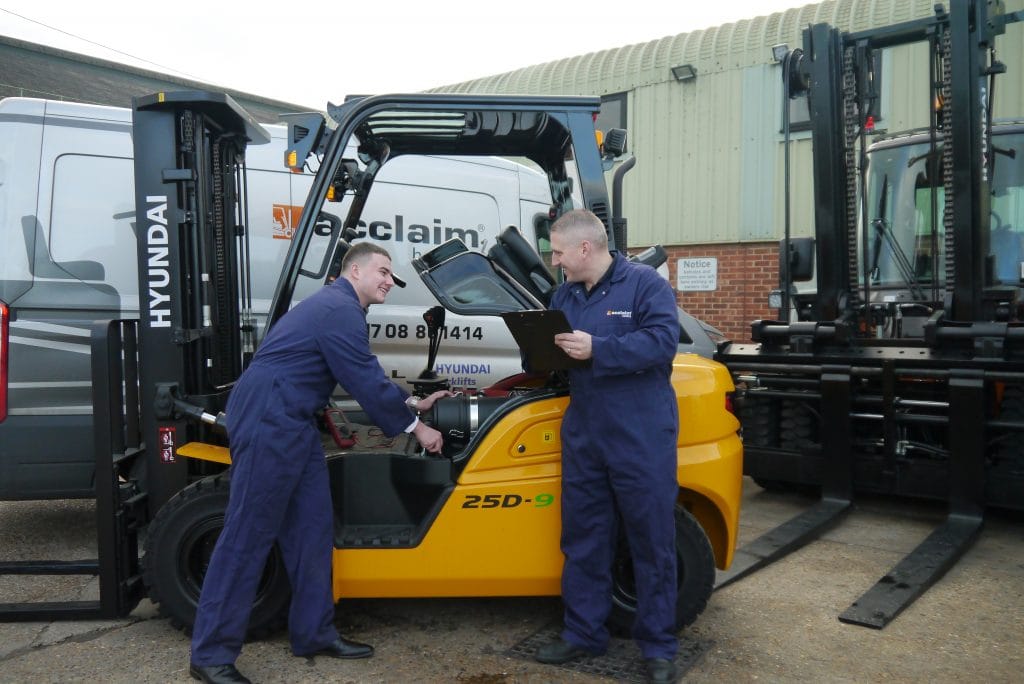
Where it suits, we can manage the fleet on your behalf rather than alongside you: scheduling, servicing, parts, compliance dates and reporting handled as a service, with a named local Account Manager and regular review meetings where the reports are discussed and issues raised.
That is a conversation about your specific operation rather than a package, so the practical next step is a site visit.

Resident engineers and on-site parts
On sites that run several shifts or around the clock, waiting for an engineer to travel is time the fleet cannot spare. For those sites we base our own engineers on site, working your shift pattern, with a stock of the parts your fleet uses most held there with them.
- An engineer already on site when a fault happens.
- Planned servicing done between shifts, not during them.
- On-site parts stock set from your fleet’s own repair history.
- The depot’s engineers and our parts operation behind them for anything bigger.
Your account manager and fleet reviews
Managed fleets have a named local account manager who knows the sites and the machines. At regular fleet reviews they go through the reports with you:
- Performance: uptime, first fix and breakdowns, machine by machine.
- Usage: hours worked against hours available, so idle trucks show up.
- Wear and tear: what is normal for the hours, and what points to damage or the wrong truck for the job.
- Cost: cost per hour and over contract charges for each machine.
Each review ends with what changes: a truck moved, swapped, part exchanged or handed back, a service interval adjusted, a layout or training point raised. For a wider look at whether the fleet is the right size and the right power, including electric against diesel and LPG over the life of the trucks, see our fleet review.
Telematics and monitoring
Fleet monitoring systems can add live data from the machine itself: impact detection, access control so only trained operators can start a truck, pre-use check prompts on a terminal, and hour meter readings that arrive automatically rather than being written down. Where a fleet already has telematics fitted, that data can feed the same reporting. See forklift telematics for what a system records and controls, and pedestrian detection for the safety side.
Whether telematics is worth fitting depends on the size of the fleet and the problem you are trying to solve, and on some fleets the honest answer is that the reporting above already tells you what you need. Ask, and we will tell you which it is.
Most fleets have two or three machines distorting the whole cost. The reporting is how you find them.
Fleet management: common questions
Eight depots across the UK
Our own engineers, out of our own depots - wherever you are, service comes from us.
Talk to us about fleet management
Monday to Friday, 8:00am to 5:00pm.
Additional Services
Checkout our range of other machine services below