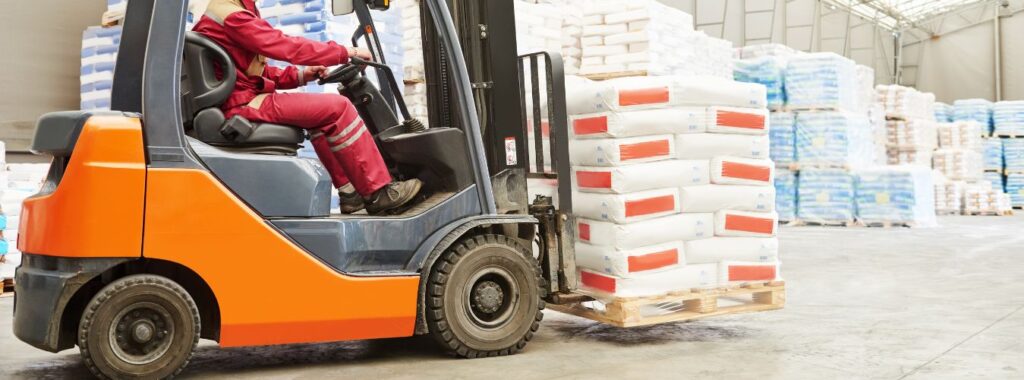
What “explosion proof” actually means
There is no such thing as a forklift that cannot be blown up. What the industry means by an explosion proof forklift is a truck that has been engineered so that it cannot become the source of ignition in an atmosphere that is already capable of exploding. The correct term is explosion protected, or Ex rated, and the distinction matters when you are specifying one.
You will also hear it called an ATEX forklift or an Ex truck. The work done to the truck itself is usually called flameproofing: see flameproof forklifts for what that involves on each type of machine.
A standard truck offers a long list of ignition sources: the starter motor and alternator, switchgear and contactors, the exhaust and engine surfaces on a diesel or LPG machine, static discharge, and friction sparks from forks, wheels or a dropped load. Protection works by removing or containing every one of them while leaving the machine usable.
Equipment sold for use in an explosive atmosphere in Great Britain is governed by the Equipment and Protective Systems Intended for Use in Potentially Explosive Atmospheres Regulations 2016. Those regulations implement EU Directive 2014/34/EU, which came into force on 20 April 2016 and replaced the older Directive 94/9/EC.
Machines placed on the GB market must be UKCA or CE marked, carry a Declaration of Conformity and come with instructions in English. Northern Ireland works to the 2017 regulations and continues to follow 2014/34/EU.
If a quotation or a data sheet still cites ATEX 94/9/EC, it is quoting a directive that was repealed a decade ago. That on its own does not make the equipment unsafe, but it is a reasonable prompt to ask when the certification was last reviewed.
DSEAR: the duty is yours, not the truck’s
The regulations above govern the equipment. The duty that governs your site is the Dangerous Substances and Explosive Atmospheres Regulations 2002, usually shortened to DSEAR.
DSEAR requires an employer to assess the risk from dangerous substances, to eliminate or control it, and, where an explosive atmosphere may occur, to classify the place into zones. That classification is the employer’s responsibility.
No equipment supplier can classify your site for you, and no truck specification is meaningful until it has been done.
This is the single most common reason an enquiry for an Ex rated truck stalls. The buyer knows they have a problem and does not yet have a zone. Until the area is classified, nobody can tell you which category of equipment you need, and any price you are given is a guess.
The HSE publishes its own guidance on ATEX and explosive atmospheres. One practical point worth knowing: equipment already in use before July 2003 may continue in use indefinitely, provided a risk assessment shows it is safe to do so. An older protected truck on site is not automatically non-compliant.
Zones and equipment categories, in plain terms
Zones describe how often an explosive atmosphere is present. Gases, vapours and mists use zones 0, 1 and 2. Dusts use zones 20, 21 and 22. The two run in parallel.
- Zone 0 and zone 20: an explosive atmosphere is present continuously, for long periods, or frequently. The inside of a solvent tank, or the inside of a powder silo.
- Zone 1 and zone 21: likely to occur in normal operation, but only occasionally. A paint mixing room, a solvent decanting bay, a flour handling area around a tipping point.
- Zone 2 and zone 22: not likely in normal operation, and only for a short period if it does happen. Much of the floor area of a warehouse holding sealed drums of solvent, or a general dust environment away from the emission source.
Equipment is then rated by category, and the category has to match the zone:
| Gas zone | Dust zone | How often an explosive atmosphere is present | Equipment category needed |
|---|---|---|---|
| Zone 0 | Zone 20 | Continuously, for long periods, or frequently | Category 1 (1G / 1D) |
| Zone 1 | Zone 21 | Likely in normal operation, but only occasionally | Category 2 (2G / 2D), or category 1 |
| Zone 2 | Zone 22 | Not likely in normal operation, and only briefly | Category 3 (3G / 3D), or category 1 or 2 |
A G suffix means gas, vapour or mist. A D suffix means dust.
So a truck marked II 2G is Group II equipment, category 2, for gas: a zone 1 forklift. A truck marked II 3D is category 3 for dust, which covers zone 22 only.
Group I is mining equipment and does not apply to surface industry; almost everything in materials handling is Group II.
In practice, most sites that need protected materials handling are working in zone 1, zone 2, zone 21 or zone 22. Category 1 trucks for zone 0 or 20 are rare, because a machine is very seldom driven into a continuously explosive atmosphere.
The industries this applies to
If your process produces flammable gas, vapour or combustible dust, you are likely to have a zoned area somewhere, even if the truck only enters it briefly.
- Chemical and petrochemical: solvent handling, decanting, drum and IBC storage, tank farms.
- Paint, coatings, inks and adhesives: mixing rooms, solvent stores, spray areas.
- Pharmaceutical and fine chemicals: solvent based processes, active powder handling.
- Distilleries, breweries and spirits: bonded warehouses, cask filling and vatting halls.
- Food production: flour, sugar, starch, custard powder, milk powder and other combustible dusts.
- Grain, animal feed and agriculture: intake pits, silos, bagging lines.
- Waste, recycling and biomass: refuse derived fuel, wood chip, landfill gas, battery processing.
- Woodworking and joinery: sanding and machining dust.
- Fuel, oil and aerosol: terminals, filling and packing lines.
- Printing: solvent based inks and washes.
Battery charging areas are worth a separate mention. Lead acid batteries give off hydrogen while charging, which is why charging bays are ventilated and are sometimes zoned in their own right. If you are reviewing your charging area, our battery supply and regeneration page covers the equipment side.
Tell us the zone, the substance and the duty, and we will come back with a specification rather than a guess.
Protecting the truck itself
Protection is engineered onto a specific base machine for a specific zone: enclosures for anything that can arc or spark, limits on every hot surface, non-sparking fork cladding, static control and, on many trucks, gas detection that stops the truck before the atmosphere becomes dangerous. We do this for every type of machine we supply. The engineering, the options and the machines are covered in detail on our flameproof forklifts page.
What Acclaim can do
Acclaim Handling has supplied and maintained materials handling equipment since 1982, from eight depots with our own engineers, and we supply flameproofed, explosion protected versions of every machine type we sell. Each conversion is certified for the zone and substance it is built for, under the 2016 Regulations and Directive 2014/34/EU.
Where we can help:
- Specifying and sourcing the base machine. The protected truck starts life as a standard one, and choosing the right model, capacity, mast and power source is the part we do every day. We supply counterbalance forklifts, reach trucks and powered pallet trucks, and we have been the UK distributor for STILL since 1982.
- Flameproofing the truck for your zone, substance and duty cycle, new or converted: see flameproof forklifts.
- Thorough examinations. A protected truck is still lifting equipment, so LOLER applies exactly as it does to any other forklift. See LOLER regulations and thorough examinations.
- Routine servicing, repairs and parts on the materials handling side of the machine, through forklift servicing, repairs and parts.
- Fleet management, so certification dates and service intervals across a mixed fleet are tracked in one place rather than in a spreadsheet. See fleet management.
- Hire and short term cover for the standard part of your fleet while a protected machine is away, through forklift hire.
Periodic inspection of the explosion protection itself, and repairs to protected components, are part of the same service, planned alongside the truck’s servicing and thorough examinations.
Keeping a protected truck compliant
Two separate regimes run alongside each other on the same machine, and they are commonly confused.
The LOLER thorough examination covers the lifting function: forks, carriage, chains, mast and hydraulics. For a standard counterbalance truck that is at least every 12 months, and 6 months where the machine lifts people. That is the same for a protected truck as for any other, and it is covered on our thorough examinations page.
The Ex inspection is a different thing entirely. Explosion protected installations are subject to periodic inspection to confirm the protection concept is still intact: enclosure integrity, seals, cable glands, earthing and bonding, and the gas detection system where one is fitted. It follows a defined inspection scheme, set out in EN 60079-17, and neither examination substitutes for the other.
Our health, safety and compliance page covers the wider picture of what a site is expected to hold.
Before you ask for a price
Three pieces of information turn an explosion protection enquiry from a conversation into a specification. If you have them to hand, the first call is much shorter.
- The zone. Zone 1, 2, 21 or 22, from your DSEAR hazardous area classification, and whether the truck works in it continuously or only passes through.
- The substance. Which gas, vapour or dust, because that fixes the gas group and the temperature class the equipment has to meet.
- The duty. Capacity, lift height, hours per shift, indoor or outdoor, and whether it needs to work in a non-zoned area as well.
If you do not yet have a hazardous area classification, say so. It is a normal place to be starting from, and it changes the order in which things need to happen rather than stopping the conversation.
Tell us the zone, the substance and the duty, and we will come back with a specification rather than a guess.
Explosion protection: common questions
Eight depots across the UK
Our own engineers, out of our own depots - wherever you are, service comes from us.
Talk to us about explosion protection
Monday to Friday, 8:00am to 5:00pm.
Additional Services
Checkout our range of other machine services below