On this page
Most forklift accidents don’t happen because operators are reckless. They happen because someone misunderstood what the truck could safely carry, often in good faith, often having glanced at a number on a plate without knowing what that number actually meant. The load capacity chart is one of the most important pieces of information attached to any forklift, and it’s also one of the most consistently misread.
Understanding it properly isn’t complicated, but it does require knowing what you’re actually looking at, and why each variable on the chart exists.
The Number on the Nameplate Is Not the Whole Story
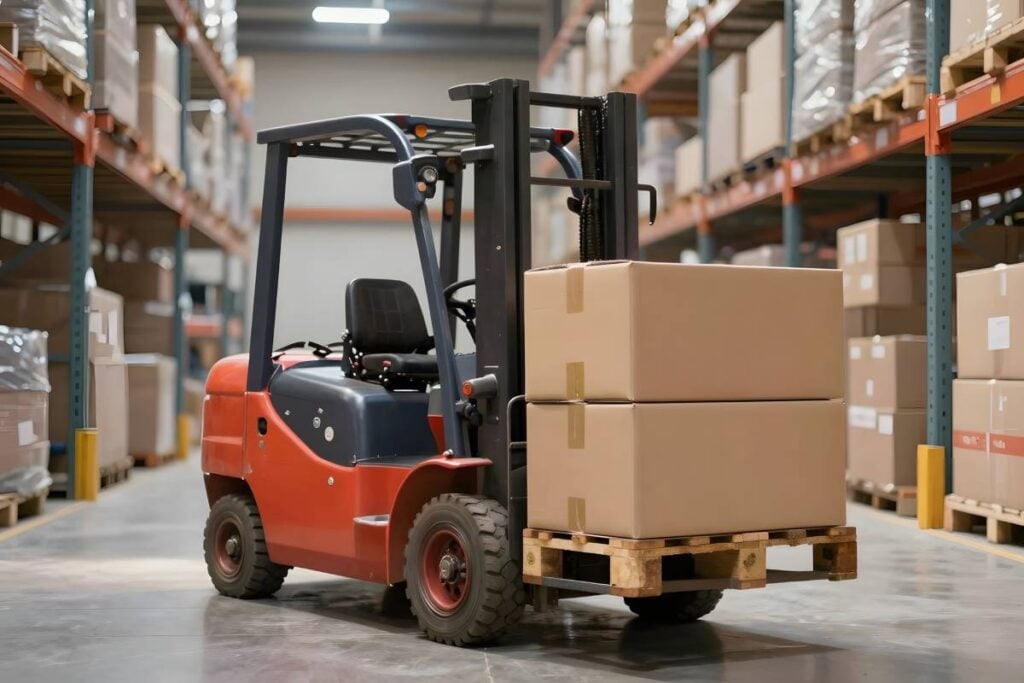
Every forklift has a data plate, usually fixed to the mast or dashboard, that displays a rated capacity figure, typically expressed in kilograms. Say 2,500kg. The instinct is to read that as a simple ceiling: if the load weighs less than 2,500kg, you’re fine. This is where the misunderstanding begins.
That rated capacity figure applies under very specific conditions: forks at a standard load centre, mast in an upright position, no attachments fitted. Change any of those variables and the actual safe capacity changes with them, often significantly downward. The load capacity chart exists precisely to communicate how those variables interact across real operating conditions. It isn’t supplementary information. It is the information.
What Load Centre Actually Means
Load centre is the concept that catches most people out, and it’s worth understanding properly rather than just accepting as a given.
It refers to the horizontal distance from the face of the forks to the centre of gravity of the load. The standard load centre used for most rated capacity calculations is 500mm, which assumes a uniformly loaded standard pallet with weight distributed evenly front to back. In practice, many loads don’t meet this assumption, and that’s where the chart becomes essential.
The physics behind it is straightforward. The front axle of a forklift acts as a fulcrum. The further the load’s centre of gravity sits from the fork face, the greater the rotational force trying to tip the truck forward. To counteract that force within safe stability limits, the maximum allowable load weight must decrease as the load centre distance increases. A forklift rated at 3,000kg at a 500mm load centre might safely carry only 2,100kg at a 700mm load centre. These are not conservative estimates; they’re the point at which the physics of stability become unforgiving.
Reading the Chart Itself
Forklift load capacity charts are typically presented as a table or graph with load centre distance on one axis and lift height on the other. Each cell or data point gives the maximum safe load for that specific combination of the two variables. The discipline required is using both axes together, every time.
It’s not enough to check the load centre column if you’re lifting to a height different from the standard. Capacity decreases as lift height increases, because raising a load shifts the truck’s combined centre of gravity upward and reduces its resistance to tipping. A load that sits comfortably within safe limits at ground level may exceed them at four metres. This is not a marginal effect; on triplex masts at full extension, the reduction in effective capacity relative to ground-level rated capacity can be substantial.
Read across both dimensions for every non-standard lift, not just one, and never assume that ground-level safety translates automatically to working height.
Attachments Change Everything
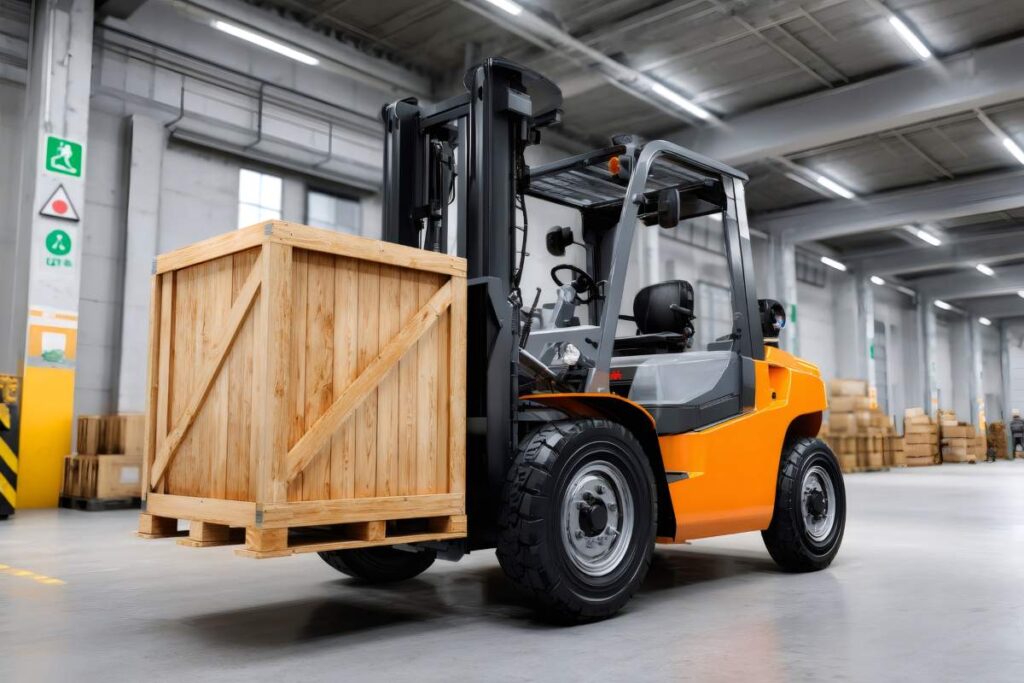
If the truck is fitted with an attachment, such as a side-shifter, rotating clamp, extended fork arms, or a paper roll clamp, a separate capacity plate for that configuration should be present on the truck. The base capacity chart no longer applies once an attachment is fitted, for two reasons: the attachment itself adds weight to the front of the truck, effectively extending the load centre, and it may alter the geometry of how loads are carried.
Using the original rated capacity with an attachment in place is one of the most common errors in forklift operation, and one of the most dangerous. If a truck has been retro-fitted with an attachment and no revised capacity plate is present, that needs to be rectified before the truck goes back into service.
Load Weight Distribution Matters Too
Not all loads are uniform, and the physical dimensions of a pallet don’t tell you where the weight actually sits within it. A load where the mass is concentrated toward one end will have its centre of gravity displaced in that direction. If you’re measuring load centre from the pallet edge rather than from the actual centre of gravity, you may be working from an incorrect assumption even if you’ve done everything else correctly.
For irregular, dense, or awkwardly shaped loads, the safest approach is to establish where the centre of gravity actually lies before lifting, then cross-reference that against the chart. When in doubt, assume a more conservative load centre figure and verify the chart against it. Erring toward caution here costs nothing; getting it wrong can cost considerably more.
How This Works in Practice
Reading the load capacity chart shouldn’t be a task reserved for when a load looks borderline heavy. It should be a standard part of the pre-lift assessment for any load that deviates from normal pallet dimensions, is stacked unusually high, involves an attachment, or is being placed at significant height. Operators who build this habit develop an accurate working sense of their equipment’s limits; those who rely on intuition alone tend to gradually drift toward margins that aren’t as safe as they feel.
The chart should also be physically legible. If the data plate on a truck is damaged, faded, or missing, that truck should not be operated until the plate has been replaced. This isn’t bureaucratic caution; the chart is a legal requirement under PUWER and a practical safety tool. A truck without a readable capacity plate is an unknown quantity in operation.
Tip: Choosing the correct forklift capacity for an application in the first place is the upstream decision that shapes how often operators find themselves working near the limits of their equipment. Getting the specification right at the procurement stage means the day-to-day operating margins are wider and safer for everyone.
Why Choose Acclaim Handling?
Acclaim Handling has been supplying, servicing, and supporting materials handling equipment across the UK since 1982, with 43 years of technical knowledge informing every recommendation they make. If you’re looking at material handling forklifts for sale and want to be certain you’re selecting the right capacity for your specific operation, Acclaim’s engineers and equipment specialists will give you a straight answer based on your actual loads, your lift heights, and your environment, not a generic one. Eight regional service centres, engineering support Monday to Friday, 8:00am to 5:00pm with a 24/7 emergency callout line, and four decades of practical experience on the ground across the UK. Talk to Acclaim Handling before you commit.