Walk through any warehouse and you’ll see dozens of safety signs. Most get ignored so completely they might as well be invisible.
This happens because there are too many signs, they’re poorly designed, they’re positioned where nobody looks, or they’ve been there so long they’ve become part of the background scenery. The human brain is excellent at filtering out visual noise, and safety signage often becomes exactly that – noise.
But some signs actually matter. They communicate genuine hazards, mark zones where specific behaviours are required, or provide information that prevents injuries. Operators who can’t recognise and respond to these critical signs create risks for themselves and everyone around them.
The most fundamental sign marks where forklifts operate. Simple graphic of a forklift, usually on a yellow or blue background, sometimes with text like “Forklift Operating Area” or “Caution: Forklifts in Use.”
This tells pedestrians they’re entering a space where they need heightened awareness. It’s not a keep-out sign – most warehouses can’t function with absolute segregation – but it establishes that this zone has different rules and risks than pedestrian-only areas.
For operators, these signs mark boundaries of their operating authority. Some facilities restrict certain forklifts to specific zones based on capacity, fuel type, or operator certification levels. The signs define where you’re permitted to work.
Effective placement is at entry points to forklift zones, visible from both pedestrian approaches and forklift routes. Mounting them too high means pedestrians focused on ground-level hazards miss them. Too low and they’re blocked by racking or equipment.
These signs specify the weight limits for specific areas – how much load racking can safely hold, what floor load capacity is in certain sections, maximum weights for mezzanines or raised platforms.
Exceeding these limits causes structural failures. Racking collapses. Floors crack or give way. Mezzanines become unstable. The consequences aren’t abstract – people get buried under falling loads or drop through failed floors.
Operators need to know their load weights and compare them against posted limits before entering restricted areas. This requires actually checking load documentation rather than guessing, and actually reading the signs rather than assuming everywhere can handle whatever you’re carrying.
The signs typically show weight in kilograms or tonnes. Some include pictograms showing prohibited activities like double-stacking beyond rated capacity. They’re usually red and white, following standard prohibition signage conventions.
Forklifts moving too fast create multiple hazards. Reduced stopping distance when unexpected obstacles appear. Increased tip-over risk during turns. Higher impact forces during collisions. Loads shifting or falling from forks during sudden movements.
Speed limit signs establish maximum safe speeds for different areas. Typically lower limits in congested areas with pedestrian traffic, higher limits in open warehouse spaces, very low limits near blind corners or intersections.
The limits aren’t arbitrary. They’re based on sight distances, turning radii, floor conditions, and traffic density. A 5mph limit in busy picking areas versus 10mph in main aisles reflects different risk profiles.
Compliance depends on operators understanding why limits exist rather than viewing them as bureaucratic restrictions. Speed limits that seem unreasonably low often reflect hazards that aren’t immediately obvious – blind corners created by racking layout, pedestrian routes that cross forklift paths, or floor conditions that reduce traction.
These mark designated locations where pedestrians should cross forklift routes. Usually accompanied by road markings – zebra crossings or painted walkways that extend the visual signal to floor level.
The purpose is predictability. When pedestrians cross at marked locations, operators know where to expect them. When operators know pedestrians will use marked crossings, they can adjust speed and awareness appropriately when approaching these points.
This only works when both groups comply. Pedestrians who ignore crossing points and dart across aisles randomly undermine the entire system. Operators who don’t yield at marked crossings destroy pedestrian confidence in their protection.
Identifying high-risk areas that need signage often starts with observing where pedestrians actually walk rather than where plans say they should walk. Putting crossing signs where pedestrians never go achieves nothing. Marking the routes people actually use creates compliance.
The opposite of crossings – areas where pedestrians are prohibited entirely. Usually marked with red circular signs showing a crossed-out walking figure.
These zones exist where forklift activity is too intense or space too constrained to safely mix pedestrian and vehicle traffic. Loading docks during busy periods. Narrow aisles where forklifts operate at speed. Areas where loads are moved overhead.
Enforcement is crucial. One pedestrian taking a shortcut through a prohibited zone creates the risk these signs are meant to prevent. Physical barriers help – bollards, barriers, or gates that make casual violation difficult. But ultimately compliance requires understanding why the restriction exists.
For operators, these signs create obligations too. You can operate with different awareness levels in pedestrian-free zones, but that requires confidence the zone is actually clear. If management doesn’t enforce pedestrian restrictions, operators can’t trust the signs.
Signs indicating loads are moved overhead, usually showing a pictogram of a suspended load with a warning symbol. These mark areas where walking or standing underneath lifted loads is prohibited.
The risk is obvious but frequently ignored. Load securing failures, mechanical problems, or operator errors can cause loads to fall. Anyone underneath when this happens faces serious injury or death from falling cargo that might weigh tonnes.
The signs require both pedestrians and operators to modify behaviour. Pedestrians shouldn’t walk under raised loads. Operators shouldn’t travel with loads raised higher than necessary, shouldn’t raise loads over occupied areas when avoidable, and need to ensure loads are secure before lifting.
Placement matters. Signs at entry points to areas where overhead load movement is common. Additional signs at specific high-risk locations like loading areas where forklifts regularly raise loads to truck height.
Signs specifying required personal protective equipment in certain zones. Hard hat symbols for areas with overhead hazards. High-visibility vest requirements in mixed traffic areas. Safety footwear in zones where heavy items are handled.
These signs establish enforceable requirements rather than recommendations. Everyone entering the marked zone must wear specified equipment, no exceptions for quick visits or familiar staff who “know what they’re doing.”
For forklift operators, these signs might require equipment beyond standard PPE. Hearing protection in areas with loud machinery. Respiratory protection where dust or fumes are present. The signs define minimum standards that apply to you as much as to pedestrians.
Non-compliance is usually obvious, which makes enforcement straightforward. Someone in a mandatory hard hat area without a hard hat is visibly violating the requirement. This visibility helps because peer pressure and management oversight both work to drive compliance.
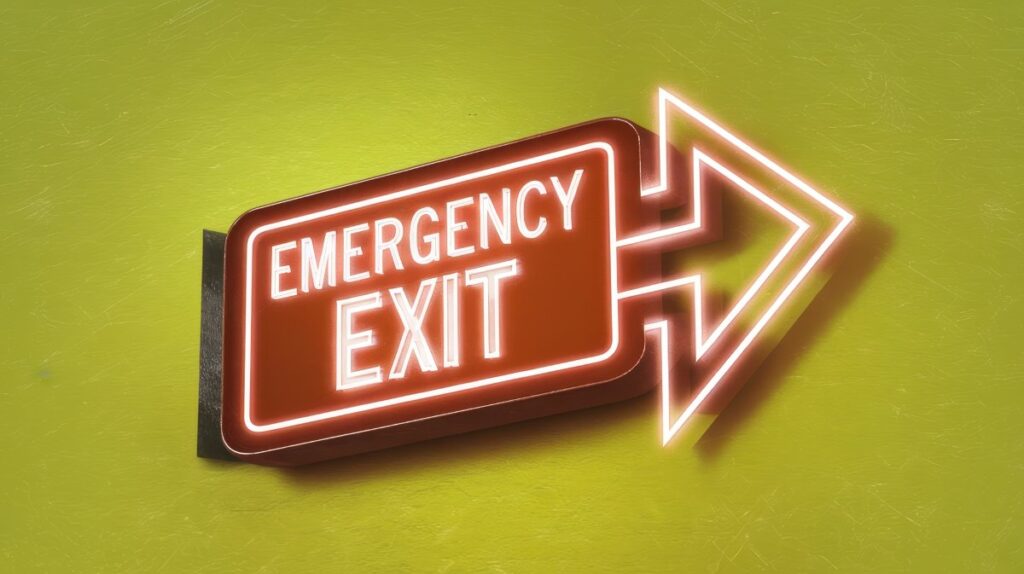
Signs marking fire extinguisher locations, emergency exits, assembly points, and fire alarm call points. Usually green with white pictograms for exits and assembly points, red for fire equipment.
Operators need to know where these are for two reasons. First, forklifts – especially LPG or diesel models – present fire risks. Knowing the nearest extinguisher location when you notice fuel leaks or smell burning isn’t the time to start looking.
Second, emergency exits must remain accessible. Operators who temporarily block exits with loads or equipment create serious hazards if evacuation becomes necessary. The signs help you avoid accidentally obstructing emergency routes.
Exit route signs also matter during normal operations. Understanding building layout helps with route planning and prevents operators finding themselves in dead ends that require awkward reversing manoeuvres in tight spaces.
Even critical signs don’t work if they’re implemented poorly.
Too many signs create clutter where nothing stands out. The important warnings get lost among less critical information. Better to have fewer signs that actually get noticed than comprehensive coverage that gets universally ignored.
Poor placement means signs aren’t visible when needed. A speed limit sign positioned after a turn doesn’t help operators reduce speed before entering the zone. Warning signs mounted too high get missed by operators focused on ground-level hazards and loads.
Lack of maintenance degrades effectiveness. Faded signs, damaged pictograms, or text obscured by dirt or damage might as well not exist. Regular sign audits and replacement maintain visibility.
Inconsistent design makes recognition harder. When every sign uses different colours, fonts, and symbols, operators can’t develop automatic recognition. Standardisation based on recognised systems – ISO 7010 or BS 5499 in the UK – helps.
Training needs to cover specific signs in your facility, not just generic recognition. Walk operators through the warehouse, point out actual signs they’ll encounter, explain what each requires from them.
Link signs to consequences. Don’t just say “this is a no pedestrian zone sign.” Explain that a pedestrian was injured here three years ago, which is why the restriction exists. Make it concrete.
Include signage in induction for all staff, not just operators. Warehouse workers who understand what forklift signs mean behave more safely around equipment. Drivers delivering to your facility benefit from understanding your signage system.
Test understanding periodically. Not formal exams, but conversations during toolbox talks or observations. “What does that sign mean?” “Why is the speed limit lower here than in the main aisle?” Surface misunderstandings before they cause incidents.
Invest in durable forklifts designed for long-term use and match that investment with durable, clearly visible signage that supports safe operation of that equipment.
Safety signs are only useful when operators know what they mean and actually modify behaviour accordingly. Recognition without compliance achieves nothing.
The critical signs aren’t decorative elements to satisfy safety audits. They communicate genuine hazards and establish necessary restrictions. Operators who treat them as important information rather than background noise work more safely and create safer environments for everyone around them.

We prioritize accuracy and integrity in our content. Here's how we maintain high standards:
Our content is carefully reviewed by experienced professionals to ensure accuracy and relevance.
Look for the expert-reviewed label to read content you can trust.
 01708 861 414
