Most fatal forklift accidents happen because operators try to escape a tipping vehicle, get partially thrown, and end up crushed between the forklift and the ground. The ones who stay restrained and brace themselves inside the protective cage generally walk away bruised but alive.
Yet seatbelt compliance in forklift operations remains depressingly low. Operators skip buckling up because it’s inconvenient, because they’re only moving the vehicle a short distance, because they’ve operated for years without incident and assume they always will.
This complacency costs lives that could easily be saved by a simple strap across the lap.
Forklifts have a high centre of gravity and narrow wheelbase, which makes them inherently unstable compared to other vehicles. Add a raised load that shifts weight even higher, throw in uneven surfaces or tight turns, and you’ve got physics working against stability.
When a forklift tips, it happens fast. There’s no time to carefully assess options. The vehicle is going over, and you’ve got maybe half a second to react.
Operators who aren’t restrained instinctively try to jump out. They might partially succeed, getting one leg clear while the rest of their body remains inside. As the forklift continues tipping, the overhead guard comes down on top of them. The guard that’s designed to protect them when they’re properly positioned inside instead becomes the thing that crushes them.
Seatbelts prevent serious tip-over injuries by keeping operators in the safest position – inside the protective cage, braced against the restraint system, protected by the overhead guard doing what it was designed to do.
The reasons for not wearing seatbelts are consistently terrible but persistently common.
“I’m only moving it a few metres” ignores that most accidents happen during short movements in familiar environments. The distance doesn’t determine risk – momentary inattention, unexpected obstacles, or mechanical failures can cause tip-overs regardless of how far you planned to travel.
“It’s uncomfortable” or “it restricts movement” are valid observations that don’t justify the risk. Yes, seatbelts are somewhat restrictive. That’s the entire point. They restrict your ability to be thrown from the vehicle during an incident.
“I need to be able to get out quickly in an emergency” misunderstands what emergencies actually look like. Fire risks exist but are rare compared to tip-over risks. And in most fire scenarios, the few seconds to unbuckle don’t meaningfully affect escape time.
Some operators have worked for decades without wearing seatbelts and haven’t been injured, which they interpret as evidence they don’t need them. This is survivorship bias. The operators who made the same choice but encountered a tip-over aren’t around to share their perspective.
UK health and safety law requires employers to ensure forklift operators use seatbelts where fitted. This isn’t a suggestion or a recommendation – it’s a legal obligation.
The Provision and Use of Work Equipment Regulations 1998 (PUWER) establishes that equipment must be used safely and in accordance with manufacturer instructions. Every forklift manufacturer specifies seatbelt use in their operating instructions.
The Health and Safety at Work Act 1974 places duties on both employers and employees. Employers must provide safe systems of work and enforce seatbelt use. Employees must follow safety procedures, which includes wearing provided safety equipment.
Enforcement varies, but HSE inspections that find systematic non-compliance with seatbelt requirements can result in improvement notices, prohibition notices, or prosecution. The financial penalties are significant, but the reputational damage and potential civil liability if an unrestrained operator is seriously injured or killed are worse.
Relying on operator choice doesn’t work. Compliance needs to be built into operational procedures rather than left to individual discretion.
Pre-use checks should include seatbelt condition as a standard item. Damaged, frayed, or malfunctioning belts need immediate replacement, not workarounds. If the seatbelt doesn’t work properly, the forklift shouldn’t be operated until it’s fixed.
Supervision matters enormously. When managers or supervisors observe operators without seatbelts and say nothing, they’ve communicated that the rule doesn’t actually matter. Consistent enforcement – every operator, every time, regardless of seniority or circumstances – establishes that seatbelt use is non-negotiable.
Some operations use interlock systems that prevent forklift operation unless the seatbelt is fastened. These remove the compliance question entirely, though they require investment and can create frustration when operators need to move a vehicle very short distances during maintenance or positioning.
Most forklift training covers seatbelt requirements, but often superficially. “You must wear your seatbelt” gets mentioned, operators nod, everyone moves on.
More effective training explains the physics of why seatbelts matter. Show videos of tip-over incidents. Explain how the protective cage works and why being inside it makes the difference between minor injury and death. Make the consequences concrete rather than abstract.
Address the specific objections operators raise. Acknowledge that seatbelts are slightly inconvenient. Explain why that inconvenience is vastly preferable to the alternative. Give operators permission to refuse to operate forklifts with faulty seatbelts rather than improvising workarounds.
Refresher training should revisit seatbelt importance regularly. It’s easy for habits to slip over time, especially when operators have never personally experienced or witnessed a serious incident.
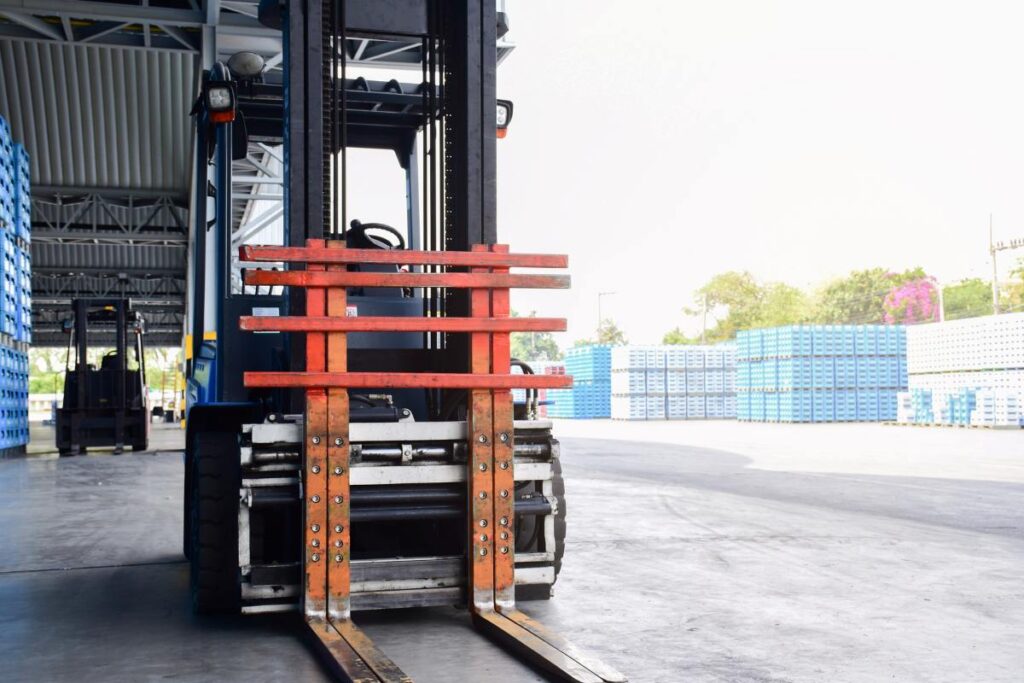
Modern forklift seatbelts are designed specifically for the vehicle and its risks. They’re not identical to car seatbelts because the risk profile is different.
Most use a lap belt rather than a shoulder harness. This is deliberate – the primary risk is tip-over, and the lap belt keeps the operator positioned correctly within the protective frame without restricting the torso movement needed for visibility and vehicle operation.
The belt should be adjusted to fit snugly without being uncomfortably tight. Too loose, and it won’t effectively restrain the operator during a tip-over. Too tight, and operators will be tempted not to use it because it’s genuinely uncomfortable during normal operation.
Anchorage points are engineered to handle significant force. The belt needs to withstand the operator’s body weight multiplied by the acceleration forces during a tip-over, which can be substantial. Damaged anchorage points compromise the entire restraint system.
Seatbelts address tip-over risks specifically. They don’t prevent all forklift injuries.
Collisions with pedestrians, other vehicles, or fixed objects aren’t prevented by operator restraints. Load handling incidents, where cargo falls or shifts, aren’t addressed by seatbelts. These risks require different control measures – pedestrian segregation, speed limits, load handling procedures, and so on.
This matters because some operators use the existence of other risks to rationalise not wearing seatbelts. “There are lots of ways to get hurt operating a forklift, so why worry about this specific one?” Because tip-overs are among the most lethal incidents, and seatbelts are among the most effective and simple controls available.
Organisations with strong seatbelt compliance didn’t achieve it through policy alone. They changed culture around forklift safety more broadly.
This starts with leadership taking safety seriously rather than treating it as bureaucratic obligation. When managers consistently wear seatbelts themselves if they operate forklifts, when they stop operations to address non-compliance, when they resource proper equipment maintenance rather than accepting deteriorated seatbelts, it signals that safety is genuine priority.
Peer pressure works both ways. In cultures where seatbelt use is normal, operators who don’t buckle up face social pressure to comply. In cultures where non-compliance is common, operators who do wear seatbelts might get mocked as overly cautious. Shifting the norm changes which behaviour faces social resistance.
Investing in high-performance models for material handling that include well-designed, comfortable restraint systems helps. Equipment design affects compliance – better designed seatbelts see higher usage rates than uncomfortable or awkwardly positioned ones.
Forklift seatbelts save lives when operators actually use them. The evidence is overwhelming. The physics is clear. The legal requirements are explicit.
The gap between what we know works and actual operator behaviour comes down to culture, enforcement, and individual choices. Closing that gap doesn’t require complex interventions or significant investment. It requires treating seatbelt use as the non-negotiable safety fundamental it is.
Every operator who starts their shift, every manager who observes operations, every organisation that runs material handling equipment has the opportunity to make the simple choice that prevents needless deaths. Buckle up. Every time. No exceptions.

We prioritize accuracy and integrity in our content. Here's how we maintain high standards:
Our content is carefully reviewed by experienced professionals to ensure accuracy and relevance.
Look for the expert-reviewed label to read content you can trust.
 01708 861 414
