Warehouse layout affects forklift efficiency more than most businesses realise. The difference between a well-planned layout and a poorly designed one shows up daily – in how long tasks take, how safely operators can work, how much inventory fits in your space, and ultimately in operational costs that compound over months and years. Put simply, understanding warehouse risk assessment planning helps identify potential hazards that layout decisions can mitigate or eliminate.
Many warehouses evolve rather than being deliberately designed. Racking gets added where space allows, aisles end up whatever width is left over, and forklift routes develop organically based on where people need to go. This approach works until it doesn’t – until you’re dealing with congestion, safety incidents, damaged stock, or productivity that’s significantly lower than it should be.
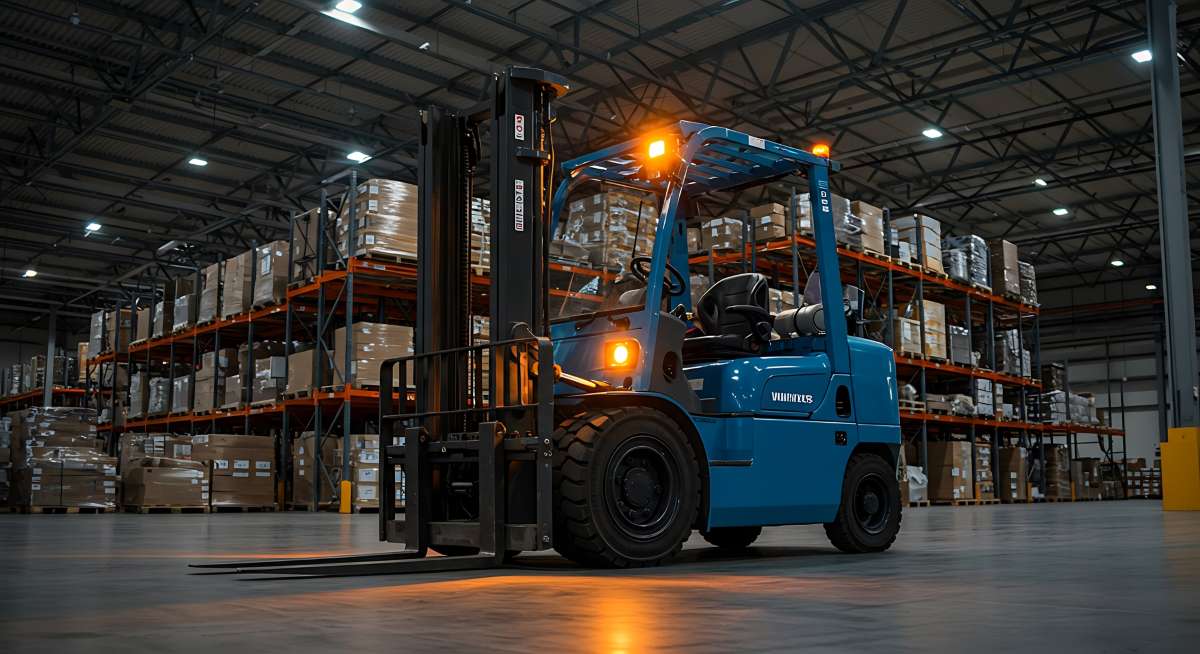
Proper layout planning considers forklift operations from the start, designing the space around how equipment and operators actually need to move rather than forcing them to work around whatever layout exists.
Aisle width directly affects both the types of forklifts you can use and how efficiently they can operate. Narrow aisles maximise storage density – more racking fits in the same space. But they require specific forklift types and reduce operational speed as operators navigate tighter clearances.
Standard counterbalance forklifts typically need aisles of 3.5-4 metres for comfortable operation. Narrow aisle forklifts can work in 2.5-3 metre aisles. Very narrow aisle (VNA) trucks operate in aisles as tight as 1.6-2 metres, but these are specialised equipment with higher costs and specific operational requirements.
The temptation is to make aisles as narrow as possible to maximise storage capacity. This works if you’ve got the right equipment and your operation suits narrow aisle working. If you’re using standard forklifts in tight aisles, you’ll see increased damage to racking and stock, slower pick times, and operator frustration.
Aisles should accommodate your forklift type with adequate clearance. If operators are constantly making multi-point turns or struggling to position accurately because clearances are too tight, your aisle width is costing you productivity and creating safety risks.
Two-way aisles allow forklifts to travel in both directions, providing flexibility but requiring wider clearances and creating potential for congestion when two forklifts meet. One-way systems use narrower aisles and reduce conflicts, but require careful planning to ensure efficient routing.
One-way systems work well when you can create logical flow patterns – receiving at one end, dispatch at the other, with pick routes following predictable paths. They’re less practical when operations require frequent criss-crossing or random access to different warehouse areas.
Analyse your picking patterns and storage needs. High-turnover items should sit closer to dispatch areas, reducing the distance forklifts travel for frequent picks. Slow-moving stock can occupy locations further from main traffic routes.
Creating zones based on product velocity – fast movers near dispatch, medium velocity in mid-warehouse, slow movers at the extremes – reduces average travel time per pick significantly. Over thousands of picks per month, those distance savings compound into substantial efficiency gains.
Every forklift has a minimum turning radius – the space needed to rotate 90 or 180 degrees. If your aisle intersections or loading areas don’t accommodate this turning circle, operators waste time making multiple-point turns or repositioning.
Check the turning radius specifications for your forklifts, then ensure aisle intersections, loading bays, and other manoeuvring areas provide adequate space. Adding even half a metre to intersection width can eliminate the need for three-point turns that waste time on every trip.
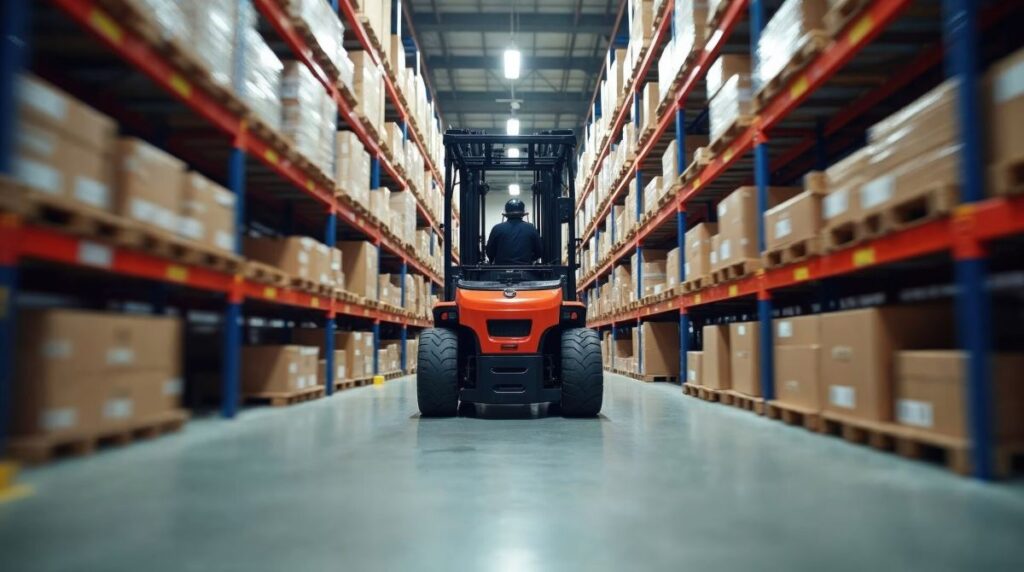
Dock areas need sufficient space for forklifts to approach, position, and manoeuvre whilst loading or unloading. Congestion at loading bays creates bottlenecks affecting your entire operation.
Provide enough space for multiple forklifts to work simultaneously without interfering with each other. If you’ve only got room for one forklift at the dock whilst others queue, you’re creating unnecessary delays.
Maximising vertical space through high-bay racking increases storage capacity without expanding your footprint. But it requires forklifts with adequate lift height and often demands slower, more careful operation as loads go higher.
Consider sight lines when planning racking height. If operators can’t clearly see over loads or through racking to detect other forklifts or personnel, you’re creating collision risks. Some layouts benefit from mesh racking backs or strategic gaps that improve visibility across aisles.
Every stored item should be accessible without moving other stock. Double-deep racking increases density but requires reaching the back position means removing the front pallet first. This works for certain inventory types – full pallet storage of the same SKU – but creates problems when you need selective access.
If your operation requires frequent access to varied SKUs, selective racking where every pallet position is directly accessible improves efficiency despite lower storage density.
Forklifts and pedestrians shouldn’t share the same space. Dedicated pedestrian walkways with physical barriers – not just floor markings – reduce accident risk significantly.
Plan pedestrian routes that minimise crossing forklift traffic. Where crossing is unavoidable, use clearly marked crossing points with visibility mirrors and signage alerting both pedestrians and operators.
Blind corners create collision risks. Convex mirrors positioned at intersections allow operators to see approaching traffic before entering aisles. Some warehouses use warning lights or sensors that alert operators to traffic in adjacent aisles.
Good lighting matters enormously. Dark warehouse areas force operators to work more slowly and carefully, reducing productivity whilst increasing risk. Ensure adequate lighting throughout the warehouse, particularly in high aisles where visibility decreases with height.
Uneven floors, cracks, or surface deterioration affect forklift operation directly. Operators slow down over rough surfaces, loads become unstable, and equipment experiences accelerated wear.
If your floor surface has degraded, resurfacing might seem expensive until you calculate how much it costs in reduced forklift speed, increased maintenance, and damaged stock from unstable loads.
Clear floor markings guide traffic flow, designate pedestrian areas, and identify hazards. Faded or missing markings create confusion – operators unsure which routes to take, pedestrians unclear where it’s safe to walk.
Regular remarking maintains clarity. It’s maintenance that directly supports safety and efficiency rather than just cosmetic upkeep.
Warehouse layouts should accommodate growth and changing needs. Fixed installations like mezzanines or permanent racking make reorganisation difficult and expensive.
Modular racking systems allow reconfiguration as inventory profiles change. Leaving some expansion space – areas that could accommodate additional racking if needed – provides flexibility for growth without requiring complete warehouse redesign.
Operations change over time. Product mix shifts, order profiles evolve, inventory levels fluctuate. Layouts that worked perfectly five years ago might not suit current needs.
Periodically reviewing your layout against current operations identifies opportunities for improvement. Sometimes small changes – moving high-velocity SKUs closer to dispatch, widening a congested aisle, adding a mirror at a blind corner – deliver significant efficiency or safety improvements.
Ultimately, effective warehouse layout planning considers forklift operations as a primary design factor, not an afterthought. Proper planning also considers equipment maintenance needs. Providing adequate space for mechanical upkeep for forklift trucks ensures routine servicing doesn’t interfere with operations or happen in unsafe locations because there’s nowhere suitable.
At Acclaim Handling, we understand how warehouse layout affects forklift efficiency and safety. Whether you’re designing a new facility, reorganising an existing warehouse, or evaluating equipment that suits your current layout, we help you make decisions that optimise both storage capacity and operational efficiency.

We prioritize accuracy and integrity in our content. Here's how we maintain high standards:
Our content is carefully reviewed by experienced professionals to ensure accuracy and relevance.
Look for the expert-reviewed label to read content you can trust.


 01708 861 414
