The question sounds straightforward, but the answer depends on a set of variables that most warehouse managers haven’t fully quantified. Buying or hiring too few forklifts creates bottlenecks, missed dispatch windows, and operators standing idle waiting for a machine. Too many forklifts means wasted capital, unnecessary congestion, and maintenance costs on equipment that spends half its time parked. The right number sits at the intersection of throughput requirements, shift patterns, warehouse layout, and the type of work being performed.
What Determines the Minimum Number of Forklifts a Warehouse Needs?
Start with throughput. How many pallet movements does the operation need to complete per hour, per shift, and per day? This is the foundational metric. Every forklift has a practical cycle time, the time it takes to pick up a load, transport it to its destination, place it, and return for the next one. That cycle time is a function of travel distance, lift height, load weight, and the speed at which the operator can safely work.
If the warehouse needs to move 40 pallets per hour and each forklift completes five cycles per hour, the arithmetic says eight trucks. But arithmetic doesn’t account for the real world. Operators take breaks. Machines need charging or refuelling. Aisles get congested. Trucks go down for unscheduled maintenance. A fleet sized at exactly the theoretical minimum will fail to hit its targets on any day that isn’t perfect, and perfect days are rare in warehousing.
A practical rule of thumb is to add 15 to 20 percent above the calculated minimum to absorb the inefficiencies that every operation experiences. That buffer prevents a single breakdown or absent operator from cascading into a missed dispatch.
How Do Shift Patterns Affect Fleet Size?
A single-shift operation with moderate throughput might need three or four forklifts. The same operation running two or three shifts doesn’t necessarily need six, eight, or twelve. If the equipment can be charged or refuelled between shifts, the same trucks can serve multiple shifts with appropriate handover procedures.
Electric forklifts powered by lithium-ion batteries can be opportunity-charged during breaks, which means a single truck can run across two or even three shifts without needing a replacement battery. Lead-acid batteries are slower to charge and require cooling periods, which may mean additional batteries or additional trucks to cover the gap. The battery technology in the fleet directly influences how many physical machines are required.
Operations running 24/7 also need to account for scheduled servicing windows. Every truck needs periodic maintenance, and pulling a machine out for servicing during a busy shift reduces available capacity. Planning warehouse layout to determine forklift requirements in conjunction with servicing schedules prevents the situation where two trucks are unavailable simultaneously because nobody coordinated the maintenance calendar.
Does the Type of Work Change the Number of Trucks Needed?
Significantly. A warehouse that primarily receives full pallets and puts them away into racking has a different forklift profile from one that does intensive order picking across thousands of SKUs. Put-away and bulk retrieval operations tend to use counterbalance trucks or reach trucks making relatively long, predictable runs. Order picking operations need more frequent, shorter movements, often with different equipment like order pickers or powered pallet trucks.
Mixed operations, those that receive, store, pick, and dispatch, typically need a varied fleet rather than a homogeneous one. Two counterbalance trucks for goods-in, three reach trucks for put-away and retrieval, and two powered pallet trucks for ground-level picking might be more effective than seven identical machines trying to do everything. Different equipment types have different strengths, and matching the tool to the task reduces the total number of machines required.
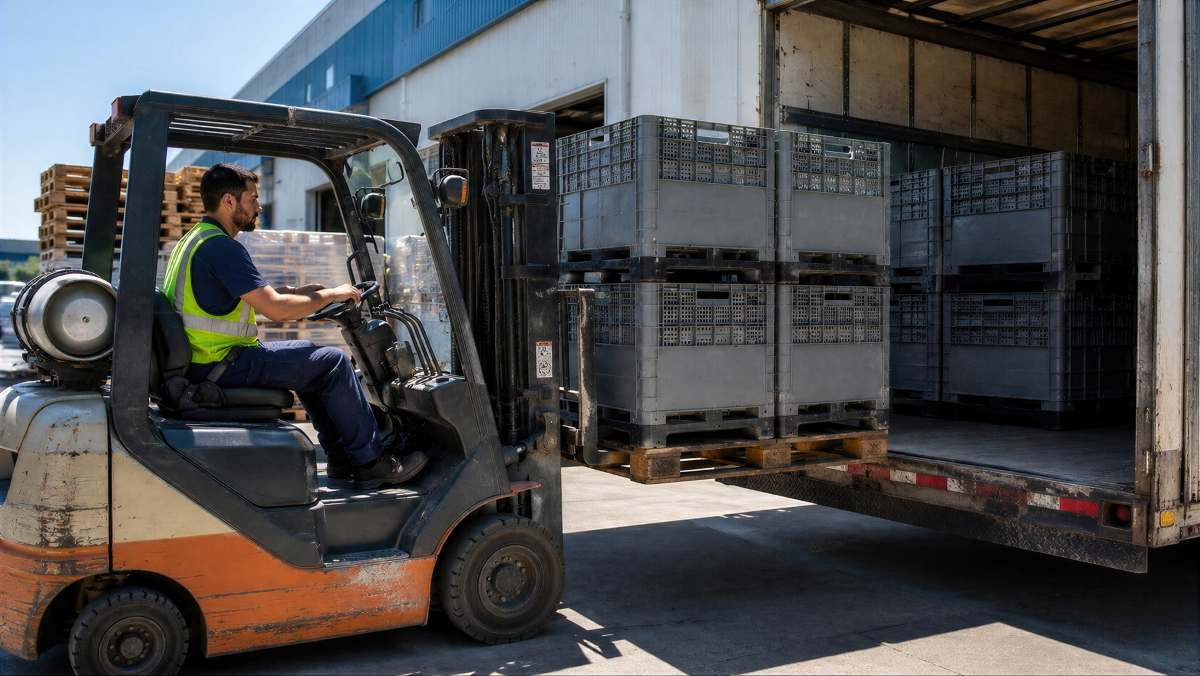
Loading and unloading dock operations have their own requirements. A truck dedicated to the loading bay during peak dispatch hours prevents the situation where a reach truck gets pulled off its racking duties to load a lorry, which then creates a backlog in the storage aisles. Dedicated dock trucks are underutilised during quiet periods, but the cost of that idle time is usually less than the cost of disrupting the entire warehouse workflow.
How Does Warehouse Layout Influence Fleet Requirements?
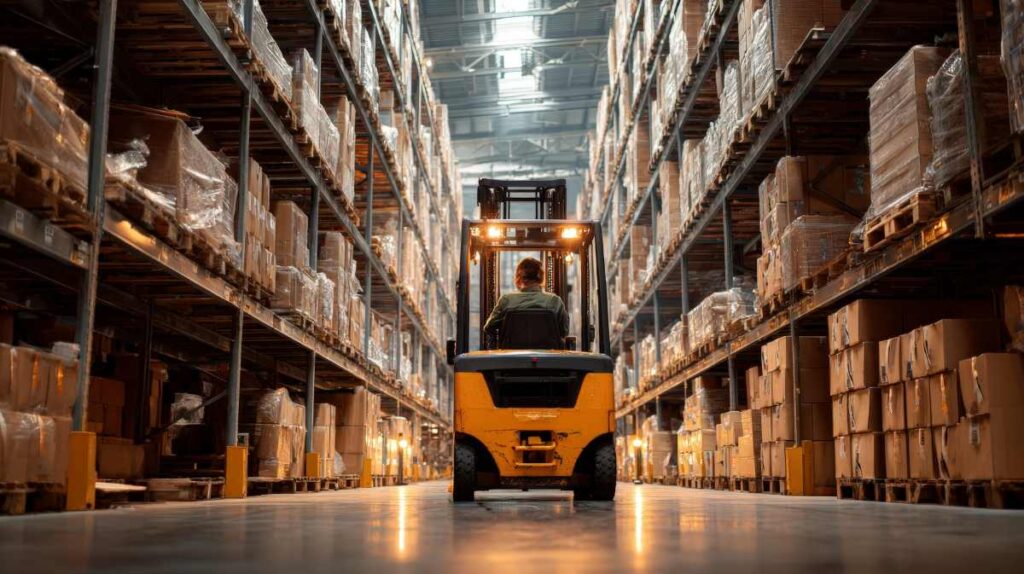
A well-designed warehouse reduces the number of forklifts needed because each machine operates more efficiently. Short travel distances between receiving, storage, and dispatch zones mean faster cycle times. Wide, unobstructed aisles allow trucks to move at safe operating speeds without constant slowing for congestion or blind corners. Logical product placement, with high-turnover items close to dispatch and slow movers further away, reduces average travel per pick.
A poorly designed layout does the opposite. Long travel distances, narrow or congested aisles, and inefficient product placement mean each forklift completes fewer cycles per hour, which means the operation needs more of them to hit the same throughput targets. Before adding trucks to solve a productivity problem, it’s worth asking whether the layout is forcing the existing fleet to work harder than it should.
One-way traffic systems, clear pedestrian separation, and designated crossing points all contribute to smoother flow. They also reduce the stop-start patterns that eat into cycle times and increase energy consumption. A forklift that can maintain a steady pace through a well-planned route structure is measurably more productive than one navigating a chaotic floor.
Should I Own All My Forklifts or Hire Some of Them?
For baseline capacity, the trucks that run every day regardless of volume, ownership or long-term contract hire often makes economic sense. For variable capacity, the extra machines needed during seasonal peaks, project surges, or to cover breakdowns, short-term material handling hire is more cost-effective than buying equipment that sits idle for large portions of the year.
This blended approach, a core owned or contract-hired fleet supplemented by short-term hires for peaks, is how most well-managed warehouses operate. It keeps fixed costs under control while preserving the ability to scale up when demand requires it.
When Should I Reassess Fleet Size?
Whenever the operation changes. A new product line, a shift to e-commerce fulfilment, an additional shift, a change of warehouse, or a new customer with different throughput requirements can all alter the fleet calculation. The number of forklifts that worked last year may not be the number that works this year.
Reviewing fleet utilisation data, hours run per machine, idle time, and bottleneck frequency, provides the evidence base for informed decisions. Operators are also a valuable source of intelligence; they know where the queues form, which machines are underused, and where an additional truck would make the biggest difference. The goal isn’t a fixed number. It’s a fleet that reflects the operation as it is now, with enough flexibility to adapt when conditions shift.

Related Posts
Predictive vs Preventive Maintenance: What’s the Difference?

The True Cost of Delaying a Forklift Repair
How Forklift Rentals Help Warehouses Stay Flexible
Top Industries that Benefit from Forklift Hire
How Warehousing Demands Are Changing Forklift Requirements