Racking systems
Pallet racking
The most flexible way to store pallets: every pallet within reach of the truck, any mix of products, and beam levels you can move as your stock changes.
- Every
- pallet directly accessible
- Wide or narrow
- aisle layouts
- Any mix
- of products and pallet sizes
How it works
How pallet racking works
- Upright frames are bolted to the floor in runs, back to back or against a wall.
- Beams hook into the frames at the heights your loads need, and can be moved later.
- Trucks work the aisles: counterbalance and reach trucks in wide aisles, VNA trucks and order pickers in narrow ones.
- Every pallet has its own location, so stock counts and picking stay simple.
- Access
- Every pallet, any time
- Stock rotation
- Any order you like
- Space use
- Good; best in narrow aisle
- Picking
- Direct from the lower levels
Is it right for you?
A good fit, and when to look elsewhere
A good fit for
- Lots of different products, each needing its own location
- Stock that must be reachable at any time
- A warehouse that needs to change as the business does
- Picking straight from the racking
Consider something else if
- You hold many pallets of the same product Drive-in and drive-through racking →
- You want pallets to rotate first in, first out on their own Pallet flow and push back racking →
- Floor space is the limit, not access Mobile racking →
Components and options
What goes into it
Upright frames
Two uprights braced together, bolted up on site and anchored to the floor. Sized for the weight they carry.
Beams
Hook into the frames at any level. The beam section is chosen for the load on each level.
Row spacers
Join back-to-back runs at the right gap. Where sprinklers are fitted, they also carry the pipework.
Decking and pallet supports
Mesh or timber decks and support bars for pallets that do not span the beams, and for hand-loaded stock.
Upright guards and barriers
Take truck impacts before the racking does, at the uprights and at the ends of the aisles.
Load notices and labels
Safe working loads and location addresses shown clearly at every bay.
Buying guide
Specifying pallet racking
A pallet racking quote starts from five numbers: the pallet size, the heaviest pallet, how many pallet locations you need, the clear height of the building to the underside of the lowest obstruction (sprinklers, lights, roof steel), and the trucks that will work the aisles.
- Bays. The most common bay in the UK takes three pallets per level on 2.7 m beams, with 1,100 mm deep frames for 1,200 mm deep pallets, so the pallet overhangs the beams slightly front and back.
- Height. Set by the building and the truck, not the racking: the top beam has to be within the truck's lift height, with the load still inside its rated capacity at that height.
- Aisles. Roughly 3.5 m or more for counterbalance trucks, around 2.7 to 3 m for reach trucks, and about 1.6 to 1.9 m for very narrow aisle trucks. The exact figure comes from the truck's data sheet and your pallet size.
- Load per level. Every beam level has a safe working load, shown on a load notice at the end of the run. Beams and frames are sized to it.
Buying guide
What affects the price
- The number of pallet locations, and how high they go.
- The load per level, which sets the beam and frame sections.
- Wide aisle or narrow aisle: narrow aisle racking needs flatter floors and more precise installation, but fits far more pallets into the building.
- Accessories: mesh decking, pallet supports, anti-collapse mesh, upright guards and end barriers.
- The building: floor slab condition and thickness for the anchors, sprinkler layout, and whether the work has to happen around a live operation.
- New or used racking. Used racking can save money, but it has to be inspected, compatible and correctly rated, and mixing makes is not recommended.
Because every building is different, we price racking from a free site survey rather than a list, and we price the trucks at the same time, so you never pay for height your trucks cannot reach.
Buying guide
Rules, inspection and installation
Racking is work equipment under PUWER 1998. The UK industry guidance comes from SEMA, the Storage Equipment Manufacturers' Association, and EN 15635, the standard for racking in use, which calls for a documented inspection by a technically competent person at least every 12 months. Between inspections, a named person on site checks the racking regularly and after any impact, using a red, amber and green damage scale: red means offload and isolate now, amber means repair within four weeks.
We carry out racking inspections to EN 15635, with a written report and a schedule of any damage, and we install racking to SEMA guidance: see racking installation.
We install pallet racking with our own trained installers, working to SEMA guidance: anchored to the floor, set level and plumb, and handed over with a load notice on every run before it is used. See racking installation.
Racking and trucks, sized together
The trucks that work it
Racking and trucks decide each other: aisle width, top beam height and capacity at height all have to match. We supply both, so we check them together.
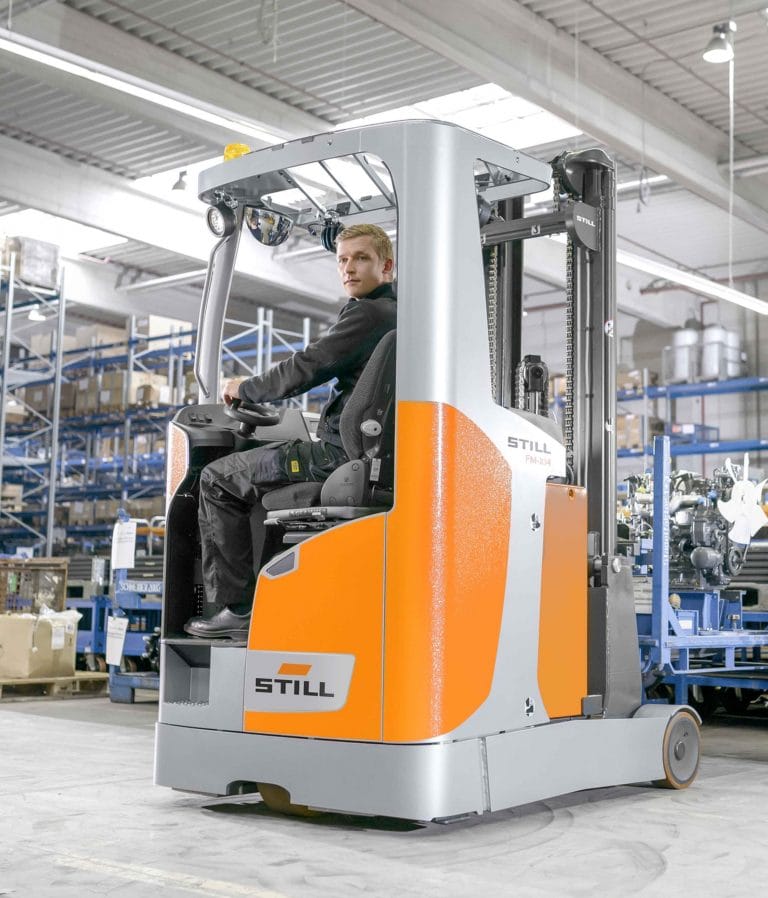 Reach trucks
High lift in narrow aisles. The workhorse of pallet racking.
View range →
Reach trucks
High lift in narrow aisles. The workhorse of pallet racking.
View range →
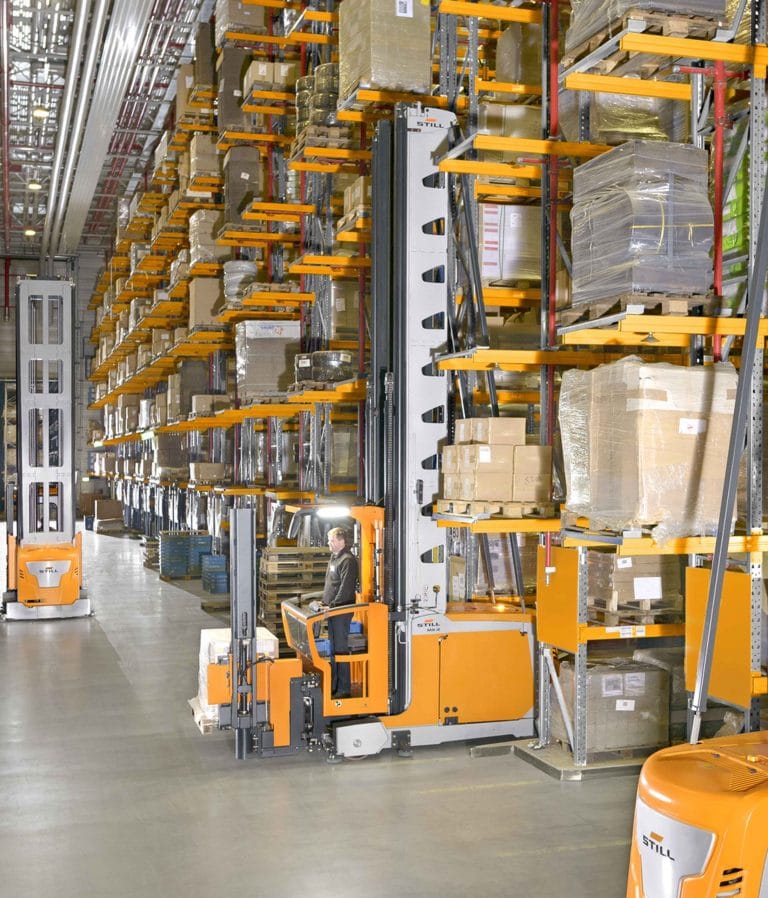 Order pickers and VNA
Very narrow aisles and picking at height.
View range →
Order pickers and VNA
Very narrow aisles and picking at height.
View range →
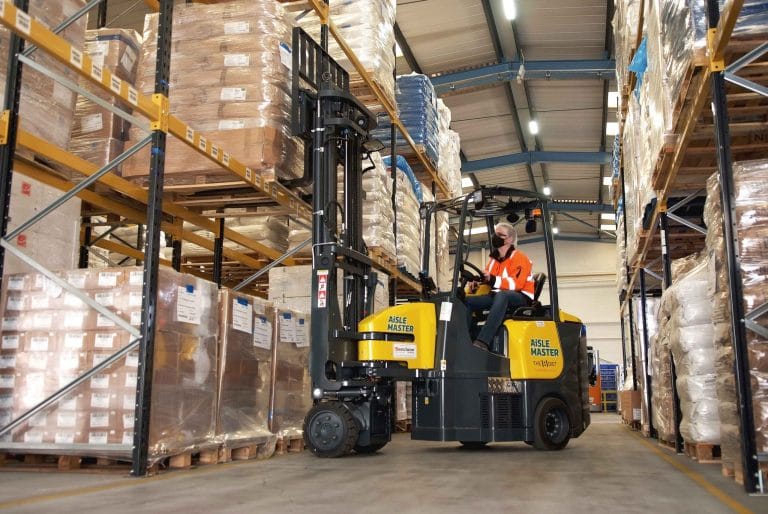 Articulated forklifts
Narrow aisle work, indoors and out.
View range →
Articulated forklifts
Narrow aisle work, indoors and out.
View range →
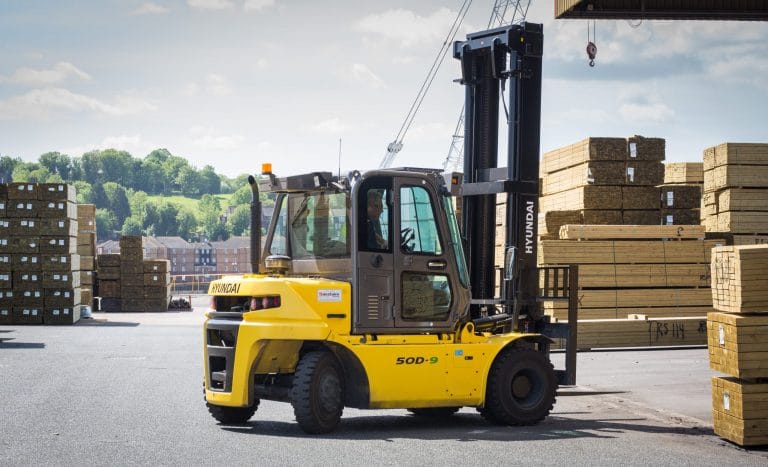 Counterbalance forklifts
Loading, yard work and wide aisle racking.
View range →
Counterbalance forklifts
Loading, yard work and wide aisle racking.
View range →
Tell us what you store, and we will tell you what fits
Every building is different, so we start with a free site survey: pallet or product sizes and weights, how many locations, how fast stock moves, the clear height and the trucks you run. We come back with a design and a price, install it, and inspect it once it is in use.
Pallet racking: common questions
Eight depots across the UK
Our own engineers, out of our own depots - wherever you are, service comes from us.

Additional Services
Checkout our range of other machine services below