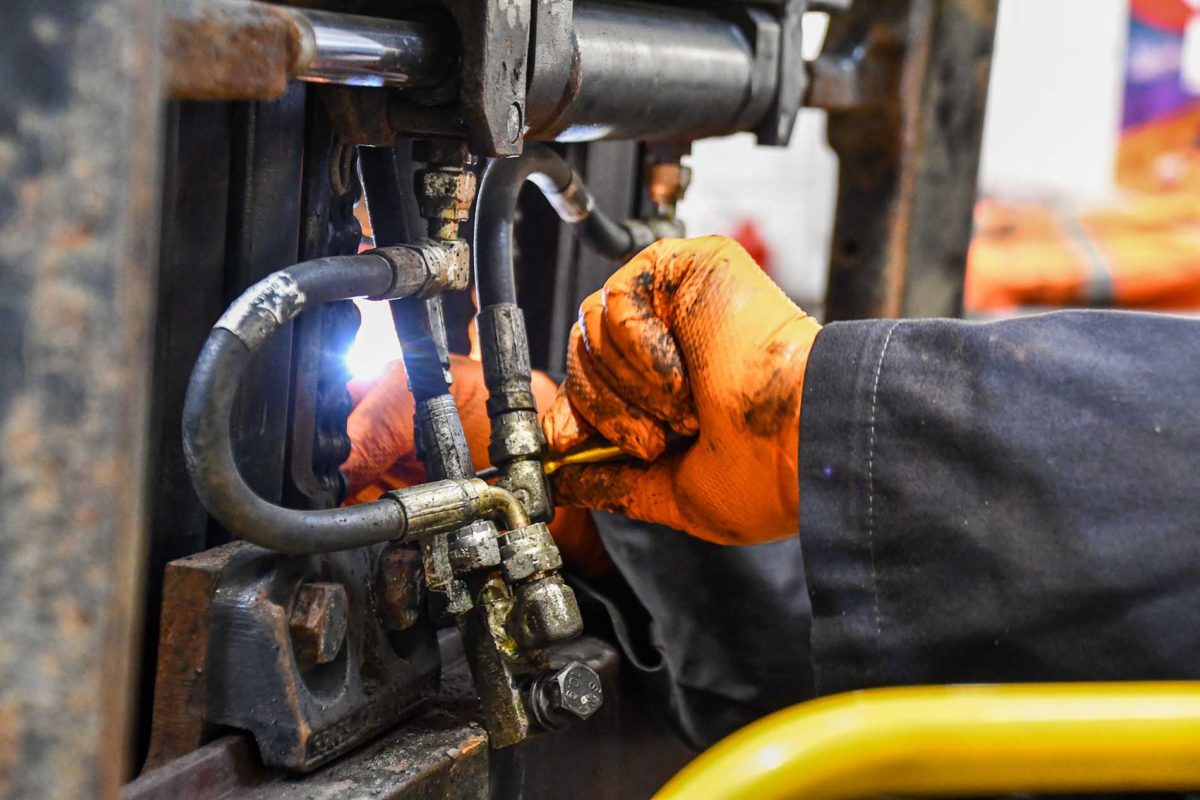
A practical self-check. Work through the eight questions below on one machine picked at random. If any of them takes more than a few minutes to answer, that is where your gap is.
The two minute version
Pick one truck. Try to produce four things:
- Its current report of thorough examination.
- Its service record.
- The pre-use check sheets for the last week.
- The training certificate of whoever drove it yesterday.
If you cannot find all four in ten minutes, an inspector will not be able to either, and that is the point.
Most operations we visit can produce two of the four. The two that go missing are almost always the pre-use checks and the right training certificate for the right machine.
The eight checks
1. Does every lifting machine have a current thorough examination?
At least every 12 months for a standard counterbalance, 6 months if it lifts people or is a lifting accessory. Not a service: a report of thorough examination. See thorough examinations.
If you are being told a service covers it, read thorough examination vs service first.
2. Can you produce the report?
Keep it until the next report or two years, whichever is later. A report you cannot find is, in practice, a report you do not have.
3. Is every operator certificated for the machine they actually drive?
A certificate covers a category, not every truck. Someone trained on a counterbalance is not certificated on a reach truck or a VNA machine. Certificates also expire.
4. Have you authorised them in writing?
Training is not the whole duty. The employer authorises the operator for that machine and that site, in writing. This is the one almost nobody has.
5. Are pre-use checks being done and recorded?
Each shift: tyres, forks, chains, mast, hydraulics for leaks, brakes, steering, horn, lights, seat belt. Recorded, not just performed. See pre-shift inspection training.
6. Is there a defect reporting route the operator will actually use?
There also needs to be a clear rule about what stops the truck. A reporting process nobody uses is worse than none, because it looks like evidence that nothing was wrong.
7. Do you have a current written risk assessment?
Covering pedestrian segregation, traffic routes, loading areas, racking, floor condition, visibility, lighting and any battery charging area. Our warehouse risk assessment guide walks through it.
8. For hired-in machines, do you hold their reports?
You must not use hired-in lifting equipment without physical evidence that its last thorough examination has been carried out.
Where the duty actually sits
This is worth stating plainly, because it is the thing most often assumed away.
The duty sits with the employer or the person in control of the equipment. Buying a service contract does not transfer it.
Ownership is not the test either. If you have hired a machine in and it is working on your site under your direction, the duty is yours while it is there. Where a contractor operates on your site, control can be shared, and a shared duty is still your duty: agree in writing who holds what.
What a supplier can do is make the duty easy to discharge: carry out the examinations, hold the schedule, provide the reports, train the operators, and say plainly when something has to stop.
Not sure which machines are due what? A free site visit will tell you where you actually stand.
The gaps we find most often
| Gap | Why it happens | Fix |
|---|---|---|
| Service records instead of examination reports | Genuine confusion: same engineer, same day, same machine | Ask what document you were given. See thorough examination vs service |
| Pre-use checks signed but not done | No time allowed for it in the shift | Build it into the shift start and spot-check |
| Operator trained on the wrong category | A new machine type arrived and nobody re-trained | Match training to the fleet, not the other way round |
| No written authorisation | Almost nobody knows it is required | One sheet per operator, per machine type |
| Examination dates chased per machine | Mixed fleet, several sites, different in-service dates | Fleet management: dates tracked centrally |
| Hired machine put to work with no report | Urgency: the truck arrived and the job was waiting | Ask for the report at the point of order |
What happens if you are not compliant
Day to day, the risk is an improvement or prohibition notice, which can stop a machine, an area or an operation immediately. Insurance is the second: a machine in use without a current examination leaves you in a difficult position on a claim.
The larger risk is after an incident. The absence of examination records, training certificates or a risk assessment is what turns an accident into a prosecution, and since 2016 sentencing guidelines have linked health and safety fines to turnover.
If liability specifically is what is on your mind, our am I legally liable page covers the employer duty around operator training in detail.
Closing the gaps
- CFTS thorough examinations, LOLER and PUWER in one visit, on any machine, whoever supplied it: thorough examinations.
- RTITB accredited operator training, matched to the machines you actually run: training courses.
- Planned servicing and repairs, so defects found get fixed: servicing and repairs.
- Compliance tracked across the fleet, scheduled before dates fall due: fleet management.
- The wider picture, including our accreditations and the certificates: health, safety and compliance.
The quickest way to find out where you stand is to have someone walk the site. A free site visit establishes which machines are due what and when, whether the pre-use checks are real, and whether your operators are certificated for the trucks they are actually driving. It costs nothing and it takes an hour.
Not sure which machines are due what? A free site visit will tell you where you actually stand.
Compliance: common questions
Eight depots across the UK
Our own engineers, out of our own depots - wherever you are, service comes from us.
Talk to us about Am I Compliant? A Forklift Compliance Self-Check
Monday to Friday, 8:00am to 5:00pm.
Additional Services
Checkout our range of other machine services below