


Capital allowances on forklifts
Forklift tax relief: write off up to 100% of the cost in year one
Most UK businesses buying a forklift can deduct the cost from their taxable profits, and in many cases they can deduct the whole cost in the year they buy it. The relief covers used machines as well as new ones, and hire purchase as well as outright purchase. Here is how it works, in plain English.
- Annual Investment Allowance
- 100%Up to £1,000,000 a year. Covers new and used equipment.
- Full expensing
- 100%No cap. Limited companies, brand new equipment only.
- First-year allowance
- 40%New main rate plant and machinery bought on or after 1 January 2026.
- Hire purchase
- QualifiesClaim on the capital cost once the machine is in use. Not the interest.
A forklift is not just a cost. It is a deduction.
A forklift is plant and machinery, so it normally qualifies for capital allowances. That means you do not simply absorb the price: you set it against the profits you pay tax on. Where the Annual Investment Allowance or full expensing applies, you can claim the full cost in the first year rather than writing it down slowly over many years.
For a business replacing a truck, that changes the arithmetic. A machine that looks like a capital outlay in month one becomes, by the end of your accounting period, a deduction that reduces the tax you owe. The relief is the same whether the forklift is diesel, electric or gas, and whether it is a counterbalance truck, a reach truck or a warehouse machine.
What the relief does depend on is how your business is structured, whether the machine is new or used, and how you pay for it. Those three things decide which of the allowances below applies to you, and they are worth understanding before you choose a machine rather than afterwards.
You buy the machine
Outright, or on hire purchase where you will end up owning it. The machine has to be brought into use in your business.
You claim the allowance
Your accountant claims the right allowance on your tax return for the period in which you bought it.
Your tax bill falls
The cost comes off your taxable profit, so you pay tax on a smaller number. The saving is real cash in the year of purchase.
£7,000Illustration only
A company buys a £28,000 forklift and claims the Annual Investment Allowance on the full amount. That £28,000 comes off its taxable profit. If the company pays corporation tax at the 25% main rate, the deduction is worth about £7,000 off its tax bill.
Illustration only, to show how the arithmetic works. Corporation tax rates vary with profit, sole traders and partnerships pay income tax instead, and your own position depends on your circumstances. Confirm the figures with your accountant.
Which relief covers your purchase?
There are three routes that matter when you are buying handling equipment. Which one applies depends on how your business is structured and on whether the machine is new or used. Your accountant will choose the right one, but it is worth understanding the difference before you choose a machine, because a used truck and a new one are not treated the same way.
| Relief | What you can deduct | Who can claim | Used equipment? |
|---|---|---|---|
| Annual Investment Allowance (AIA) | 100% of the cost, up to £1,000,000 a year across all qualifying plant and machinery. | Limited companies, sole traders and partnerships where all the members are individuals. | Yes. The AIA is not restricted to new machines. |
| Full expensing | 100% of the cost of main rate plant and machinery, with no upper limit. 50% for special rate assets. | Limited companies within the charge to corporation tax only. Not sole traders or partnerships. | No. The machine must be unused and not second-hand. |
| 40% first-year allowance | 40% of the cost in year one for main rate plant and machinery, with the balance written down after that. | Businesses paying corporation tax or income tax, including unincorporated businesses, for spending on or after 1 January 2026. | No. The machine must be unused and not second-hand. |
Annual Investment Allowance
100% up to £1,000,000For most of our customers this is the one that does the work. You deduct the full value of qualifying plant and machinery from your profits before tax, up to £1,000,000 in a year.
It is open to limited companies, sole traders and partnerships alike, and, crucially, it is not restricted to brand new equipment.
Full expensing
100%, no upper limitIf you are a limited company buying a brand new forklift, full expensing deducts 100% of the cost with no cap at all.
The equipment has to be unused and not second-hand, and it is not available to sole traders or partnerships. It is now a permanent part of the system rather than a temporary measure.
The 40% first-year allowance
40% from 1 January 2026This allowance is open to more businesses than full expensing. Unincorporated businesses can claim it, and it reaches some spending on assets bought for leasing.
It gives 40% in the first year rather than 100%, with the rest written down over time. If the AIA or full expensing covers your purchase, one of those is usually the better claim.
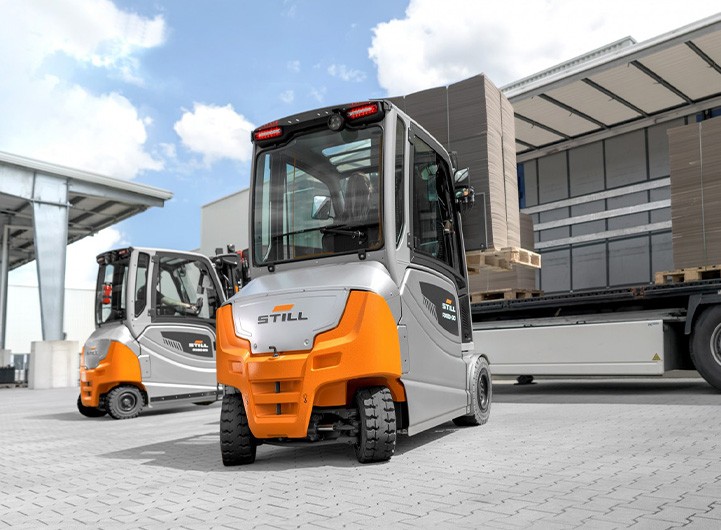 Used stock qualifies
Buying used? The AIA still gives you 100%.
This is the part people get wrong. Full expensing and the 40% first-year allowance both require the machine to be unused and not second-hand, so a used forklift does not qualify for either. The Annual Investment Allowance carries no such condition. A second-hand machine can attract 100% relief under the AIA in the same way a new one can, up to the £1,000,000 annual limit.
For many operations that is the whole argument for buying used: a lower price and the same first-year deduction. We hold hundreds of used forklifts for sale, refurbished in our own workshops, alongside new machines in stock.
Buying on hire purchase? You can still claim.
You do not have to pay for the machine outright to get the relief. If you buy under a hire purchase contract, so that you will own the forklift at the end of it, you can claim capital allowances on the capital cost once you start using the machine, even though you are still paying for it.
That combination is what makes hire purchase attractive: the cash leaves your account monthly, while the deduction falls in the first year. If you are still weighing up the options, we have written in more detail on hiring, leasing or buying a forklift and on choosing between buying, leasing and hiring plant equipment.
Four things worth knowing before you order
The accounting period matters
The claim falls in the accounting period in which you incur the expenditure, so ordering a machine just before or just after your year-end can move the relief into a different tax year.
The limit is annual
The £1,000,000 AIA is a yearly allowance covering all your qualifying plant and machinery, not one per machine.
It has to be in use
The machine needs to be brought into use in the business. Ask us about lead times if timing is tight.
Keep the paperwork
Your accountant will want the invoice, the finance agreement if there is one, and the date the machine went into service.
What does not qualify
Being straight about the limits is more useful than overselling the relief, so here is where capital allowances stop applying.
- Standard operational leasing and contract hire. If you rent or lease a machine and never own it, the machine is not your asset, so you cannot claim capital allowances on it. The payments are normally treated as an ordinary business expense instead, which is still a deduction, just a different one.
- Claiming twice for the same cost. You can use more than one allowance across a year, but not both on the same pound of expenditure. GOV.UK is explicit that you must not claim two allowances for the same cost.
- Used machines under full expensing or the 40% allowance. Both require equipment that is unused and not second-hand. Used stock goes through the AIA instead.
- The interest on a hire purchase agreement. The capital cost qualifies. The interest does not, although it is normally deductible as a business expense.
- Cars, and items you already owned before using them in the business, or that were given to you.
Common questions
Can I really write off the whole cost of a forklift in one year?
Often, yes. Under the Annual Investment Allowance you can deduct 100% of qualifying plant and machinery up to £1,000,000 a year, and a forklift is normally plant and machinery. A limited company buying new can use full expensing instead, which has no cap. Whether your particular purchase qualifies depends on your circumstances, so confirm it with your accountant before you rely on it.
Does a second-hand forklift qualify?
For the Annual Investment Allowance, yes. The AIA is not restricted to new equipment. Full expensing and the 40% first-year allowance are more restrictive: both require plant and machinery that is unused and not second-hand.
I am a sole trader, not a limited company. Can I claim?
You can claim the Annual Investment Allowance. Sole traders and partnerships whose members are all individuals are eligible. Full expensing is only for companies within the charge to corporation tax. The 40% first-year allowance introduced from 1 January 2026 is open to businesses paying income tax as well as corporation tax.
What if I buy on hire purchase?
If you will own the machine under the agreement, you can claim capital allowances on the capital cost from the point you start using it. You cannot claim on the interest element of the payments.
What about a forklift I hire or lease?
If you never take ownership of the machine, you cannot claim capital allowances on it. The rental is normally an allowable business expense instead. Hiring can still be the better commercial decision, particularly for short-term cover or seasonal peaks.
Does Acclaim give tax advice?
No. We sell and maintain handling equipment. This page is general information to help you have a better conversation with your accountant, who is the person who should confirm what you can claim.
Talk to us about the machine, and to your accountant about the claim.
Tell us what you need to lift, how high and how often, and we will put a specification and a price in front of you. New or used, outright or on hire purchase. We can also take your old machine in part exchange, keep it running with servicing, or run the whole fleet under fleet management.
- Since 1982Independent then, and independent now.
- 8 depotsEngineers across the UK, working on your machines whoever supplied them.
- New & usedBuilt to factory order, or hundreds of refurbished machines in stock.
Important: this is general information, not tax advice
This page is general information about UK capital allowances. It is not tax, accounting or financial advice, and Acclaim Handling is not a tax adviser. Allowances, rates and thresholds change, and what you are able to claim depends on your own circumstances, including your business structure, how the equipment is funded, when you buy it and how it is used. Nothing on this page is a guarantee that any particular purchase will qualify for relief, or that any particular amount of tax will be saved. Always confirm your position with your accountant or with HMRC before making a purchase decision.
Further reading. The GOV.UK guidance on capital allowances: