Warehouse automation does not have to mean a new building full of robots. For most sites it starts with one flow: a pallet run that goes back and forth all shift, a production line that needs feeding, a picking aisle where people spend more time walking than picking, or a floor that needs scrubbing every night. Automate that, keep people for the work that needs judgement, and build from there.
We supply and hire automated forklifts, pallet trucks and tow tractors from STILL’s iGo range, autonomous mobile robots and robotic cleaning machines, and plan them around the manual fleet that stays. Larger projects, up to fully automated storage, we deliver together with STILL’s automation specialists. The automated trucks are series-built machines, the same trucks we sell, hire and service as manual versions, maintained by our own engineers from eight depots.
What is warehouse automation?
Warehouse automation is the use of machines and software to move, store, pick and handle goods with less manual driving, carrying and walking. It runs from a single driverless pallet truck on one route to a fully automated store where pallets go in and out without anyone in the aisles, and most sites sit somewhere in between.
Every automated system has two halves. The equipment does the physical work: automated forklifts and pallet trucks, autonomous mobile robots, automated storage and robotic cleaning machines. The control system decides what each machine does next: it hands out jobs, manages traffic at junctions and doors, sends machines to charge, and can take its orders from your warehouse management system.
Automation, mechanisation and robotics
The words overlap, so it helps to separate them. Mechanisation gives a person a machine to do the work, such as a forklift with a driver.
Automation lets the machine do the task itself, without a driver on board. Robotics is the usual name for the compact mobile robots and picking systems at the lighter end of automation.
A warehouse can use all three at once, and most do.
The main types
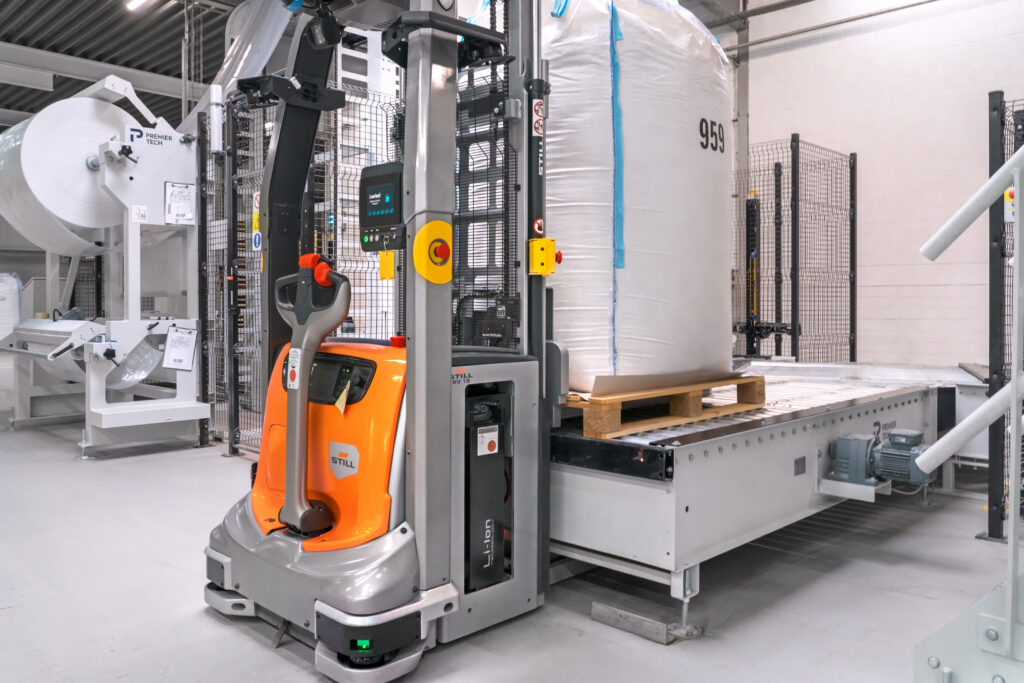
- Automated guided vehicles (AGVs). Forklifts, pallet trucks, reach trucks and tow tractors that drive and lift without an operator, on routes set up for the site. See automated forklifts and AGVs.
- Autonomous mobile robots (AMRs). Compact robots that plan their own route from a map and drive round obstacles, carrying trolleys and smaller loads. See autonomous mobile robots.
- Automated storage and retrieval. Shuttle racking and automated high bay stores that put away and retrieve pallets inside the racking itself.
- Assisted picking. Order pickers that follow the picker down the aisle and stop at the next pick, so people pick rather than drive.
- Robotic cleaning. Scrubber dryers and vacuums that learn a route and clean it on their own.
Why warehouses automate
- Labour. Repetitive moves across several shifts are the hardest jobs to staff and the first to automate.
- Consistency. An automated truck does the same move the same way every time, at the same speed, on every shift.
- Safety. Fewer manned truck movements in busy areas, and every automated truck carries 360 degree personal protection that slows and stops it for a person or object in its path.
- Space. Automated storage works in narrower aisles and at greater heights, so more pallets fit in the same building.
- Information. Every move is recorded, which shows where routes, transfer points and stock locations need changing.
It is not the answer to everything. Automation earns its place on predictable, repeated work, and people stay better at the varied tasks that need judgement. That is why most of the projects we plan automate one flow first and keep the manual fleet for the rest.
Tell us the flow you want to automate, how many moves a shift and how far. We will tell you whether automation is worth it.
What can be automated
Pallet transport
Driverless pallet trucks and stackers that move pallets between goods in, storage, production and dispatch on fixed or flexible routes. See automated forklifts and AGVs.
Storage and retrieval into racking
Automated reach trucks put away and retrieve at height in wide aisle racking, and automated very narrow aisle trucks work high bay stores guided by wire or rail. They can also feed pallet shuttle racking.
Lorry loading and unloading
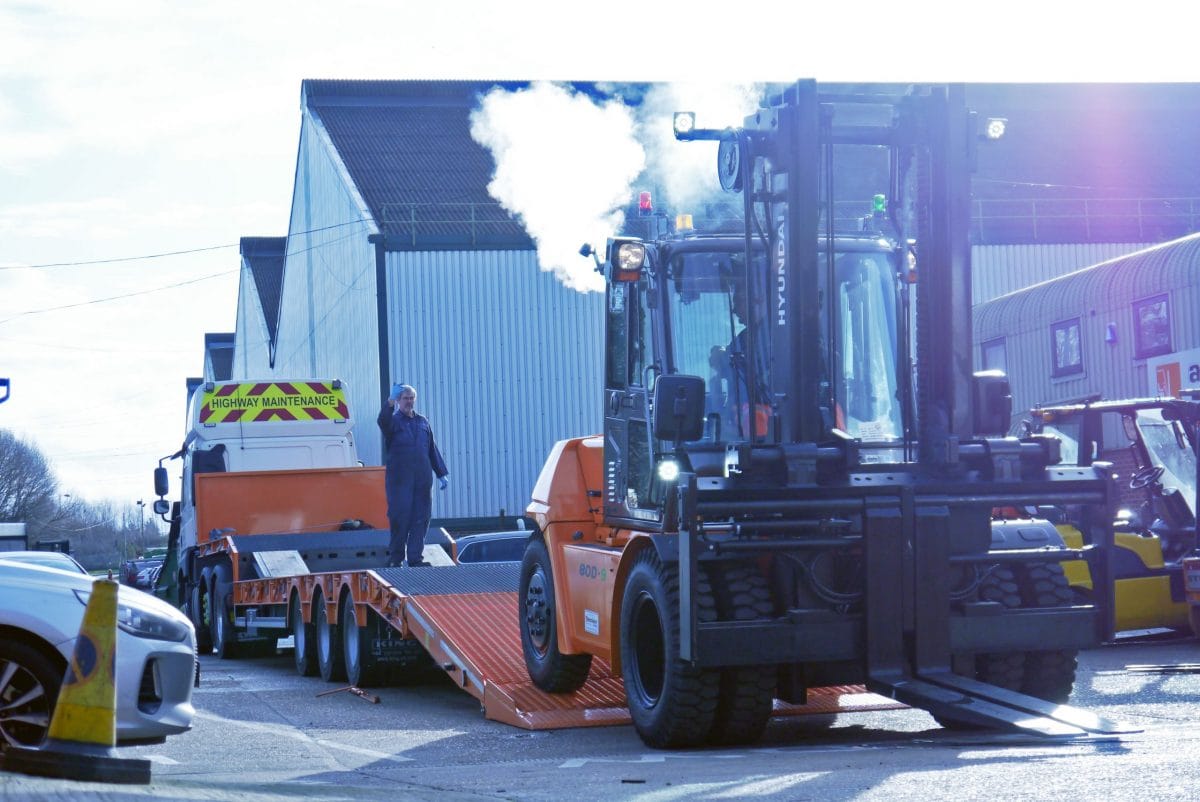
An autonomous low-lift truck that loads and unloads trailers on its own, without fixed equipment at the dock.
Production supply
Automated tow tractors pulling tugger trains on a timed loop to the line, and autonomous mobile robots carrying trolleys and small loads between cells.
Order picking
Order pickers that follow the picker down the aisle and stop at the next pick position, so the operator stops climbing on and off the truck all shift.
Floor cleaning
Robotic scrubber dryers and vacuums that learn a route and clean it on their own, often overnight. See robotic floor cleaning.
Four levels of automation
The right level depends on the volume, how predictable the work is and how much the building can change. Most sites use more than one.
| Level | What it is | What the building needs | Suits |
|---|---|---|---|
| Assisted | Operator-assist trucks, such as order pickers that follow the picker, and automatic speed and zone control | Very little | Picking, mixed traffic, a first step |
| Automated trucks (AGVs) | Series-built forklifts and pallet trucks that drive and lift without a driver | Defined routes and transfer points, good pallets, Wi-Fi | Repetitive pallet flows, storage at height, multi-shift work |
| Mobile robots (AMRs) | Compact robots that plan their own route and drive round obstacles | A map of the site, low level loads | Trolleys, carriers and small loads, changing layouts |
| Automated storage | Shuttle racking and fully automated stores | Purpose designed racking, often a new or reworked building | High volume, dense storage, long term |
Where it pays, and where it does not
Automation pays back where the work is repetitive and predictable: the same loads, on the same routes, many times a shift, across more than one shift. It is strongest where labour is hard to find or keep, where the cost of damage and accidents is high, and where a process has to run the same way every time.
It is harder to justify where loads vary a lot, pallets are poor, volumes are low, or the route is shared with heavy mixed traffic that cannot be organised. We would rather tell you that at the start than after a pilot.
How a project runs
- Site survey and data. Routes, distances, volumes per hour, pallet and load quality, floors, doors, racking and how the work changes across the day.
- Concept and business case. Which flows to automate first, which trucks, how many, and what it costs against what it saves.
- Safety and integration. Traffic rules for people, manual trucks and automated ones together, and any connection to your warehouse management system, doors or lifts.
- Pilot. One flow first, measured, before anything is rolled out. Automated trucks can be hired for a pilot.
- Rollout and training. Commissioning, operator and supervisor training, and handover.
- Service. Planned maintenance and breakdown cover from our own engineers, as for any other truck in the fleet.
Which navigation suits each route, how a site is mapped and how trucks take orders from your warehouse management system are set out under navigation, site mapping and integration.
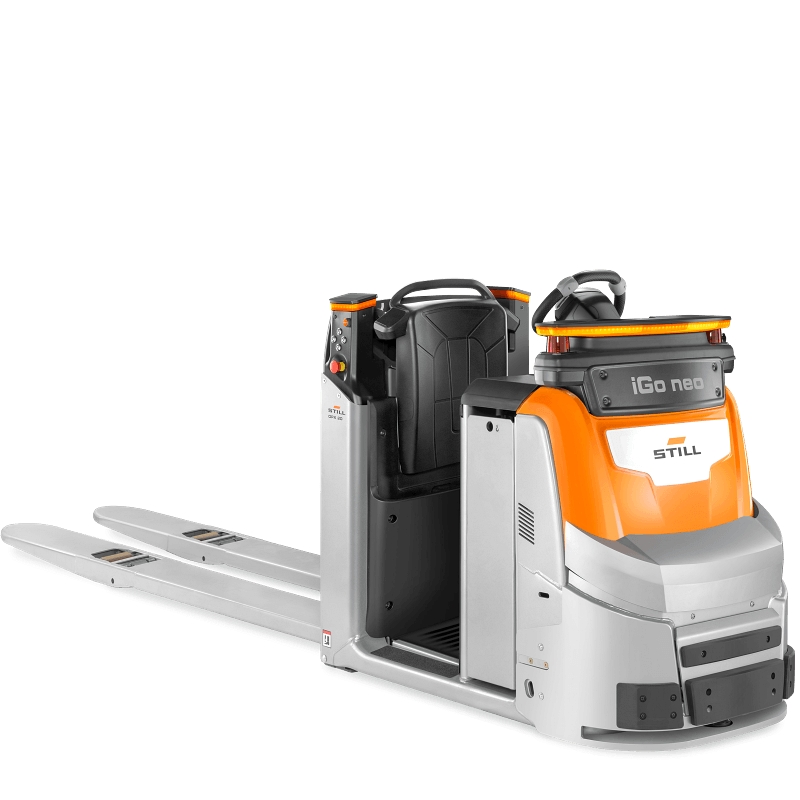
Automated and manual trucks together
Very few sites go fully driverless. The automated trucks we supply are series-built machines that can be driven manually when needed, so a truck is not stranded if a route is blocked or the job changes.
Every automated truck carries 360 degree personal protection that slows it and stops it when a person or object is in its path, and the site needs clear rules for where people, manual trucks and automated trucks go. Pedestrian detection and telematics on the manual fleet complete the picture.
How jobs are shared out and traffic is managed where robots and manned trucks meet is covered under fleet control.
Monitoring automated trucks remotely
Automated trucks are watched from a screen rather than a driver’s seat. The control system shows where every truck is, which job it is doing, its battery level and any truck that has stopped, so a supervisor can run the fleet from the office or from the floor.
- Alarms. A truck that stops for a blocked route, a damaged pallet or a fault raises an alarm with the reason, so someone goes to the right place with the right fix.
- Release and reassign. Many stoppages, such as a cleared obstruction or a re-placed pallet, are released from the screen. Jobs can be paused, given priority or moved to another truck.
- Performance. Moves per hour, waiting times and availability are recorded, which shows where a route or a transfer point needs changing.
- Faults. Anything that needs hands on the truck goes to our own engineers, as for any other truck in the fleet, and the truck can be driven manually in the meantime.
Automated storage
Semi-automated pallet shuttle racking is often the most practical first step in dense storage, and automated reach trucks can feed it. Larger fixed systems, such as fully automated high bay stores, are projects in their own right, and we deliver them together with STILL’s automation specialists, from the first survey to service. See racking systems.
Talk to us
Call 01708 861 414 or contact the team. Tell us the flow you want to automate, how many moves a shift and how far, and we will tell you whether automation is worth it and what it would look like.
Tell us the flow you want to automate, how many moves a shift and how far. We will tell you whether automation is worth it.
Warehouse automation: common questions
Eight depots across the UK
Our own engineers, out of our own depots - wherever you are, service comes from us.

Talk to us about Warehouse Automation
Monday to Friday, 8:00am to 5:00pm.
Additional Services
Checkout our range of other machine services below