Servicing is the one cost on a forklift that reliably reduces the others. This page sets out what it prevents, what it is worth in money, and what is actually included when we do it.
The case in one paragraph
A forklift is a machine that lifts tonnes, several hundred times a day, indoors, near people. It wears in predictable ways. Planned servicing finds that wear while it is a £40 part, instead of after it has become a £900 repair, a stopped shift, or an incident.
Everything on a forklift that fails expensively gives warning first. Servicing is how you get to hear it.
The argument against servicing is always the same: the machine seems fine. That is what a machine looks like shortly before it is not.
Safety, and the legal side
The first reason is the one that does not have a price on it. Brakes, steering, mast chains, hydraulics and forks all degrade, and all of them fail in ways that put the operator and everyone near the machine at risk.
There is a legal dimension too, and it is commonly misunderstood:
- PUWER requires that work equipment is maintained in efficient working order and in good repair. That is a duty on you, and servicing is how it is discharged.
- LOLER requires a separate statutory thorough examination, at least every 12 months on a standard counterbalance truck.
- A service is not a thorough examination, and a thorough examination is not a service. You need both. See thorough examination vs service.
A well-serviced machine also passes its examination. An unserviced one generates defects on the report, which then have to be fixed anyway, usually in a hurry and at a worse price.
What a breakdown actually costs
The repair invoice is the smallest part of it. What a stopped truck really costs:
- The stopped work. Loading bays, production lines and picking faces that were relying on the machine.
- The callout premium. An emergency attendance and travel, against a planned visit at a planned time.
- The parts premium. Whatever is available now, rather than what was best value.
- The hire. A stand-in machine while yours is repaired: emergency hire.
- The knock-on. Late deliveries, missed slots, overtime to catch up.
None of that appears on the maintenance budget, which is exactly why cutting the maintenance budget looks like a saving.
Tell us what you run and how hard, and we will put a service schedule against it.
Longer life, and what the machine is worth at the end
Two effects, both financial.
Life. Hydraulics, transmission and mast components last far longer with clean oil, correct adjustment and early replacement of wear items. A serviced truck reaches a higher hour count before replacement becomes the sensible option, which spreads its purchase cost over more years.
Resale. When it is time to change the machine, service history is one of the three things that sets its value, alongside hours and condition. A documented truck with current examination certificates sells for more and sells faster. That is money you get back at the end, and it is the first thing we look at when we value a machine for part exchange.

Running costs
A neglected machine costs more to run every hour it works. Under-inflated or worn tyres increase fuel and battery consumption and hammer the transmission. A clogged filter makes the engine work harder. Poor mast adjustment wears chains and rollers.
What a service from us includes
Servicing is carried out by our own engineers from eight depots, on machines from any supplier, at intervals set by the hours run and the manufacturer’s schedule rather than by a generic calendar.
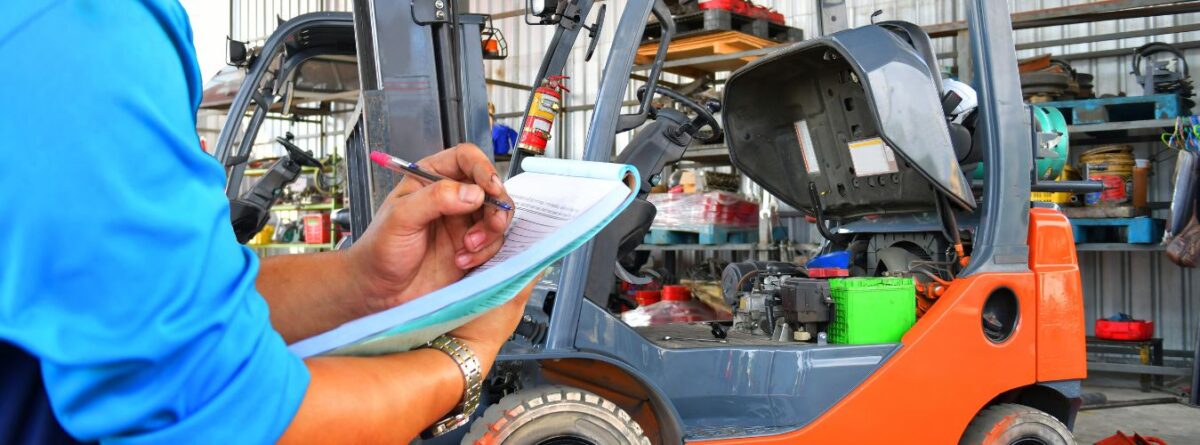
A planned service typically covers:
- Engine oil, filters, air and fuel filters on diesel and LPG machines; motor and controller checks on electric.
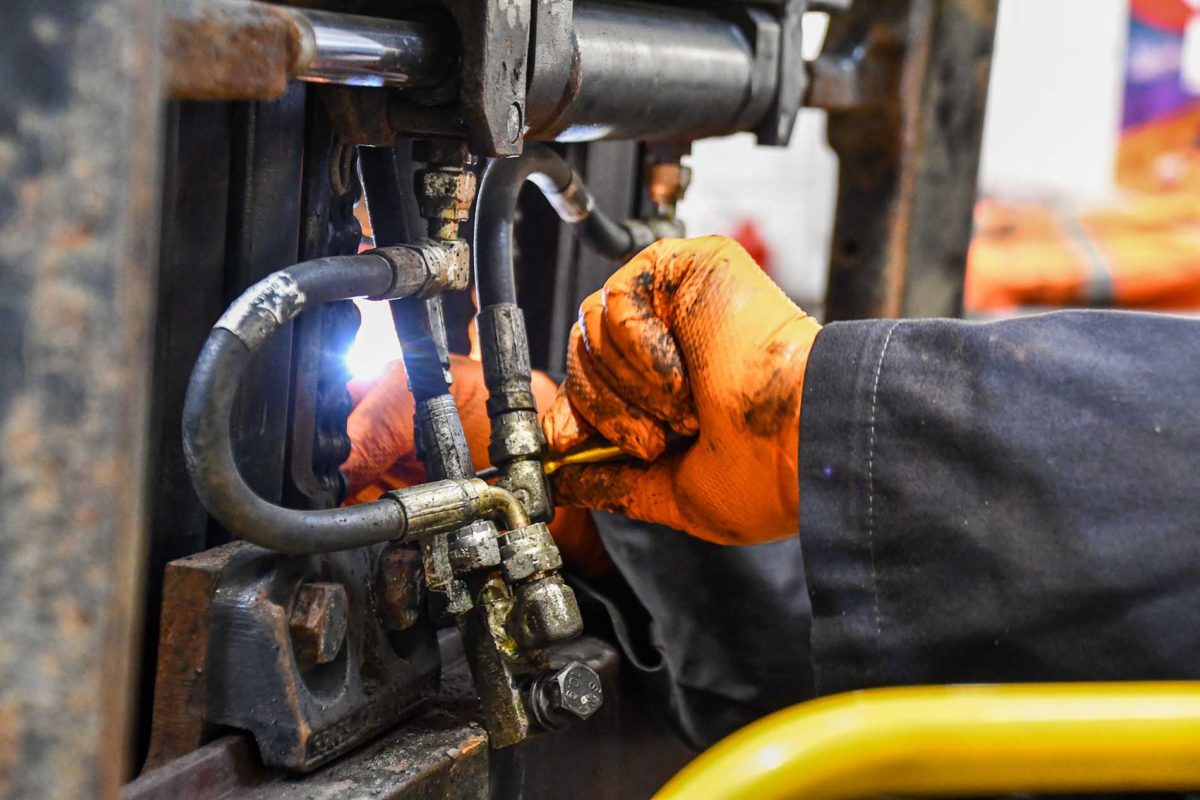
- Hydraulic oil level and condition, rams, hoses and pipework for leaks and wear.
- Mast channels, rollers, chains for stretch and lubrication, forks for wear and cracks.
- Brakes, steering, tyres and wheels.
- Battery condition and charging on electric machines. See forklift batteries.
- Lights, horn, beacons, seat and seat belt.
- Diagnostics, fault codes and a written report of anything that needs attention.
Where something needs replacing, we hold over £1 million of forklift parts in UK stock, so most jobs are finished on the visit rather than booked for a return.
Getting the schedule right
- Service by hours, not months, where usage varies. A truck doing 2,000 hours a year and one doing 200 do not need the same schedule.
- Combine the service and the thorough examination where the intervals allow. One visit, one lot of downtime.
- Track it centrally on a mixed fleet. Different in-service dates across several sites is exactly how services get missed: fleet management reporting shows uptime, first fix rates and spend per machine.
- Do not skip the daily check. Servicing is periodic; the pre-use inspection is what catches things in between, and it is a PUWER expectation.
Full detail of the service itself is on our forklift servicing page. If a machine has already stopped, our urgent and critical repairs page is the faster route.
Tell us what you run and how hard, and we will put a service schedule against it.
Servicing: common questions
Eight depots across the UK
Our own engineers, out of our own depots - wherever you are, service comes from us.

Talk to us about Why Service My Forklift?
Monday to Friday, 8:00am to 5:00pm.
Additional Services
Checkout our range of other machine services below