On this page
Executive summary
The UK’s logistics, manufacturing, warehousing, construction and distribution industries are entering a period of significant workforce change. At the centre of this transition is a profession that is essential to the movement of goods but is rarely included in public discussions about skills shortages: the forklift engineer.
Forklift engineers service, inspect, diagnose and repair the trucks and other materials-handling equipment used throughout the UK economy. Their work supports warehouses, factories, ports, construction sites, wholesalers, retailers and distribution centres. When a machine fails, the consequences can extend beyond the equipment itself. Goods may not be loaded, production may be delayed, orders may not be dispatched, and other employees may be required to work around unavailable equipment.
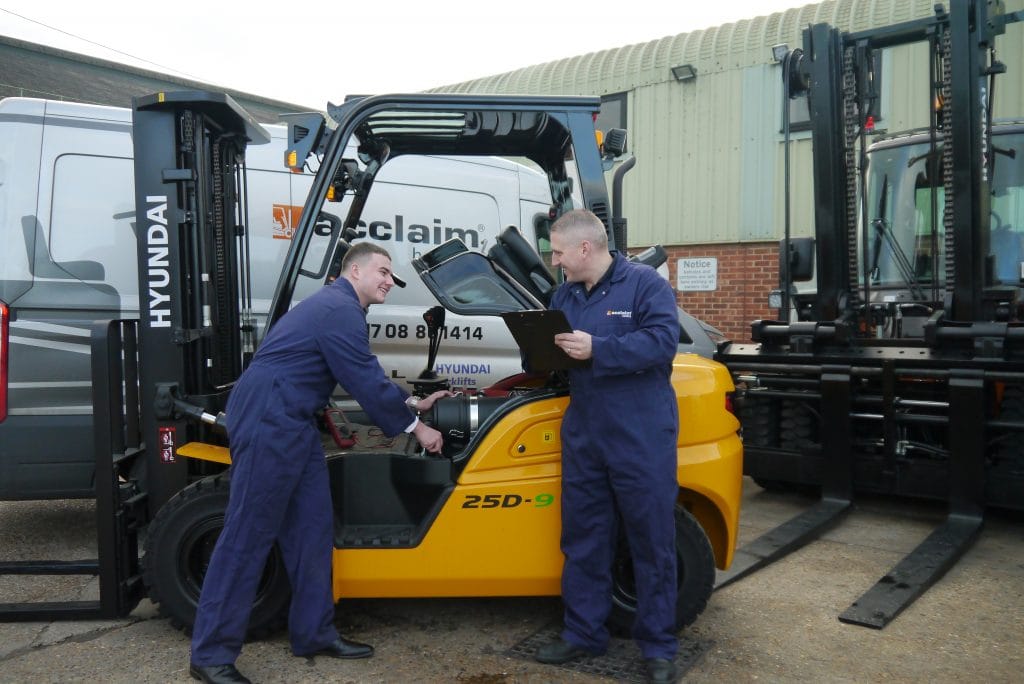
The occupation is also becoming more technically demanding. The traditional forklift engineer required a strong understanding of mechanical systems, hydraulics, engines, transmissions, steering and braking. Those capabilities remain important, but modern equipment increasingly includes advanced electrical systems, electronic control units, CAN-bus communication, lithium-ion batteries, battery-management systems, telematics and automation.
The role is consequently developing into a multi-disciplinary engineering profession combining mechanical, electrical, electronic and digital skills. This creates a two-dimensional workforce challenge. The industry must attract and train new entrants while also replacing the knowledge and practical judgement of experienced technicians who leave the sector.
There is no single official UK dataset that identifies every person employed specifically as a forklift engineer. This means that the scale of any national shortage cannot be expressed confidently through one definitive figure. Instead, the issue must be assessed through several related sources: wider engineering and technician data, employer surveys, occupational classifications, recruitment activity, apprenticeship provision and evidence from businesses operating in the materials-handling sector.
The wider evidence is significant. The Department for Education’s 2024 Employer Skills Survey recorded 250,500 skills-shortage vacancies across the UK. A skills-shortage vacancy is one that employers find difficult to fill because applicants lack the required skills, qualifications or experience. The figure represents the whole economy, not forklift engineers specifically, and was lower than the 531,200 recorded in 2022. Nevertheless, skilled trades vacancies remained particularly difficult to fill: 48% of vacancies in that occupational group were classified as skills-shortage vacancies, while manufacturing recorded a skills-shortage vacancy density of 34% (Department for Education, 2025).
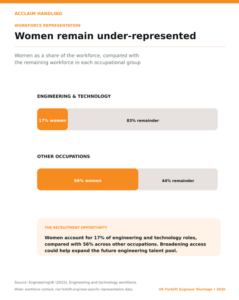
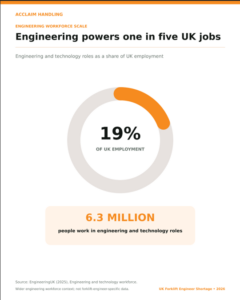
EngineeringUK estimates that 6.3 million people work in engineering and technology roles, representing approximately 19% of UK employment. However, women account for only 17% of this workforce, compared with 56% in other occupations. These figures illustrate both the scale of the engineering economy and the potential for widening recruitment by attracting people from groups that remain under-represented (EngineeringUK, 2025).
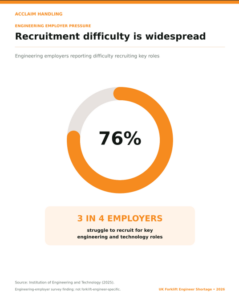
 The Institution of Engineering and Technology has reported that 76% of engineering employers struggle to recruit for key roles. Its 2025 survey also identified barriers to upskilling, including lack of time and employee turnover. It found that employers were less confident about transferring knowledge from employees approaching retirement than about sharing knowledge among existing employees (Institution of Engineering and Technology, 2025).
 Skills England has identified engineering occupations and technicians as important across several priority sectors. Its advanced-manufacturing assessment identifies engineering technicians, electrical engineers, electronics engineers, mechanical engineers and production and maintenance fitters among its priority occupations. Engineering technicians appear across multiple sectors, which means forklift businesses compete with employers in manufacturing, construction equipment, automotive, clean energy, rail, utilities and other technical industries for people with similar capabilities (Skills England, 2026a; Skills England, 2026b).
The evidence supports describing the issue as a specialist workforce pressure. It does not support claiming that a precise, nationally measured forklift-engineer shortage already exists. Nor is there sufficient published evidence to support the estimate that more than 35% of senior forklift technicians will leave the workforce within the next decade. That claim should be removed unless it can be supported by a transparent and independently verifiable dataset.
The sustainable response cannot therefore rely indefinitely on higher salaries or the movement of engineers from one competing employer to another. Those measures may help an individual business recruit in the short term, but they do not increase the total number of skilled technicians available to the industry.
A long-term response requires investment in apprenticeships, employer-led training, mentoring, cross-training, career development, better workforce data and a clearer public image of forklift engineering as a technology-led field profession.
The central argument of this study is straightforward: the UK material-handling industry must not only recruit more engineers; it must build more engineers.
Why forklift engineering matters
Forklift trucks are part of the UK’s industrial infrastructure. They move raw materials, components, finished goods, pallets, containers and construction materials through the workplaces on which modern commerce depends. Some are used intensively in large distribution centres, where a fleet may operate for long shifts and handle thousands of movements. Others work in factories, timber yards, ports, building sites, food-storage facilities and smaller warehouses.
The equipment itself varies considerably. The term “forklift” can refer to counterbalance trucks, reach trucks, pallet stackers, order pickers, rough-terrain machines, articulated trucks, powered pallet trucks and specialist vehicles adapted for particular industries. Trucks may be powered by diesel, LPG, lead-acid batteries, lithium-ion batteries or hybrid systems.
The importance of the machine becomes most visible when it stops working. A failed truck can create a bottleneck in a warehouse or production facility. If several machines fail at the same time, managers may have to reorganise work, hire replacement equipment, increase overtime or accept longer loading and unloading times. In a highly utilised operation, a relatively small technical fault can have consequences far beyond the cost of a replacement part.
Maintenance is also directly connected to workplace safety. The Health and Safety Executive states that thorough examination of industrial lift trucks is required under health and safety law. LOLER applies to lifting equipment, while PUWER covers other safety-related aspects, including items such as brakes, steering and tyres (Health and Safety Executive, 2025; Health and Safety Executive, n.d.-a).
A routine service or preventive-maintenance visit is not automatically the same thing as a statutory thorough examination. A thorough examination is a systematic and detailed examination of safety-critical components carried out by a competent person. The examination must be recorded in a written report, and defects requiring remedial action must be addressed before the equipment is used again where appropriate (Health and Safety Executive, 2025).
PUWER requires work equipment to be maintained in an efficient state, in efficient working order and in good repair. HSE guidance also states that maintenance should be carried out by people who are competent, meaning that they possess the necessary skills, knowledge and experience to do the work safely (Health and Safety Executive, n.d.-b; Health and Safety Executive, n.d.-c).
This regulatory context gives forklift engineering an importance that is sometimes overlooked. The engineer is not merely helping a company avoid inconvenience. They may be working on machinery that lifts heavy loads, operates in close proximity to pedestrians and is relied upon in safety-critical industrial environments.
The work is physically and intellectually demanding. An engineer may begin the day investigating a hydraulic leak, then attend a truck with an intermittent electrical fault, inspect a mast and carriage assembly, diagnose an electronic control system and advise a customer about battery performance. The role requires technical knowledge, practical dexterity, methodical fault-finding, an understanding of risk and the ability to communicate with customers and site managers.
The occupation is therefore broader than its public image often suggests. It is not simply a matter of replacing tyres, changing oil or fitting components. A competent engineer must understand how mechanical, hydraulic, electrical and electronic systems interact. They must also know when a machine is safe to return to service and when a defect requires further investigation or prevents continued operation.
This creates an important recruitment problem. A young person considering engineering may be familiar with careers in automotive, aerospace, civil engineering, robotics or software. Materials-handling engineering is less visible, even though it offers exposure to many of the same technologies.
If the sector is not present in schools, colleges, careers services and apprenticeship information, potential recruits may never realise that the profession exists. The question facing the industry is consequently not only how many vacancies exist today. It is whether enough people know about the profession, want to enter it and can access the training required to become competent.
Measuring workforce pressure
| Indicator | Latest figure in study | Source | Relevance to forklift engineering |
| UK skills-shortage vacancies | 250,500 | Department for Education (2025) | Demonstrates wider UK difficulty recruiting workers with required skills |
| UK skills-shortage vacancies in 2022 | 531,200 | Department for Education (2025) | Shows recruitment pressure has fallen from the post-pandemic peak |
| Skilled trades vacancies classified as skills-shortage vacancies | 48% | Department for Education (2025) | Particularly relevant because forklift engineering is a skilled technical trade |
| Manufacturing skills-shortage vacancy density | 34% | Department for Education (2025) | Relevant to a major sector employing and competing for engineering technicians |
| UK engineering & technology workforce | 6.3 million | EngineeringUK (2025) | Shows the scale of the wider engineering labour market |
| Engineering & technology share of UK employment | 19% | EngineeringUK (2025) | Demonstrates the importance of engineering to the UK economy |
| Women in engineering & technology | 17% | EngineeringUK (2025) | Highlights potential for widening recruitment |
| Engineering employers struggling to recruit key roles | 76% | IET (2025) | Demonstrates competitive recruitment conditions across engineering |
Source: Department for Education (2025); EngineeringUK (2025); Institution of Engineering and Technology (2025). The figures provide wider labour-market context and should not be interpreted as measurements of a forklift-engineer-specific shortage.
A careful assessment must distinguish between a shortage of people, a shortage of skills and a shortage of people in a particular location.
A business may receive applications for an engineering vacancy but still be unable to appoint someone who possesses the required combination of mechanical knowledge, electrical competence, diagnostic ability, customer-service skills and relevant field experience. Conversely, a business may find that candidates are available in the labour market but not within a practical travelling distance of its customers.
These distinctions are particularly important for forklift engineering because much of the work is field-based. Unlike some professional and technical roles, it generally cannot be performed remotely. The engineer must attend the machine, assess the site, isolate the equipment where necessary, carry out the repair and verify that the truck is safe to use.
The UK does not currently have a comprehensive national dataset for forklift engineers as a separate occupation. Forklift engineers may be recorded within broader occupational categories such as engineering technicians, vehicle technicians, mechanical technicians or other maintenance-related classifications. Job titles also vary. Employers may advertise for forklift engineers, lift-truck engineers, materials-handling engineers, mobile engineers, service engineers or powered-access technicians.
This makes direct comparison difficult. A national figure based only on job advertisements could overstate demand by counting the same vacancy more than once, miss vacancies that are filled through informal networks and fail to distinguish between permanent jobs, temporary roles and replacement recruitment. It would also be unable to show how many people are already employed in the sector or how many experienced technicians are likely to leave.
The most reliable approach is therefore triangulation. Several sources of evidence should be considered together.
The first is the wider engineering labour market. The Employer Skills Survey provides a useful benchmark. In 2024, employers reported 250,500 skills-shortage vacancies across the UK. This was a substantial reduction from 2022, when 531,200 were recorded, and it indicates that the post-pandemic peak in recruitment pressure had eased. However, the result should not be interpreted as evidence that skills shortages have disappeared. Skilled trades and manufacturing continued to experience notable difficulty, and the survey remains useful evidence of the wider environment in which forklift businesses recruit (Department for Education, 2025).
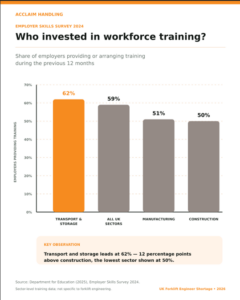
The survey also shows why training matters. In 2024, 59% of UK employers had provided or arranged training for staff during the previous twelve months. The proportion was lower in manufacturing, where 51% of employers provided training, and in construction, where the figure was 50%. Transport and storage performed better, at 62%, but the results still demonstrate that training is not automatically available across the sectors that depend on technical workers (Department for Education, 2025).
| UK sector | Employers providing or arranging training in 2024 |
| Transport & storage | 62% |
| UK employers – all sectors | 59% |
| Manufacturing | 51% |
| Construction | 50% |
Key observation: Transport and storage recorded the highest training participation among the sectors shown, at 62%. However, almost four in ten employers across the wider economy did not provide or arrange training during the period measured.
Source: Department for Education (2025), Employer Skills Survey 2024.
 These figures should be interpreted carefully. The Employer Skills Survey measures employers’ experiences across the economy. It does not identify forklift engineers as a separate group and cannot be used to calculate a national forklift-engineer shortage.
The second source is engineering-specific evidence. EngineeringUK’s estimate of 6.3 million people in engineering and technology roles demonstrates the size of the market in which forklift businesses compete. The IET’s finding that 76% of engineering employers struggle to recruit for key roles illustrates the wider competitive environment. However, neither figure measures forklift engineers directly. These statistics should therefore be used as context, not as proof of a forklift-specific national shortage (EngineeringUK, 2025; Institution of Engineering and Technology, 2025).
The third source is occupational demand analysis. Skills England’s work is useful because it identifies engineering technicians as relevant across multiple economic sectors. Its advanced-manufacturing assessment reports that 19 of 25 priority occupations overlap with at least one other priority sector. Engineering technicians are among the occupations with demand from several sectors (Skills England, 2026b).
This matters because a capable forklift engineer may have transferable skills that are valuable to employers in construction equipment, automotive, plant maintenance, manufacturing, agriculture, utilities or transport. The same mobility that creates opportunity for an engineer creates competition for the employer seeking to retain them.
The fourth source is business experience. Service managers can report the time taken to fill vacancies, the number of suitable applicants, reliance on overtime, geographic coverage, customer-response times and the age profile of their teams. Engineers can describe the skills they use most often, the training they receive and the areas in which they feel least confident.
A properly designed industry survey should record:
- the number of engineers employed by each business;
- vacancies and time taken to fill them;
- geographic areas covered by engineers;
- average experience and age bands;
- employee turnover and retirement expectations;
- qualifications and manufacturer training;
- demand for electrical, electronic and battery skills;
- use of apprenticeships;
- overtime, subcontracting and temporary labour;
- customer response times;
- pay, benefits and progression opportunities; and
- the effect of vacancies on equipment downtime.
This approach would produce a much more useful picture than a headline claim based on anecdote.
The available evidence supports the following conclusion: the UK forklift-engineering sector operates within a wider engineering labour market that is under pressure, while the occupation itself is specialist, mobile and increasingly technically complex. That combination creates a credible workforce risk. It does not, however, justify presenting an exact national shortage figure without further primary research.
Demography, competition and technology
Recruitment is only one part of the challenge. The other is replacement.
| Traditional engineering competencies | Developing / additional competencies |
| Mechanical systems | Electronic control systems |
| Hydraulics | CAN-bus diagnostics |
| Engines | Electric powertrains |
| Transmissions | Lithium-ion battery systems |
| Steering and braking | Battery-management systems |
| Mechanical fault-finding | Electronic diagnostics |
| Component replacement | Telematics |
| Preventive maintenance | Digital fault analysis |
| Safety inspection | Data interpretation |
| Practical fault diagnosis | Connected and automated equipment |
The study identifies the occupation as increasingly multi-disciplinary, combining mechanical, electrical, electronic and digital capabilities.
Every technical profession depends on the transfer of knowledge from experienced workers to newer entrants. In forklift engineering, that knowledge is often highly practical. An experienced engineer may recognise that a particular noise, vibration or intermittent fault points towards a specific component. They may know which problems occur in a particular model, how a truck behaves in a certain operating environment or which information is most useful when speaking to a customer.
This knowledge is not always fully captured in manuals or diagnostic software. It develops through repeated exposure to machines, faults and working conditions. It is also often shared informally: during a repair, over a telephone call, in a workshop discussion or while a junior engineer accompanies a senior colleague to a difficult site.
When an experienced technician leaves, the employer may lose more than a person who can complete a set of tasks. It may lose a source of judgement, historical knowledge and informal coaching. The loss can be particularly serious in a small business where only a few people possess advanced diagnostic experience.
There is no verified national evidence supporting the claim that more than 35% of active senior forklift technicians will leave the workforce within the next decade. That figure should not be used without a transparent methodology, a defined population and independently reviewable data. Nevertheless, the underlying risk is reasonable and is consistent with wider evidence about ageing technical workforces and weak knowledge transfer.
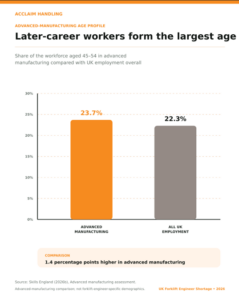
The advanced-manufacturing workforce provides a relevant comparison, although it cannot be treated as a direct proxy for forklift engineers. Skills England reports that the largest age group in advanced manufacturing is 45 to 54, representing 23.7% of the workforce, compared with 22.3% across UK employment. It also reports that the sector is male-dominated, with men accounting for 76% of the workforce (Skills England, 2026b).
 The demographic lesson is twofold. First, the industry must prepare for retirement and career changes among experienced employees. Second, it must widen the recruitment pool. Women, people from minority ethnic backgrounds, disabled people and individuals changing careers are all potential sources of talent.
EngineeringUK reports that women represent only 17% of the engineering and technology workforce, compared with 56% in other occupations. That imbalance is not inevitable; it indicates an opportunity for employers to reconsider recruitment language, workplace culture, progression and flexibility (EngineeringUK, 2025).
Forklift businesses also compete for engineers across sectors. A skilled technician may be able to move into construction plant, agricultural machinery, HGV maintenance, rail, manufacturing, mobile power systems or industrial maintenance. Some of those sectors may offer higher salaries, more visible career pathways or stronger public recognition.
This competition means that recruitment cannot be reduced to advertising more vacancies. Employers must explain why the work is attractive, provide credible training and show how a person can progress. They must also consider the quality of the job itself, including travel expectations, tools, workload, on-call arrangements, management, safety, pay and opportunities to specialise.
Salary remains important, particularly where employers are competing for people with scarce skills. However, salary competition alone has limits. If every business increases pay to recruit the same experienced technicians, the result may be redistribution rather than growth in the overall workforce. A technician may move from one dealer or service company to another, while the original employer becomes the next organisation seeking to recruit.
A sustainable strategy must therefore combine recruitment with workforce development. The distinction can be expressed simply:
- recruitment fills a vacancy;
- training creates a new technician;
- mentoring preserves practical judgement; and
- career development improves retention.
The industry needs all four.
The forklift engineer’s work is also changing because the equipment is changing. Traditional internal-combustion trucks continue to operate across the UK, and many businesses will continue to need engineers who understand engines, transmissions, fuel systems, exhaust systems and hydraulics. Mechanical competence is not becoming obsolete.
At the same time, electric and electronically controlled machines are becoming more prominent. The current Level 3 apprenticeship standard for lift-truck and powered-access engineering covers machines powered by manual, electric, diesel, LPG and hybrid systems. Its scope reflects the breadth of the occupation rather than a simple shift from one technology to another (Skills England, 2025).
Modern trucks may contain:
- electronic control units;
- motor controllers;
- sensors and actuators;
- CAN-bus communication networks;
- digital displays and diagnostic interfaces;
- lithium-ion or other advanced battery systems;
- battery-management systems;
- onboard chargers;
- telematics and impact-monitoring technology; and
- automated or semi-automated operating functions.
Lithium-ion systems may reduce some maintenance requirements associated with conventional batteries, but they do not eliminate the need for specialist competence. Engineers must understand charging, isolation, fault codes, battery condition, safe handling and manufacturer procedures. In some environments, they may also need awareness of high-voltage working practices.
| Technology | Implication for the engineer |
| Electronic control units | Requires electronic diagnostic knowledge |
| Motor controllers | Requires understanding of electronically controlled drive systems |
| Sensors and actuators | Requires electrical fault-finding capability |
| CAN-bus networks | Requires knowledge of vehicle communication systems |
| Digital displays | Requires interpretation of electronic information and fault codes |
| Lithium-ion batteries | Requires specialist battery knowledge and safe handling procedures |
| Battery-management systems | Requires understanding of battery monitoring and control |
| Onboard chargers | Requires electrical and charging-system knowledge |
| Telematics | Creates additional data for maintenance and diagnostics |
| Automated/semi-automated functions | Increases the need for electronic and digital competence |
The study notes that modern trucks increasingly incorporate these technologies and that engineers must combine practical fault-finding with the ability to interpret digital information.
Telematics adds another dimension. A connected fleet can produce information about operating hours, impacts, fault codes, battery performance, utilisation and maintenance history. This information may allow service teams to identify emerging problems before a breakdown occurs. It can also help engineers prepare for a visit by identifying likely parts, tools or diagnostic equipment.
Remote diagnostics may improve first-time fix rates, but it cannot replace physical intervention. A technician may still need to inspect a mast, test a brake, replace a hydraulic hose, repair a steering system, check a fork or investigate damage caused by a collision.
Artificial intelligence may assist with interpreting maintenance records, searching technical information, identifying patterns in fault histories or generating preliminary diagnostic suggestions. It should be treated as an aid rather than a substitute for engineering judgement. In safety-critical settings, the engineer remains responsible for applying the correct procedure, verifying the condition of the machine and making a professional decision about whether it can return to service.
The likely future is therefore augmentation rather than elimination. Technology may allow one engineer to work more efficiently, reduce unnecessary travel and improve preventive maintenance. It may also increase the amount of information that an engineer must interpret.
This has implications for training. The future technician will need to understand not only how components work, but also how systems communicate. They will need to interpret digital information while retaining practical fault-finding skills. They may need stronger numeracy, documentation, customer communication and problem-solving abilities.
Skills England’s advanced-manufacturing analysis identifies numeracy, problem-solving and decision-making, and digital literacy as important core skills. It also reports that demand for priority occupations is expected to increase, although these projections are indicative scenarios rather than precise forecasts (Skills England, 2026b).
The changing technology should therefore be presented as an opportunity. Forklift engineering can offer a career involving mechanics, electronics, software, energy systems, data and automation. The challenge is to communicate that reality to potential recruits.
| Workforce indicator | Figure | What it indicates |
| Largest advanced-manufacturing age group | 45–54 years | A significant proportion of the workforce is approaching later career stages |
| 45–54 age group in advanced manufacturing | 23.7% | Higher than the equivalent UK employment figure |
| 45–54 age group across UK employment | 22.3% | Provides a comparison benchmark |
| Men in advanced manufacturing | 76% | Indicates substantial gender imbalance |
| Women in engineering & technology | 17% | Demonstrates potential for a wider recruitment pool |
Source: Skills England (2026b); EngineeringUK (2025). These figures relate to wider engineering/advanced manufacturing populations and should not be presented as forklift-engineer-specific demographics.
Apprenticeships and training
The most sustainable route to a larger workforce is the creation of new entrants.
| Stage | Primary objective | Example activity |
| 1. Education | Establish technical foundations | Engineering theory, safety and electrical principles |
| 2. Workplace learning | Apply knowledge in a real environment | Routine servicing and supervised maintenance |
| 3. Supervised diagnosis | Develop fault-finding ability | Investigating mechanical and electrical faults |
| 4. Mentoring | Transfer practical experience | Working alongside experienced engineers |
| 5. Independent engineering | Achieve workplace competence | Carrying out repairs and diagnostics independently |
| 6. Specialist / management progression | Retain and develop talent | Diagnostic specialist, trainer or service manager |
Apprenticeships are particularly relevant because they combine employment, practical experience and structured learning. The lift-truck and powered-access engineering technician apprenticeship is a Level 3 route with a typical duration of approximately 36 months. It was developed for an occupation involving the inspection, maintenance, diagnosis and repair of lift trucks and powered-access equipment (Skills England, 2025).
The existence of an apprenticeship standard is important, but it does not by itself create a pipeline. Employers must offer places, training providers must deliver high-quality education and apprentices must receive sufficient exposure to real equipment and real faults.
The short-term cost can discourage some businesses. An apprentice requires supervision, protected learning time, tools, travel and mentoring. They may contribute less productive work during the early stages of training. In a busy service department, managers may feel that they cannot spare a senior engineer to coach a new entrant.
That calculation is understandable but incomplete. If businesses recruit only fully experienced technicians, the total supply of engineers does not increase. The sector becomes dependent on transferring people between employers. Apprenticeships create the possibility of expanding supply, even though the benefit takes longer to appear.
The apprenticeship model should also be viewed as more than an entry-level recruitment scheme. It should form part of a succession plan. A business should ask:
- Which experienced engineers are likely to reduce their hours or retire?
- Which areas of knowledge are held by only one person?
- Which junior employees could develop into technical specialists?
- How many apprentices are needed to maintain future capacity?
- Which training provider can deliver the required standard?
- How will manufacturer-specific training be integrated?
- What opportunities will exist after qualification?
A useful workforce model is:
Education → workplace learning → supervised diagnosis → mentoring → independent engineering → specialist or management progression.
The most important element is the connection between formal learning and practical experience. Classroom teaching can explain electrical principles, hydraulics, control systems and safe working practices. It cannot reproduce every fault encountered on customer equipment. Apprentices must be exposed to routine servicing, difficult diagnostics, safety inspections, customer communication and the consequences of poor repair decisions.
| Workforce pressure | Service impact | Potential customer consequence |
| Fewer available engineers | Reduced service capacity | Longer response times |
| Increased engineer workload | More emergency callouts | Greater fatigue and reduced resilience |
| Larger service territories | Increased travelling | Slower attendance |
| Reactive work takes priority | Preventive maintenance delayed | Increased equipment downtime |
| Vacancies remain unfilled | Reduced fleet-support capacity | Greater reliance on rental equipment |
| Limited diagnostic capacity | Longer repair times | Production or logistics disruption |
| Lack of specialist skills | More complex faults take longer to resolve | Increased maintenance costs |
| Loss of experienced engineers | Loss of practical knowledge | Reduced technical capability |
Structured mentoring is therefore essential. Senior engineers should be recognised for developing others rather than being expected to provide informal support in addition to a full workload. Mentoring time should be planned, measured and protected.
Knowledge transfer can be formalised through:
- joint visits to complex customer sites;
- fault-history reviews;
- repair debriefs;
- standard diagnostic checklists;
- video or photographic records of specialist procedures;
- internal technical forums;
- manufacturer training;
- documented escalation routes; and
- competency matrices showing which engineers can safely perform particular tasks.
The IET’s 2025 survey found that 80% of engineering employers believed they shared knowledge effectively between employees, but only 57% felt they did so effectively with retiring staff. This difference is important. Routine knowledge may circulate within a team, while knowledge held by employees approaching retirement may not be captured before they leave (Institution of Engineering and Technology, 2025).
Cross-training is another priority. Some experienced engineers may have strong mechanical skills but limited exposure to lithium-ion batteries, electronic diagnostics or telematics. Employers should not assume that every technician can develop these capabilities without support. Training should include protected time, access to appropriate equipment and opportunities to apply learning under supervision.
Smaller businesses may need collaborative solutions. Several employers could share access to a training facility, specialist instructor or mobile diagnostic equipment. Industry associations, manufacturers, colleges and independent providers could develop regional training partnerships. Such arrangements would be particularly valuable where individual employers cannot sustain a full internal training department.
The wider skills system also needs to become easier for employers to navigate. Skills England has identified employer complexity, time pressures and declining business investment as barriers to training. Its 2026 report emphasises the importance of employer involvement, more flexible training products and stronger links between national priorities and local provision (Skills England, 2026a).
For forklift businesses, this means that training provision should be practical, accessible and clearly linked to the occupation. Generic engineering education is useful, but employers also need programmes that reflect the real equipment, working conditions and safety responsibilities of a lift-truck engineer.
| Strategic priority | Recommended action | Intended outcome |
| Recruitment | Promote forklift engineering as a modern engineering career | Increase awareness and applicant numbers |
| Apprenticeships | Expand Level 3 apprenticeship recruitment | Create new technicians rather than simply moving existing ones |
| Mentoring | Allocate protected mentoring time | Transfer practical knowledge |
| Cross-training | Develop electrical, battery and diagnostic skills | Prepare existing engineers for changing technology |
| Career development | Establish clear technical and management pathways | Improve retention |
| Inclusive recruitment | Review recruitment and entry requirements | Expand the available talent pool |
| Job quality | Review workload, travel, tools, safety and scheduling | Improve retention and employee experience |
| Knowledge preservation | Document specialist knowledge before retirement | Reduce loss of organisational expertise |
| Workforce data | Establish a national workforce survey | Measure the forklift-engineering workforce more accurately |
| Regional planning | Map vacancies, training and industrial demand | Identify local workforce pressure |
Downtime: the hidden maintenance bill
Strategic outlook and conclusion
An engineer shortage affects more than recruitment departments.
When a service business has too few engineers, the remaining employees may cover larger territories, work longer hours or take on more emergency callouts. Travel increases, fatigue becomes a concern and planned maintenance may be delayed by reactive repairs. Managers may have to prioritise urgent breakdowns over preventive work.
For customers, the consequences may include:
- longer response times;
- more equipment downtime;
- greater reliance on rental trucks;
- increased overtime;
- delayed loading and unloading;
- disruption to production;
- reduced fleet availability; and
- higher maintenance costs.
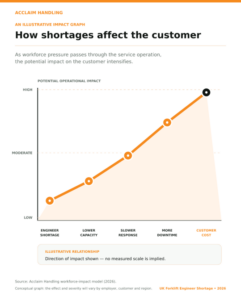 The relationship can be expressed as a chain:
Engineer shortage → reduced service capacity → slower response → equipment downtime → operational disruption → customer cost.
The effect is not identical across the UK. Forklift engineers must be located close enough to the customers and machines they serve. Industrial activity is concentrated in areas such as the Midlands, the South East, major ports and large distribution corridors, but important manufacturing, agricultural, construction and logistics activity exists throughout the country.
A national average could conceal serious local problems. A business might have enough engineers in one region but too few in another. A training provider may be producing technicians in an area where demand is modest while employers in a nearby industrial cluster struggle to recruit.
A useful next step would be a regional workforce map combining:
- forklift-engineer vacancies;
- apprenticeship locations;
- industrial and logistics employment;
- customer fleet density;
- travel times;
- engineering wages;
- training-provider capacity; and
- employer-reported recruitment difficulty.
The result could be a UK Forklift Engineer Workforce Heatmap. It should not claim to measure shortage perfectly, but it could identify areas where several indicators point in the same direction.
Regional analysis should also take account of the devolved nature of the UK skills system. Skills England is responsible for England, while Scotland, Wales and Northern Ireland have their own institutions and policy arrangements. UK-wide engineering data can provide context, but recommendations about colleges, funding and apprenticeships need to reflect the relevant national systems.
Migration policy is another area requiring caution. The Temporary Shortage List Stage 2 report recommended 18-month access for the broad occupation code 3113, engineering technicians, within advanced manufacturing. The wider Skilled Worker information also lists engineering technicians under code 3113 (UK Government, 2026; UK Visas and Immigration, 2025).
However, a broad occupational code is not the same as a forklift-engineer-specific shortage designation. Whether a particular role qualifies depends on the actual duties, occupational coding and immigration rules in force at the time. The existence of a route for a broad engineering category should not be used as evidence that the whole forklift-engineering workforce is nationally undersupplied.
No single intervention will solve the workforce challenge. The industry needs a coordinated programme involving employers, manufacturers, colleges, training providers, professional bodies and policymakers.
First, forklift engineering should be presented as a modern engineering career. Careers material should show that technicians may work with mechanical systems, electronics, battery technology, diagnostics, data and automation. Schools and colleges should be introduced to the occupation through site visits, demonstrations, work experience and practical projects.
Second, employers should expand apprenticeship and early-career recruitment. Apprenticeship targets should be based on future workforce requirements rather than immediate vacancy numbers. A company expecting several senior engineers to leave over the next five to ten years may need to recruit apprentices before the vacancies occur.
Third, the industry should make recruitment more inclusive. Employers should review entry requirements, job descriptions, assessment methods and workplace support. Where appropriate, they should consider career changers, women, people from minority ethnic backgrounds, disabled applicants and candidates who may not have followed a traditional academic route.
Fourth, mentoring should be included in workload planning. Senior engineers cannot transfer knowledge effectively if every hour is allocated to billable repairs and emergency callouts. Businesses should identify priority competencies, pair experienced and developing engineers and assess progress regularly.
Fifth, employers should develop modular upskilling in areas such as electrical fault-finding, electronic control systems, CAN-bus diagnostics, lithium-ion battery safety, battery-management systems, telematics, high-voltage awareness and data interpretation.
Sixth, an individual entering the sector should be able to see a future beyond the first qualification. Potential progression routes include senior field engineer, diagnostic specialist, battery and electrical specialist, technical trainer, service manager, technical support engineer, fleet consultant or regional operations manager.
Career development improves retention because employees can see how additional skill and responsibility will be recognised. It also gives businesses a way to retain technical expertise without requiring every experienced employee to move into management.
Seventh, businesses should improve job quality. Pay is important, but so are workload, travel, tools, training, safety, scheduling and management. Field-based employers should monitor engineer fatigue, excessive travel and the pressure created by unrealistic response-time expectations.
Finally, every business should identify knowledge that is vulnerable to loss. This may include model-specific expertise, specialist attachments, unusual applications, historical customer information or advanced diagnostic procedures.
Retiring engineers could be offered structured consultancy, part-time mentoring or technical-trainer roles. Such arrangements would allow businesses to preserve experience while giving departing employees a gradual transition.
The next stage of work should move from informed analysis to original data collection. A national UK Forklift Engineer Workforce Survey should gather evidence from employers and technicians. It should define the occupation clearly, distinguish forklift-only roles from broader powered-access or mobile-engineering roles and collect data consistently across the four UK nations.
The survey should examine:
- workforce size;
- age and experience;
- current vacancies;
- recruitment time;
- turnover;
- retirement expectations;
- salaries and benefits;
- geographic coverage;
- training expenditure;
- apprenticeship starts and completions;
- manufacturer certifications;
- electrical and battery capability;
- diagnostic and telematics skills;
- overtime and subcontracting;
- customer response times; and
- the impact of vacancies on downtime.
Interviews would add qualitative depth. Service managers could explain recruitment and retention problems. Engineers could identify practical skills gaps. Manufacturers could describe changes in machine technology. Colleges and training providers could explain barriers to delivery. Logistics and manufacturing businesses could quantify the operational consequences of delayed repairs.
The evidence currently supports several conclusions.
First, forklift engineering is affected by the wider UK shortage of engineering and technical skills, but the scale of the forklift-specific problem has not yet been measured precisely.
Second, the occupation is becoming broader and more technically demanding as equipment incorporates electronics, connected systems, advanced batteries and automation.
Third, replacement demand may be as important as recruitment demand because businesses risk losing experienced technicians and the practical knowledge they hold.
Fourth, recruiting qualified engineers from competing companies may help individual employers temporarily but cannot increase the total supply of technicians.
Fifth, apprenticeships, structured mentoring and cross-training should form the foundation of a long-term workforce strategy.
Sixth, technology will improve productivity and diagnostic capability but will not remove the need for engineers who can inspect, repair and make equipment safe on site.
The UK material-handling industry is therefore approaching a decisive period. The challenge is not simply whether companies can fill today’s vacancies. It is whether they can maintain the capability required to support tomorrow’s fleets.
The forklift engineer of 2030 will still need practical mechanical knowledge. Alongside it, they are likely to require greater confidence with electrical systems, electronic controls, batteries, software, data and connected equipment. That combination creates a demanding role, but it also creates an opportunity to reposition the occupation.
Forklift engineering can be presented as a modern field-engineering career at the intersection of mechanics, electrification, electronics, logistics and automation. It offers practical work, technical variety, customer responsibility and opportunities for specialisation. The industry must communicate those benefits more effectively to schools, colleges, career changers and under-represented groups.
The solution is not simply to pay more for the same limited pool of experienced people. Nor is it to assume that technology will eliminate the need for human expertise. The long-term answer is to create a visible, credible and well-supported route into the profession; to train people before vacancies become critical; to transfer knowledge before senior technicians leave; and to build career structures that encourage skilled employees to remain.
The UK material-handling sector now has an opportunity to shape its workforce rather than merely react to shortages. That requires better evidence, earlier planning and sustained investment.
The central conclusion is clear: the industry does not merely need to recruit more forklift engineers. It needs to build more forklift engineers.
BIBLIOGRAPHY
Department for Education (2025) Employer Skills Survey 2024. Available at: https://explore-education-statistics.service.gov.uk/find-statistics/employer-skills-survey/2024 (Accessed: 27 August 2026).
EngineeringUK (2025) Engineering and technology workforce. Available at: https://www.engineeringuk.com/research-and-insights/our-research-and-evaluation-reports/engineering-and-technology-workforce/ (Accessed: 27 August 2026).
Health and Safety Executive (2013) Rider-operated lift trucks: Operator training and safe use: Approved Code of Practice and guidance. L117. Available at: https://www.hse.gov.uk/pubns/books/l117.htm (Accessed: 27 August 2026).
Health and Safety Executive (2025) Thorough examination. Available at: https://www.hse.gov.uk/workplacetransport/lift-trucks/thoroughexamination.htm (Accessed: 27 August 2026).
Health and Safety Executive (n.d.-a) Lifting Operations and Lifting Equipment Regulations 1998 (LOLER). Available at: https://www.hse.gov.uk/work-equipment-machinery/loler.htm (Accessed: 27 August 2026).
Health and Safety Executive (n.d.-b) Maintenance of work equipment. Available at: https://www.hse.gov.uk/work-equipment-machinery/maintenance.htm (Accessed: 27 August 2026).
Health and Safety Executive (n.d.-c) Provision and Use of Work Equipment Regulations 1998 (PUWER). Available at: https://www.hse.gov.uk/work-equipment-machinery/puwer.htm (Accessed: 27 August 2026).
Institution of Engineering and Technology (2025) Latest UK engineering and technology skills statistics 2025. Available at: https://www.theiet.org/media/press-releases/press-releases-2025/press-releases-2025-october-december/6-october-2025-latest-uk-engineering-and-technology-skills-stats-2025 (Accessed: 27 August 2026).
Skills England (2025) Lift truck and powered access engineering technician: Apprenticeship standard ST0387, version 1.2. Available at: https://skillsengland.education.gov.uk/apprenticeships/st0387-v1-2 (Accessed: 27 August 2026).
Skills England (2026a) Skills England annual skills report 2026. Available at: https://www.gov.uk/government/publications/skills-england-annual-skills-report-and-sectoral-skills-needs-assessments-2026/skills-england-annual-skills-report-2026 (Accessed: 27 August 2026).
Skills England (2026b) Sector skills needs assessment: Advanced manufacturing. Available at: https://www.gov.uk/government/publications/skills-england-annual-skills-report-and-sectoral-skills-needs-assessments-2026/sector-skills-needs-assessment-advanced-manufacturing (Accessed: 27 August 2026).
UK Government (2026) Temporary Shortage List: Stage 2 report. Available at: https://www.gov.uk/government/publications/temporary-shortage-list-stage-2-report/temporary-shortage-list-stage-2-report-accessible (Accessed: 27 August 2026).
UK Visas and Immigration (2025) Skilled Worker visa: Temporary Shortage List. Available at: https://www.gov.uk/government/publications/skilled-worker-visa-temporary-shortage-list/skilled-worker-visa-temporary-shortage-list (Accessed: 27 August 2026).
UK Material Handling Association (n.d.) UK Material Handling Association. Available at: https://ukmha.org.uk/ (Accessed: 27 August 2026).