On this page
- Executive summary
- Key Findings
- 1. The UK forklift market in 2026
- 2. Understanding the three main options
- 3. Buying a forklift: control and long-term ownership
- 4. Leasing and contract hire: spreading the cost
- 5. Short-term hire: flexibility when demand shifts
- 6. Comparing costs over a lifetime
- 7. Electric forklifts and shifting fleet decisions
- 8. Used forklifts and extending fleet life
- 9. Maintenance, safety and legal duties
- 10. Tax and accounting considerations
- 11. Choosing the right option for your business
- Conclusion
- Bibliography
Executive summary
For UK businesses, choosing how to acquire a forklift means far more than weighing a purchase price against a monthly payment. The right choice depends on how often the truck is used, how long it is needed, how reliable demand is, and how much financial flexibility the business wants to retain.
Buying can offer long-term value and control for operations with predictable needs. Leasing or contract hire spreads costs over a set period, while short-term hire offers flexibility for seasonal demand, temporary contracts and unexpected fleet shortages.

This decision matters especially in 2026. After a period of delayed investment and economic uncertainty, the UK Material Handling Association (UKMHA) has forecast a recovery in forklift truck orders. Meanwhile, businesses are weighing the shift to electric equipment, the cost of maintaining ageing fleets and the need to keep operations running through change [UKMHA,2026]
This study examines the advantages and limits of each acquisition route, the trends shaping fleet decisions and the questions businesses should ask before committing.
Key Findings
– The UK forklift market is forecast to recover in 2026. Research by Oxford Economics for UKMHA forecast a 9.4% rise in total forklift orders. This is a forecast, not a confirmed full-year result [UKMHA,2026]
– Cash flow remains central to fleet planning. Spreading costs through leasing or hiring can help businesses preserve capital, though the full contract cost must be assessed.
– Flexibility has value. Short-term hire works when demand is seasonal or uncertain, but repeated hiring over a long period may cost more than a longer arrangement.
– Ownership suits stable operations. Buying lets a business keep an asset and decide how long to hold it, but maintenance, depreciation and resale risk must be weighed.
– The lowest headline price is not always the lowest lifetime cost. Maintenance, energy, downtime, transport and end-of-contract charges can all affect the comparison.
– Safety responsibilities remain whatever the ownership model. Hired, leased and owned forklifts must all suit the work, be maintained and undergo the appropriate examinations.
1. The UK forklift market in 2026
Forklifts are vital for moving goods across warehouses, distribution centres, manufacturing sites, ports, builders’ merchants and recycling operations. When a truck becomes unreliable or unsuited to its workload, the effects spread: deliveries may be delayed, loading capacity reduced and staff diverted from other tasks.
In 2025, many businesses faced pressure from operating costs and uncertainty over investment. According to UKMHA, some delayed fleet renewals or chose shorter-term leasing while assessing future needs.
The association’s market outlook, prepared by Oxford Economics, forecasts renewed growth in 2026:
| UK forklift market measure | Forecast change in orders for 2026 |
| Total forklift truck orders | +9.4% |
| Counterbalance truck orders | +8.2% |
| Warehouse truck orders | +10.1% |
Source: UKMHA, UK Forklift Truck Market Outlook. Figures are forecasts and should not be taken as actual full-year results. [UKMHA,2025]
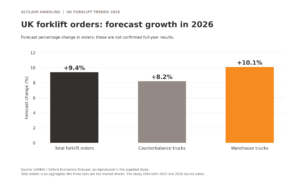 As confidence grows, the forecast suggests businesses may be more inclined to renew or expand their fleets. Yet it doesn’t reveal how many forklifts will be purchased, leased or hired. Personal decisions will still depend on a business’s finances, workload and outlook for the coming years.
For fleet managers, the real question isn’t simply whether to replace a truck. It’s how to get the right equipment for the right period, at an acceptable total cost and risk.
2. Understanding the three main options
Before comparing costs, it’s important to understand what each arrangement typically involves.
Buying
When a business buys a forklift outright, it pays the purchase price and owns the truck. It can keep, sell or replace the equipment as its needs change.
A business may also acquire a forklift through hire purchase. Payments are spread over an agreed term, with ownership passing once the agreement’s conditions are met. Despite the similar terminology, hire purchase differs from ordinary short-term forklift hire [GOV.UK, 2026]
Leasing or contract hire
Leasing usually means paying to use a forklift over an agreed period. Depending on the contract, servicing and other support may be included or arranged separately.
At the end of the agreement, the business’s options depend on the specific terms. This could involve returning the truck, extending the arrangement, or buying it where the agreement allows.
Suppliers sometimes use lease, rental and contract hire in different ways. Businesses should therefore rely on the written agreement instead of assuming what a label covers.
Short-term hire
Short-term hire provides equipment for a temporary need. It may suit a busy period or a specific project, or cover while an existing truck is out of service.
The supplier keeps ownership, and the customer pays for use under the agreed terms. Check minimum hire periods, transport costs, maintenance provisions and notice requirements.
| Consideration | Buying | Leasing / contract hire | Short-term hire |
| Typical purpose | Stable, long-term need | Predictable need over an agreed term | Temporary or changing need |
| Initial capital | Usually higher for outright purchase | Often lower, depending on deposit | Usually lower, though delivery and other charges may apply
|
| Ownership | Business owns the truck | Usually retained by the provider unless the agreement states otherwise | Retained by the hire company |
| Flexibility | Can sell or redeploy, subject to market conditions | Depends on contract and early termination terms | Often more flexible, subject to minimum term and availability |
| Maintenance | Owner arranges it or buys a service plan | May be included or excluded | May be included in the hire terms |
| End of use | Keep, sell or dispose of the truck | Return, extend or follow other agreed terms | Return under the hire agreement |
3. Buying a forklift: control and long-term ownership
Buying may appeal when a forklift is central to daily operations and the business expects to need it for many years.
A warehouse with a steady shift pattern, for instance, may be able to specify a truck around a known workload and keep it for its useful working life. Once purchased, the business can decide on servicing, attachments, refurbishment and eventual replacement.
Advantages of purchasing
Ownership and control. The business owns the asset and chooses whether to retain, sell or redeploy it. Subject to safety and manufacturer requirements, it can also select equipment and attachments suited to its site.
Potential long-term value. If the truck remains reliable and fit for years, ownership may prove cost-effective. The truck may also retain resale value at replacement.
No ongoing hire agreement. An outright purchase avoids contractual rental payments, though it does not eliminate the ongoing costs of running and maintaining the equipment.
New and used options. A suitable used forklift may reduce the initial outlay. However, its service history, condition, operating hours and battery health should be checked carefully.
Downsides of buying
The clearest drawback is the initial expenditure. Capital spent on equipment cannot simultaneously fund other priorities, such as stock, premises improvements or recruitment.
Ownership also exposes the business to variable maintenance costs. As a truck ages, repairs may become less predictable, and a major component failure can disrupt both the budget and operations.
Finally, the business bears the risk that its requirements change. A forklift bought for a single-shift warehouse may no longer suit if the operation expands, changes premises or shifts to a different load profile.
Buying could be worth considering if:
– The truck will be used regularly over a long period.
– Operational and load needs are fairly stable.
– Capital is available without straining cash flow.
– The business wants control over the equipment and replacement cycle.
– Maintenance and eventual disposal are budgeted for.
A purchase decision should always weigh total cost of ownership, not just the price.
4. Leasing and contract hire: spreading the cost
Leasing and contract hire let a business use a forklift for an agreed term without buying it outright.
For a company that needs reliable equipment while protecting cash reserves, a structured monthly payment can simplify budgeting. Some agreements also include maintenance or other services, though cover levels vary.
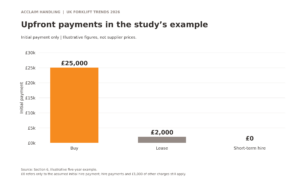 For example, a growing distribution business may need an extra truck for the next five years but prefer to spend capital on stock and staff. A lease or contract hire arrangement could supply the equipment while spreading the cost over that period.
Advantages of leasing and contract hire
Preserving capital. Depending on the deposit and agreement, the initial payment may be lower than buying outright.
Budget planning. Regular payments make fleet expenditure easier to forecast. A maintenance-inclusive contract may also reduce exposure to some unexpected servicing costs.
Replacement at set intervals. A fixed term encourages businesses to review equipment when the agreement ends and consider whether a replacement better fits their needs.
Access to newer equipment. Spreading the cost makes it easier to access a truck with features or energy technology that would otherwise require a larger upfront investment.
Downsides of leasing and contract hire
The business is bound to the contract terms. If the equipment is no longer needed before the agreed end date, early termination fees may apply.
Monthly payments also require context. A low headline payment may exclude servicing, replacement tyres, battery costs, damage, or charges for exceeding agreed operating hours.
Where ownership does not transfer, the customer typically returns the truck rather than keeping a resale asset. Some agreements may include a purchase option, but this should never be assumed.
Questions to ask before signing
- How long is the contract, and what is the initial payment?
- What happens when the term ends?
- Is there an operating-hours allowance?
- Which servicing and repairs are covered?
- Are tyres, batteries, chargers and attachments included in the cover?
- What is considered fair wear and tear?
- Are replacement trucks provided if one breaks down?
- What happens if the agreement ends early?
- Are the costs fixed or subject to change?
- Who arranges and pays for thorough examinations?
Acclaim Handling offers leasing and contract hire for materials handling equipment. The best arrangement depends on the truck, workload and agreed terms.
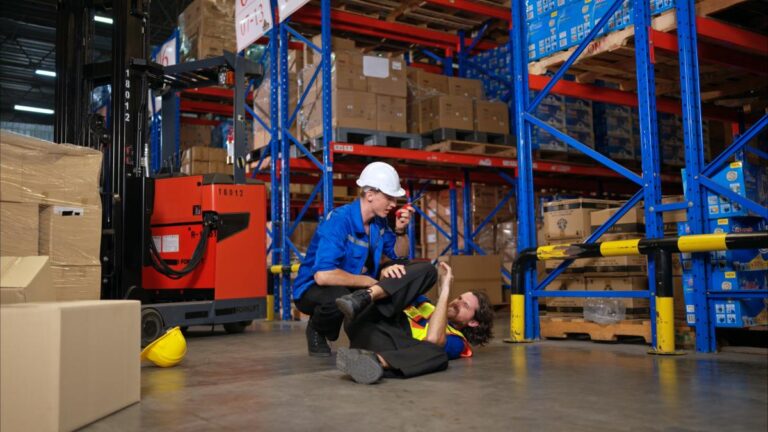
Forklift overturns can seriously injure operators, who may be crushed between the vehicle and the ground.
The HSE cites excessive speed, uneven surfaces, gradients, overloading and high loads as overturning factors.
Turning too fast
Forklifts steer with the rear wheels, so they handle unlike conventional vehicles.
Fast turns can destabilise a truck, especially with a raised load or on a slope.
Operators should slow before turning and avoid abrupt direction changes.
Loads carried too high
Raising a load shifts the forklift’s centre of gravity. Travelling with a raised load lowers stability and raises overturning risk.
Loads should normally travel in the lowered position the manufacturer specifies. Operators should raise loads only for the lift or positioning task at hand.
Uneven or slippery surfaces
Potholes, loose gravel, soft ground, steep slopes, and slippery surfaces can all reduce traction and stability.
Companies should check operating routes, keep surfaces usable, and make sure equipment suits the environment.
If conditions turn unsafe, operators should stop and report the issue.
Overloading and incorrect load distribution
A forklift’s safe capacity depends on load weight, load centre, lift height, attachments, and other factors.
A load set further forward than expected can lower stability, even if its total weight seems fine.
Before lifting, operators should check the manufacturer’s capacity plate and attachment details. Equipment must never exceed its rated capability.
Seat belts and operator protection
Where fitted and required, seat belts and other suitable restraints help keep operators inside the protected area during an overturn.
Operators should not try to jump from an overturning forklift. HSE guidance advises following the manufacturer’s emergency instructions and using the restraints supplied.
Preventing overturns
Companies should enforce suitable speed limits, maintain good surfaces, assess gradients, verify load capacity, and provide effective operator training.
Near misses involving unstable loads or wheel lift should also be investigated, even with no injuries.
5. Short-term hire: flexibility when demand shifts
Not every forklift need justifies a long-term commitment. Many businesses face workload fluctuations through the year or need extra capacity for a specific project.
Short-term hire lets businesses respond to those changes without buying a truck that may sit idle once the busy period ends.
Why hiring is common
Busy seasonal periods. Retailers, food distributors and logistics providers may need extra trucks during their busiest months.
Short-term contracts. A business running a brief project may need extra equipment for its duration.
Breakdown cover. A hired truck can provide temporary capacity while a business’s own equipment is repaired, subject to availability and suitability.
Fleet changes. If a replacement truck is ordered but hasn’t arrived, hire can bridge the gap.
Trying a different specification. Hire lets a business assess whether a truck type, power source or configuration suits its operation before committing long term.
The cost of flexibility
Short-term hire is valuable because it reduces the commitment of a permanent fleet increase. But a truck hired continuously over a long period may cost more than a longer-term agreement or purchase.
Businesses should review recurring hire needs rather than automatically extending the same arrangement. If the “temporary” truck is needed most of the year, it may be time to compare a lease, contract hire or purchase.
Also, the cheapest-looking hire rate may not cover every cost. Delivery, collection, minimum hire periods, damage charges and operating-hours limits should all be included in the comparison.
Acclaim Handling covers seasonal rental in its forklift rental guide.
6. Comparing costs over a lifetime
The most useful comparison looks at what the equipment will cost over the period it is expected to be needed.
For a truck you own, this may include:
Purchase price + maintenance + energy + insurance + examinations + downtime costs − estimated resale value
For a lease or contract hire arrangement, the calculation may include:
Initial payment + contract payments + excluded maintenance + energy + insurance + additional charges
For short-term hire, it may include:
Hire payments + delivery and collection + energy + insurance + any applicable additional charges
These approaches are simplified. Tax, financing costs and payment timing also affect the final comparison. For a substantial investment, businesses can ask their finance team to compare options using discounted cash flows.
Illustrative five-year example
The following figures are invented purely for illustration. They are not Acclaim Handling prices or market averages.
| Cost item | Buy | Lease | Short-term hire |
| Initial payment | £25,000 purchase | £2,000 | £0 |
| Payments over five years | £0 | £27,000 | £36,000 |
| Maintenance paid separately | £6,000 | £2,000 | £0 |
| Delivery and other assumed charges | £0 | £0 | £1,000 |
| Estimated resale value | −£5,000 | £0 | £0 |
| Illustrative total | £26,000 | £31,000 | £37,000 |
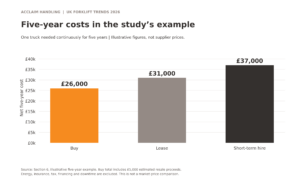 Assumptions: one truck is needed for all five years; maintenance is included in the illustrative hire price; the lease does not transfer ownership; and the purchased truck sells for £5,000. Energy, insurance, tax, financing and downtime are excluded.
In this example, buying shows the lowest stated five-year cost. Yet it also requires the largest upfront payment and relies on the truck reaching its estimated resale value. A major repair or a shorter-than-expected need could change the outcome.
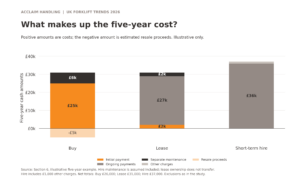 The example also shows why short-term hire should not automatically be seen as a five-year solution. If the truck were needed only a few months a year, the hire calculation—and the decision—could look very different.
7. Electric forklifts and shifting fleet decisions
The choice of acquisition route is increasingly tied to the choice of power source.
Electric forklifts suit many indoor operations and, depending on the truck and specification, some outdoor applications. Businesses weighing a move from diesel or LPG should assess the whole operation rather than assume every electric truck fits every environment.
Key questions include:
– How long does the truck run each day?
– Is there enough time and space to charge?
– Can the electrical supply support the required charging equipment?
– Must the truck operate outside or on uneven surfaces?
– What capacity is needed at the intended lift height?
– Do you need a spare battery or another charging option?
– Who looks after battery upkeep and eventual replacement?
Battery technology also affects the calculation. Each battery type has its own charging, maintenance and operating requirements. A multi-shift operation may benefit from charging flexibility, while a single-shift one may need something different.
Leasing or hiring suits a business wanting to trial an electric truck before committing to a wider fleet change. Buying appeals when the application is well understood and the equipment will be kept long term.
Either way, businesses should include charging infrastructure, electricity use and battery obligations in the contract or ownership comparison.
8. Used forklifts and extending fleet life
A used forklift can cost less upfront than a comparable new machine, making it an option for tighter budgets.
However, a lower price should be weighed against the truck’s condition and likely future costs. Two forklifts of the same age can have very different remaining lives, depending on operating hours, maintenance history and previous working environment.
When assessing a used truck, businesses should request:
– Service and repair history.
– Recorded operating hours.
– Condition of forks, mast, chains and hydraulics.
– Tyre condition and suitability for the site.
– Battery condition and charger compatibility, where relevant.
– Available thorough examination documentation.
– Warranty coverage and parts availability.
– Fitness for planned loads and lift heights.
Extending a truck’s life can make sense if it remains safe, reliable and suited to the job. Decide based on evidence: maintenance costs, breakdown frequency, parts availability and downtime impact.
A fully paid-off truck isn’t always the cheapest to keep. If repairs are frequent or a failure would halt critical loading, replacement may be better value.
9. Maintenance, safety and legal duties
Whether bought, leased or hired, a forklift must suit the work and stay safe.
A maintenance-inclusive contract helps organise servicing, but responsibilities must still be clear. The customer should know who to contact about a defect, how quickly the truck will be attended and whether a replacement is available.
Operators should carry out suitable pre-use checks and report defects promptly. Training, supervision, traffic management and safe operating procedures remain essential regardless of who owns the truck.
Thorough examination
Forklifts lifting goods generally need a thorough examination at least every 12 months, unless a competent person’s written scheme sets different intervals. Equipment for lifting people and lifting accessories have different requirements, commonly six-month intervals. Some conditions may require shorter examination intervals [HSE, 2026]
Servicing and thorough examination are separate activities. A regular service does not automatically replace the required examination.
For hired lifting equipment, HSE notes the hire company usually arranges the examination, but users should confirm a current report exists and requirements are met. hse.gov.uk
Before accepting any agreement, request written confirmation of what is included and keep the relevant records.
10. Tax and accounting considerations
Tax treatment can affect the overall comparison, depending on the business, the equipment and the specific agreement.
For eligible spending, the Annual Investment Allowance may allow a business to deduct the full value of qualifying plant and machinery from taxable profits, within the applicable rules and annual limit. According to GOV.UK, the annual allowance is currently £1 million. This reduces taxable profits; it is not a direct refund of the purchase price. gov.uk
Companies may also claim full expensing on qualifying new and unused plant and machinery, subject to the relevant conditions. It is not available for every asset or business.
Hire purchase, finance leases and other leases may each be treated differently for tax. In particular, a contract that lets ownership pass to the customer may be treated differently from an ordinary rental agreement. Accounting treatment may also vary with the reporting framework and contract terms.
Businesses should ask their accountant to review the proposed agreement before assuming a particular allowance or deduction applies.
11. Choosing the right option for your business
The best fleet decisions start with the operation, not the acquisition method.
Step 1: Establish the workload
Identify the maximum load, load dimensions, required lift height, operating surface, working hours and available space. Include any planned shift changes, product changes, or premises changes.
Step 2: Estimate how long the truck is needed
A stable five-year need is not the same as a three-month project. Estimate the shortest expected period and how likely demand is to change.
Step 3: Work out the total cost
Ask for quotes on a like-for-like basis. Check what is included, what is excluded, and what happens when each arrangement ends.
Step 4: Evaluate downtime costs
A truck used only occasionally can tolerate a longer repair window. A truck needed to load every outbound vehicle may warrant stronger support or access to a replacement.
Step 5: Review flexibility and risk
Consider what happens if the site closes, work grows, the equipment becomes unsuitable, or a contract ends early.
Step 6: Reassess the fleet regularly
A business does not have to use one approach for every truck. It may make sense to buy equipment needed daily, lease a predictable core fleet, and hire extra trucks during peaks.
| Business situation | Option worth considering | Reason |
| Consistent daily use over many years | Buying | Gives ownership and potential long-term value |
| Predictable requirement with capital needed elsewhere | Leasing or contract hire | Spreads costs over an agreed term |
| Seasonal increase in activity | Short-term hire | Adds capacity for the period needed |
| Temporary cover during repair or replacement | Short-term hire | Helps bridge an operational gap |
| Uncertain future workload | Short-term hire or a flexible option | Reduces long-term commitment, subject to terms |
| Stable core demand with occasional peaks | A mixed fleet strategy | Matches commitment to each part of the workload |
Conclusion
The 2026 UK forklift market outlook points to possible order recovery, though the best acquisition route will still vary by business.
Buying gives control and value where demand is steady and the truck will serve the operation for years. Leasing or contract hire spreads costs and supports a planned replacement cycle. Short-term hire provides flexibility when demand shifts or extra equipment is needed temporarily.
The best decision comes from weighing total cost, operational need and contractual risk. By reviewing utilisation, maintenance, energy, downtime and future plans together, businesses can choose a forklift arrangement that supports both productivity and financial planning.
Contact Acclaim Handling to discuss new and used forklift sales, hire and servicing, or to explore leasing and contract hire options.
Bibliography
Health and Safety Executive (HSE) (n.d.a) Equipment and machinery frequently asked questions. Available at: https://www.hse.gov.uk/work-equipment-machinery/faqs.htm (Accessed: 27 October 2026).
HSE. (n.d.). Thorough examinations and inspections of lifting equipment – work equipment and machinery. Www.Hse.Gov.Uk. Retrieved 30 October 2026, from https://www.hse.gov.uk/work-equipment-machinery/thorough-examinations-lifting-equipment.htm
HM Revenue & Customs (HMRC) (n.d.a) Business Leasing Manual: BLM00330 – Introduction: Lease taxation: Hire purchase contracts. Available at: https://www.gov.uk/hmrc-internal-manuals/business-leasing-manual/blm00330 (Accessed: 27 October 2026).
HM Revenue & Customs (HMRC) (n.d.b) Claim capital allowances: Annual investment allowance. Available at: https://www.gov.uk/capital-allowances/annual-investment-allowance (Accessed: 27 October 2026).
HM Revenue & Customs (HMRC) (n.d.c) Claim capital allowances: Full expensing and 50% first-year allowance. Available at: https://www.gov.uk/capital-allowances/full-expensing (Accessed: 27 October 2026).
UK Material Handling Association (UKMHA) (n.d.) Forklift market positions for recovery as confidence expected to build from 2026. Available at: https://ukmha.org.uk/news/forklift-market-positions-for-recovery-as-confidence-expected-to-build-from-2026/ (Accessed: 27 October 2026).
Forklift market positions for recovery as confidence expected to build from 2026 – UKMHA. (2025, November 19). Ukmha. https://ukmha.org.uk/news/forklift-market-positions-for-recovery-as-confidence-expected-to-build-from-2026/