On this page
- Executive summary
- 1. Introduction: Understanding Forklift Accident Risks
- 2. Poor Operator Training and Supervision
- 3. Collisions Between Forklifts and Pedestrians
- 4. Forklift Overturns and Tip-Overs
- 5. Falling Loads and Improper Load Handling
- 6. Excessive Speed and Unsafe Manoeuvring
- 7. Poor Workplace Layout and Traffic Management
- 8. Equipment Defects and Inadequate Maintenance
- 9. Unsafe Loading and Unloading Procedures
- 10. Fatigue, Distraction and Time Pressure
- 11. Using the Wrong Forklift for the Job
- 12. Environmental Hazards and Communication Failures
- 13. Poor Risk Assessments and Safety Procedures
- 14. UK Forklift Safety Legislation
- 15. Practical Strategies for Preventing Forklift Accidents
- 16. Measuring Forklift Safety Performance
- 17. Forklift Safety Checklist for Businesses
- 18. Recommendations for Acclaim Handling and Its Customers
- 19. Conclusion
- References and Further Reading
Executive summary
Forklift trucks are vital to warehouses, factories, distribution centres and logistics operations. They help businesses move heavy materials efficiently, boost productivity and maximise storage space. Yet their weight, lifting capacity and limited visibility pose serious safety risks when equipment is unsuitable, operators are poorly trained or procedures are inadequate.
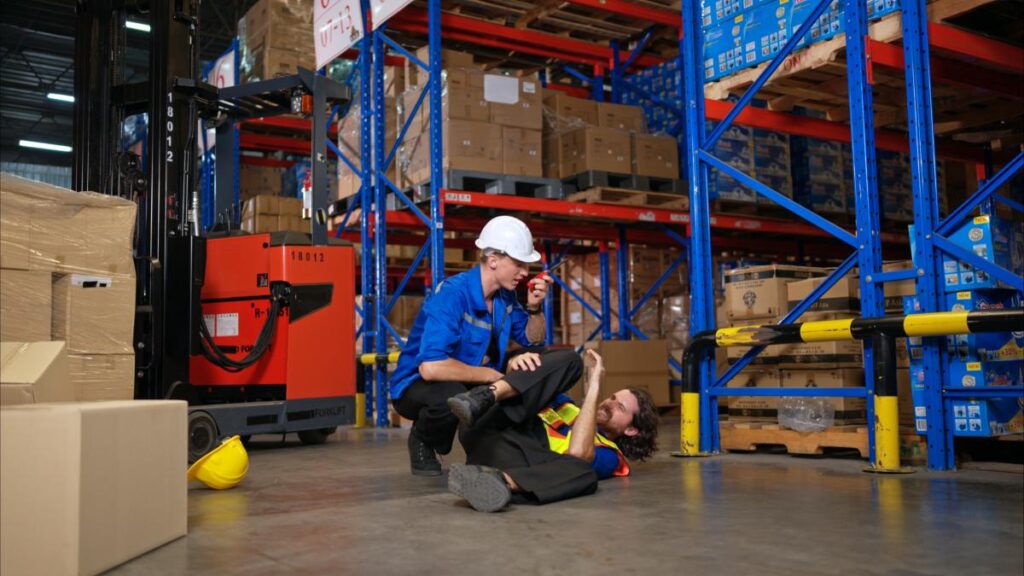
Forklift accidents can lead to serious injuries, fatalities, damaged stock, equipment repairs and operational disruption. Many incidents can be prevented through effective operator training, regular maintenance, suitable equipment and well-designed traffic management.
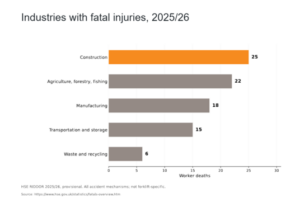
The Health and Safety Executive (HSE) regards workplace transport as a key occupational risk. Common forklift hazards include pedestrian collisions, vehicle overturns, falling loads and unsafe loading or unloading [HSE,2013].
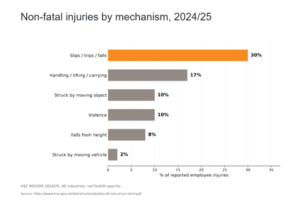
HSE recorded 59,219 employer-reported non-fatal employee injuries in 2024/25, helping establish the wider scale of workplace injury risk.
This study examines the most common causes of forklift accidents, explains how they happen and identifies practical steps businesses can take to reduce risk.
The main causes explored include:
- Inadequate operator training and supervision.
- Collisions with pedestrians and other vehicles.
- Forklift overturns and tip-over accidents.
- Falling loads and improper load handling.
- Excessive speed and unsafe manoeuvring.
- Restricted visibility and blind spots.
- Poor workplace layout and traffic management.
- Equipment defects and inadequate maintenance.
- Unsafe loading and unloading practices.
- Operator fatigue, distraction, and time pressure.
- Inappropriate forklifts and attachments.
- Environmental hazards and poor communication.
The study also reviews UK health and safety legislation and suggests ways to help employers, warehouse managers, and forklift operators create safer workplaces.
1. Introduction: Understanding Forklift Accident Risks
Forklift trucks are essential to modern material handling. They move materials quickly and efficiently, from unloading deliveries and restocking racking to transporting components across manufacturing sites.
Yet forklifts have unique operating traits that demand careful management. Their heavy weight, raised loads, rear-wheel steering, and limited sightlines make them difficult to control in tight or busy areas.
A forklift accident does not require high-speed driving. Serious incidents can happen while reversing around a corner, lifting a pallet, turning in a narrow aisle, or placing a load near racking.
An operator may not see a pedestrian behind a bulky load, or a damaged pallet may collapse during lifting. In other cases, an unstable load or uneven surface can overturn a forklift.
These incidents rarely have a single cause. Poor workplace design, inadequate training, mechanical faults, and production pressures can combine to create dangerous conditions.
Understanding these factors lets businesses address risks before they cause injuries or costly disruption.
Purpose of this study
This study identifies the main causes of forklift accidents and explains how organisations can reduce their likelihood.
It covers operational, mechanical and environmental hazards, plus the duties of employers, supervisors and operators. It also looks at practical training, maintenance, traffic management and workplace risk assessment.
The study focuses mainly on UK workplaces and official HSE guidance. It aids safety awareness and planning, but cannot replace professional advice or site-specific risk assessments.
2. Poor Operator Training and Supervision
Inadequate training is a leading forklift safety issue, since operating a truck demands more than basic driving skills. Operators must grasp load stability, lifting capacities, steering, stopping distances, visibility limits and workplace traffic rules.
Without proper knowledge, simple tasks can turn dangerous.
Operating without adequate training
An inexperienced operator may not realise how raising a load shifts a forklift’s centre of gravity. They may turn sharply with a raised load, lift beyond the truck’s rated capacity, or drive too fast in a narrow aisle.
Such errors can cause falling loads, overturns and collisions.
Training must match the specific equipment. Counterbalance forklifts, reach trucks and rough-terrain forklifts handle differently and have different operating requirements.
The HSE offers guidance on lift truck training and on employers’ duty to ensure operators are competent. Businesses should confirm that employees are properly trained and authorised before letting them operate equipment.
Insufficient supervision
Training alone cannot ensure safe operation. Operators may know the correct procedures but ignore them when supervisors allow shortcuts or production targets come first.
Examples include speeding, skipping inspections, overloading, or using faulty equipment.
Supervisors should monitor work practices, correct unsafe behaviour, and give extra instruction when needed.
Overconfidence and complacency
Experienced operators can cause accidents too. Familiarity with repetitive tasks may lead employees to assume routes are clear or that established procedures can be ignored.
Yet workplace conditions change constantly. Deliveries, temporary obstructions and pedestrian movements can create unexpected hazards.
Experience should sharpen hazard recognition, not breed complacency.
Preventing training-related accidents
Businesses should keep operator authorisation records and provide site-specific instruction on traffic routes, loading procedures, emergency arrangements and equipment limitations.
Refresher training or reassessment should be considered when equipment changes, incidents occur or unsafe practices are found.
The aim is to maintain competence throughout an operator’s working life.
3. Collisions Between Forklifts and Pedestrians
 Pedestrian collisions rank among the most serious forklift hazards, since people have little protection when struck or crushed by heavy industrial equipment.
Even a low-speed collision can cause life-changing injuries, especially if someone is trapped against racking, walls or vehicles.
Poor separation between people and vehicles
A major risk arises when pedestrian walkways and forklift routes overlap without effective controls.
Employees may cross vehicle routes to reach workstations, collect materials or access storage areas. Visitors and delivery drivers may also be unfamiliar with the site’s layout.
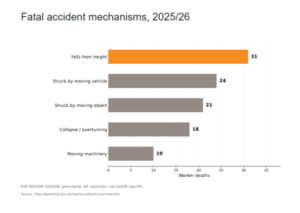
HSE reports that being struck by a moving vehicle accounted for an average of 21 worker deaths annually over the five years referenced in its October 2025 guidance. [HSE,2025] They advise keeping pedestrians apart from vehicles wherever reasonably practicable, using suitable traffic routes, crossings and barriers.
Businesses should design layouts that minimise contact between people and moving vehicles.
Reversing accidents
Reversing is especially dangerous, since the operator may have limited visibility behind the truck. A forklift’s rear can also swing out during turns.
A pedestrian could step unnoticed into the reversing path, particularly in a noisy warehouse.
Businesses should reduce reversing through one-way systems and better traffic-flow design. Where reversing is still needed, controls may include exclusion zones, clear sightlines, warning devices and a trained banksman if required.
Cameras and audible alarms can help operators but should not replace safe workplace design.
Blind spots and restricted visibility
The mast, load and other forklift parts can block the operator’s view. This makes intersections, doorways and narrow aisles especially dangerous.
Operators should follow the manufacturer’s instructions when travelling with restricted visibility. Depending on the equipment and load, reversing may be suitable when it lets the operator see the direction of travel.
If a route cannot be navigated safely, the operator should stop and seek assistance.
Preventing pedestrian collisions
Businesses should assess pedestrian and vehicle movements across the whole site, including loading bays and external yards.
Effective controls include:
- Physical barriers and designated walkways.
- Clearly marked pedestrian crossing points.
- Suitable speed limits and signs.
- Better lighting and sightlines at intersections.
- Less reversing needed.
- Clear procedures for accessing loading bays.
- Inductions for visitors and contractors.
Pedestrian safety belongs in the workplace layout, not in individual awareness alone.
4. Forklift Overturns and Tip-Overs
Forklift overturns can seriously injure operators, who may be crushed between the vehicle and the ground.
The HSE cites excessive speed, uneven surfaces, gradients, overloading and high loads as overturning factors.
Turning too fast
Forklifts steer with the rear wheels, so they handle unlike conventional vehicles.
Fast turns can destabilise a truck, especially with a raised load or on a slope.
Operators should slow before turning and avoid abrupt direction changes.
Loads carried too high
Raising a load shifts the forklift’s centre of gravity. Travelling with a raised load lowers stability and raises overturning risk.
Loads should normally travel in the lowered position the manufacturer specifies. Operators should raise loads only for the lift or positioning task at hand.
Uneven or slippery surfaces
Potholes, loose gravel, soft ground, steep slopes, and slippery surfaces can all reduce traction and stability.
Companies should check operating routes, keep surfaces usable, and make sure equipment suits the environment.
If conditions turn unsafe, operators should stop and report the issue.
Overloading and incorrect load distribution
A forklift’s safe capacity depends on load weight, load centre, lift height, attachments, and other factors.
A load set further forward than expected can lower stability, even if its total weight seems fine.
Before lifting, operators should check the manufacturer’s capacity plate and attachment details. Equipment must never exceed its rated capability.
Seat belts and operator protection
Where fitted and required, seat belts and other suitable restraints help keep operators inside the protected area during an overturn.
Operators should not try to jump from an overturning forklift. HSE guidance advises following the manufacturer’s emergency instructions and using the restraints supplied.
Preventing overturns
Companies should enforce suitable speed limits, maintain good surfaces, assess gradients, verify load capacity, and provide effective operator training.
Near misses involving unstable loads or wheel lift should also be investigated, even with no injuries.
5. Falling Loads and Improper Load Handling
Unsafe load handling can cause falling materials, damaged stock, and serious injuries. Loads may fall because they are unstable, badly positioned, too heavy, or unsuited to the equipment.
Damaged pallets
Pallets that are cracked, broken or unfit may collapse beneath their load.
A pallet that is unstable can shift while lifting, braking or turning.
Before lifting, operators should check loads and report any damaged pallets. When needed, goods should be restacked or moved onto a suitable pallet.
Incorrect fork positioning
Forks must sit correctly under the load to give adequate support.
If the forks are only partly under a pallet, the load may become unstable or slide off the tips. Uneven positioning can also make the load tilt.
Operators should check that forks are spaced properly, inserted deep enough and positioned to support the load safely.
Overloading
Lifting above the forklift’s rated capacity can cut stability and lifting performance.
Businesses should supply reliable load information and keep capacity plates legible.
If a load’s weight or configuration is unclear, work should stop until suitability is confirmed.
Poor stacking and damaged racking
Unevenly stacked goods can shift in transit, and damaged racking may fail under stored loads.
Warehouse managers should establish safe stacking procedures and arrange regular storage system inspections.
Operators should report damaged uprights, displaced beams and unstable pallet stacks without delay.
Handling unusual loads
Long, irregular or liquid-filled loads can pose extra stability challenges.
Such materials may need specialist attachments, securing arrangements or alternative lifting equipment.
Companies should evaluate each load and choose an appropriate handling method, instead of assuming one general-purpose forklift suits every task.
6. Excessive Speed and Unsafe Manoeuvring
Speed influences stopping distance, stability and the time to notice hazards.
A forklift going too fast may not stop in time before striking a pedestrian, or may lose stability while turning.
Failing to adapt speed to conditions
A speed that is safe in a clear aisle may be risky near a blind corner, loading bay or pedestrian crossing.
Operators should match speed to visibility, surface conditions, load characteristics and the space available to manoeuvre.
Posted limits are maximum permitted speeds, not targets.
Sharp turns and sudden braking
Abrupt steering and braking can destabilise a forklift or shift the load.
Operators should anticipate hazards, keep sufficient following distances and steer clear of unnecessary sudden movements.
Congestion and close following
When forklifts operate close together, an unexpected stop can lead to a collision.
Operators should leave enough distance to react safely, and managers should address congestion that encourages unsafe following.
Improving manoeuvring safety
Businesses should set appropriate speed limits, train operators in safe cornering and braking, and plan routes that cut congestion.
Supervisors should check compliance and deal with repeated unsafe behaviour.
7. Poor Workplace Layout and Traffic Management
A badly designed workplace can make safe work difficult, even for skilled operators.
Poorly planned traffic routes
Routes needing repeated reversing, tight turns or frequent pedestrian contact raise accident risk.
Plan vehicle movements to cut conflict, using one-way systems and marked routes where suitable.
Congested aisles and obstructions
Pallets, packaging and temporary storage cut space for manoeuvring.
Blocked aisles can make operators reverse suddenly or move nearer to pedestrians and racking.
Good housekeeping should keep vehicle routes, walkways and intersections clear.
Inadequate signage
Badly placed or faded signs leave operators unsure of speed limits, restricted areas and traffic directions.
Floor markings and signs should be clear, consistent and updated as the workplace changes.
Improving site design
A workplace transport assessment should cover routes, turning areas, loading bays, pedestrian crossings, blind corners, lighting and storage.
Businesses should also check whether the current forklift fleet suits the available space.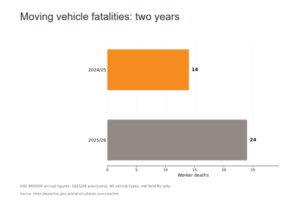
8. Equipment Defects and Inadequate Maintenance
A poorly maintained forklift may be hard to control, unreliable or unsafe.
Brake and steering defects
Faulty brakes can stop a truck from stopping safely, while steering faults make manoeuvring unpredictable.
Operators should report changes in braking, steering response or unusual noises. Defects that affect safety mean the equipment must be removed from service until repaired correctly.
Damaged tyres and wheels
Worn or damaged tyres reduce traction, stability and braking, especially on wet or uneven surfaces.
Inspect tyres and wheels as the manufacturer recommends, and choose a tyre type suited to the working environment.
Hydraulic and mast defects
Leaks, damaged hoses and faulty hydraulic controls can put lifting operations at risk.
Forks, mast chains and attachments also need proper inspection and maintenance.
Operators should not carry out repairs beyond their ability, or keep using equipment when a defect could affect safety.
Faulty safety systems
Lights, horns, reversing alarms, cameras and restraints help keep operations safe.
Include these systems in pre-use checks and report defects promptly.
Effective maintenance procedures
Operators should carry out pre-use inspections following workplace procedures and manufacturer instructions.
Businesses should record defects, repairs and planned maintenance, and fix identified problems promptly.
9. Unsafe Loading and Unloading Procedures
Loading and unloading involve heavy goods, moving vehicles and lifting equipment. Poorly managed operations can expose workers to crushing, falling loads and vehicle movement hazards.
Unexpected vehicle movement
A forklift may operate inside a trailer while the delivery vehicle is parked at a loading bay.
If the vehicle shifts unexpectedly, the forklift could fall off the dock or get trapped.
Businesses should set up procedures to secure vehicles during loading and unloading, using parking brakes, wheel restraints or other suitable controls.
Unstable trailers and dock equipment
Uneven ground, poor dock layouts and faulty levellers can cause gaps and level differences.
Loading areas should suit the vehicles and equipment in use, and work should stop if conditions turn unsafe.
Incorrect load distribution
Unevenly distributed goods can affect the stability of a load or vehicle.
Operators should follow the loading plan and keep weight distributed correctly.
Working near dock edges
Forklifts near dock edges risk driving off the platform or into a gap.
Suitable edge protection, good lighting, maintained dock equipment and clear procedures help cut this risk.
Preventing loading accidents
Businesses should assess loading operations, define responsibilities and set up clear communication procedures.
Loading zones should offer enough space, suitable surfaces and controlled pedestrian access.
10. Fatigue, Distraction and Time Pressure
Forklift operators must stay alert, since hazards can arise quickly. Fatigue, distraction and production pressure can lower concentration and raise the chance of errors.
Fatigue
Long shifts, too little rest and repetitive work can increase tiredness.
Employers must account for workload, shift patterns, breaks and staffing levels. Operators should report fatigue when it endangers safe work.
Mobile phones and distractions
Using a handheld device while driving a forklift can distract from pedestrians, vehicle movement and load stability.
Businesses should ban handheld device use while driving. Operators should stop in a safe place before communicating, per site procedures.
Pressure to work faster
Unrealistic targets can push operators to speed, skip inspections or bypass safety procedures.
Such shortcuts may cause injuries, damaged stock and costly disruption.
Managers should set performance expectations that allow enough time for safe work.
Building a positive safety culture
Employees should be encouraged to report hazards and near misses without fear of unfair treatment.
Managers should investigate why unsafe practices occur and address underlying workload, equipment or workplace layout issues.
11. Using the Wrong Forklift for the Job
Unsuitable equipment creates hazards that careful driving alone cannot remove.
Indoor and outdoor suitability
Warehouse trucks may suit smooth floors, while outdoor yards need equipment built for uneven ground and changing weather.
Businesses should weigh tyre type, ground clearance, traction and stability when choosing equipment.
Capacity and lifting height
Forklifts vary in rated capacity and lift height. Safe capacity can shift when lifting higher or using attachments.
Operators should check the capacity plate and manufacturer documents before moving loads.
Attachments and modifications
Attachments may alter a forklift’s effective capacity and handling.
Businesses should confirm attachments fit the equipment and that capacity details are available.
Unauthorised modifications should not be used.
Choosing the right equipment
When selecting equipment, weigh load weights, aisle dimensions, lifting heights, operating hours and surface conditions.
Choose the forklift for the actual job, not just because one is available.
12. Environmental Hazards and Communication Failures
Workplace conditions and communication can cause accidents even when equipment works correctly.
Slippery and uneven surfaces
Oil, grease, water and other contaminants reduce traction. Potholes and uneven floors can make loads unstable.
Report spills and clean them using proper procedures, and repair damaged surfaces promptly.
Weather conditions
Rain, ice, snow and strong winds can affect outdoor operations.
Businesses should adapt working practices to conditions and limit access to areas unsafe for the equipment in use.
Housekeeping
Loose packaging, strapping and damaged pallets can block vehicle routes.
Regular housekeeping should keep walkways, intersections and loading areas clear.
Communication with pedestrians
Pedestrians should never assume an operator has seen them.
Workers should follow site procedures before approaching a forklift, especially near forks or suspended loads.
Operators should stop and secure the truck as needed before dealing with pedestrians.
Communication during lifting operations
When a task needs a banksman or other assisting worker, signals and duties must be clear.
If communication breaks down or instructions are unclear, work should stop until it is safe to resume.
13. Poor Risk Assessments and Safety Procedures
Many accidents stem from weaknesses in the systems used to plan and control work.
Generic risk assessments
A generic assessment may miss hazards specific to a warehouse, such as a blind corner or a pedestrian crossing next to a loading bay.
Assessments should reflect real working conditions, including occasional tasks, contractors and changing storage arrangements.
Failure to review changes
New racking, extra vehicles, workforce changes and revised procedures can create new hazards.
Businesses should review risk assessments when significant changes occur or incidents reveal previously unrecognised risks.
Learning from accidents and near misses
Investigations should establish what happened, identify contributing factors and determine whether different equipment, procedures or supervision could have prevented the incident.
Corrective actions should be assigned to responsible individuals and tracked to completion.
The aim is to prevent recurrence, not simply to document the event.
14. UK Forklift Safety Legislation
Forklift safety is covered by several UK health and safety requirements. Employers must assess risks, provide suitable equipment and apply effective controls to protect employees and others affected by their activities.
Health and Safety at Work etc. Act 1974
This law sets out general duties for employers to protect employees and others affected by their activities, as far as reasonably practicable.
In forklift operations, this means safe working arrangements, suitable information and training, and effective risk management.
Provision and Use of Work Equipment Regulations 1998 (PUWER)
PUWER covers equipment suitability, maintenance, inspection, safe use and suitable training.
Forklifts must suit their intended purpose and be kept in a safe condition. Employers must ensure equipment is operated only by people with the necessary competence.
Lifting Operations and Lifting Equipment Regulations 1998 (LOLER)
LOLER applies to lifting equipment and lifting operations within its scope.
It covers planning lifting operations, suitable supervision and thorough examination of relevant equipment.
The exact requirements depend on the equipment and circumstances. Pre-use checks and LOLER thorough examinations are separate activities and should not be treated as interchangeable.
Further official guidance
Businesses should check current HSE guidance so their safety arrangements reflect applicable requirements:
- HSE workplace transport guidance
- HSE lift truck management guidance
- HSE overturning guidance
- HSE workplace transport safety guide, HSG136
15. Practical Strategies for Preventing Forklift Accidents
Avoiding forklift accidents calls for coordinated efforts in training, equipment management, workplace design and supervision.
Create a comprehensive safety policy
A written policy should specify who may operate forklifts, allowed routes, required inspections and how hazards are reported.
It should also address pedestrian access, speed limits, loading procedures and emergency arrangements.
Carry out site-specific risk assessments
Assessments should review how goods and people move across the workplace.
They should pinpoint high-risk areas such as blind corners, loading bays, pedestrian crossings and congested aisles, and set suitable controls.
Keep pedestrians and vehicles apart
Where feasible, use barriers, dedicated walkways and controlled crossings to lower collision risk.
If full separation is not feasible, extra measures should match the specific risks.
Maintain operator competence
Employers should confirm operator competence, provide suitable training and ensure effective supervision.
Training should cover equipment operation, load handling, traffic rules and site-specific hazards.
Set up reliable maintenance systems
Daily checks, planned maintenance and defect reporting should be part of routine operations.
The system should state who performs checks, how faults are reported and who clears equipment to return to service after repairs.
Improve load handling
Operators should confirm load weight, stability and suitability before lifting.
Warehouse managers should maintain storage systems, set safe stacking procedures and ensure suitable attachments are available when needed.
Control vehicle movements
Sensible speed limits, less reversing and clear loading procedures lower the risk of accidents.
Supervisors should monitor compliance and deal with unsafe practices consistently.
Encourage continuous improvement
Employees need a simple way to report defects, hazards and near misses.
Reports should be investigated quickly, with corrective actions tracked to completion.
16. Measuring Forklift Safety Performance
Businesses should not judge safety only by counting recorded accidents. Near misses, equipment defects and unsafe conditions can expose risks before a serious incident.
Accident and near-miss records
Businesses should record collisions, falling loads, overturns, equipment damage and near misses involving pedestrians.
Records can expose recurring problems linked to particular routes, shifts or equipment types.
Inspection and maintenance compliance
Managers should monitor completion of pre-use checks, timely defect reporting and scheduled maintenance.
Recurring faults may show that equipment or maintenance arrangements need improvement.
Training and competence
Training records should identify authorised operators, the equipment they may use and any extra instruction needed.
Managers should review competence when equipment or tasks change.
Workplace observations
Routine observations can reveal unsafe practices such as speeding, obstructed routes and improper load handling.
Findings should result in constructive feedback and corrective measures.
Performance review
Management should regularly review safety performance to check whether controls work and whether more improvements are needed.
Fewer reported incidents do not by themselves mean a safer workplace, so reporting quality and proactive indicators should also be weighed.
17. Forklift Safety Checklist for Businesses
This checklist can help employers review their arrangements. It should be tailored to the workplace risk assessment and the equipment in use.
Operator competence
- Confirm operators are trained and authorised.
- Give workplace-specific instruction.
- Review competence when equipment or tasks change.
- Ensure supervisors know their responsibilities.
Workplace layout
- Separate pedestrian and forklift routes where practicable.
- Keep aisles and turning areas clear.
- Mark crossing points and restricted zones.
- Improve lighting and visibility at intersections.
- Keep loading bays free of unnecessary personnel.
Forklift condition
- Carry out all pre-use checks.
- Examine the tyres, forks, mast parts, and hydraulics.
- Test brakes, steering, lights, and warning systems.
- Report faults and take unsafe equipment out of service.
- Keep proper maintenance records.
Load handling
- Verify load weight and stability.
- Check the rated capacity and related capacity data.
- Look for damage to pallets and packaging.
- Place forks correctly under loads.
- Use the right attachments for specialist materials.
Operational controls
- Apply suitable speed limits.
- Cut down on needless reversing.
- Set up safe loading procedures.
- Use banksmen when needed.
- Halt operations if conditions turn unsafe.
Safety management
- Update risk assessments after major changes.
- Look into accidents and near misses.
- Track corrective actions until they are finished.
- Monitor training and maintenance records.
- Encourage staff to report hazards.
18. Recommendations for Acclaim Handling and Its Customers
For companies using forklift trucks, safety should be a continuous operational priority, not a one-time compliance task.
Match equipment to the application
Before choosing or replacing forklifts, businesses should assess load weights, lifting heights, aisle dimensions, surface conditions and operating hours.
The right equipment can boost handling efficiency while helping operators stay within the machine’s intended capabilities.
Review the complete material-handling process
Forklift safety is shaped by warehouse layout, racking, pedestrian movements, loading arrangements and storage practices.
A full process review can reveal ways to cut vehicle movements, reduce reversing and improve separation between people and equipment.
Support maintenance and inspections
Customers should set up clear processes for pre-use checks, planned maintenance, defect reporting and applicable thorough examinations.
Maintenance records should be reviewed to spot recurring faults and improve equipment reliability.
Promote operator competence
Businesses should provide suitable training, supervision and equipment-specific familiarisation.
Regular reviews can reveal further training needs before unsafe practices take hold.
Encourage continuous improvement
Safety reviews should consider accident records, near misses, equipment defects and operator feedback.
Being proactive lets organisations tackle hazards before they cause injuries or expensive disruption.
Communicate shared responsibilities
Forklift safety is shaped by employers, supervisors, operators and pedestrians alike.
Employers must set up safe systems of work and supply suitable equipment, while employees should follow procedures and report hazards.
Clear expectations and good communication help embed safe behaviour in daily operations.
19. Conclusion
Forklift accidents stay a major concern for warehouses, manufacturing plants, distribution centres and other sites relying on industrial lifting equipment.
The effects can be serious, from damaged goods and delays to life-changing injuries and deaths.
This study reviewed the main causes of forklift accidents, such as inadequate training, pedestrian collisions, vehicle overturns, unstable loads, excessive speed, restricted visibility, mechanical defects and unsafe loading procedures. It also pointed to organisational factors like weak supervision, unrealistic productivity targets and poor risk assessments.
The key finding is that forklift accidents should not be seen simply as individual mistakes. They often stem from a mix of operational decisions, equipment limits and weaknesses in the systems meant to control risk.
Preventing them takes a coordinated approach. Employers must supply suitable equipment, assess workplace hazards and set safe traffic routes. Supervisors must monitor working practices, while operators must follow procedures, inspect equipment and report unsafe conditions.
Regular maintenance, sound load-handling procedures, appropriate speed limits and separation of vehicles from pedestrians are essential to a comprehensive safety strategy.
Businesses should also learn from near misses and review their arrangements whenever operations change.
For Acclaim Handling and the businesses it supports, better equipment selection, stronger safety management and continuous improvement can help build safer, more productive workplaces.
References and Further Reading
Rider-operated lift trucks (2013) HSE. Available at: https://www.hse.gov.uk/pubns/books/l117.htm (Accessed: 12 October 2026).
Workplace Health, Safety and Welfare. workplace (health, safety and welfare) regulations 1992. Approved Code of Practice and Guidance (1992) HSE. Available at: https://www.hse.gov.uk/pubns/books/l24.htm (Accessed: 12 October 2026).
Overturning (no date) HSE. Available at: https://www.hse.gov.uk/workplacetransport/information/overturns.htm (Accessed: 12 October 2026).
Safe driving: Loading & Unloading (no date) HSE. Available at: https://www.hse.gov.uk/workplacetransport/factsheets/loading.htm (Accessed: 12 October 2026).
Health and safety guidance (HSG) publications (2014) HSE. Available at: https://www.hse.gov.uk/pubns/books/index-hsg-ref.htm (Accessed: 12 October 2026).
Work-related fatal injuries in Great Britain – HSE (2025) Hse.gov.uk. Available at: https://www.hse.gov.uk/statistics/fatals-overview.htm?v=home (Accessed: October 15, 2026).
Kind of accident statistics in Great Britain, 2023. (2023). [online] Available at: https://www.hse.gov.uk/statistics/assets/docs/kinds-of-accident.pdf [Accessed 15 Oct. 2026].
Hse.gov.uk. (2025). Protecting workers from workplace transport: Getting the basics right – HSE media centre. [online] Available at: https://press.hse.gov.uk/2025/10/23/protecting-workers-from-workplace-transport-getting-the-basics-right/ [Accessed 15 Oct. 2026].
Hse.gov.uk. (2023). Non-fatal injuries at work in Great Britain – HSE. [online] Available at: https://www.hse.gov.uk/statistics/causinj/overview.htm [Accessed 15 Oct. 2026].
Health and Safety Executive (HSE) (2025) Kind of accident statistics in Great Britain, 2025. Available at: https://www.hse.gov.uk/statistics/assets/docs/kinds-of-accident.pdf (Accessed: 15 October 2026).
Health and Safety Executive (HSE) (2026) Work-related fatal injuries in Great Britain. Available at: https://www.hse.gov.uk/statistics/fatals-overview.htm (Accessed: 15 October 2026).