On this page
- What is a reach truck?
- Is a reach truck a forklift?
- What is a counterbalance forklift?
- What is actually on Acclaim’s reach truck list
- Are reach trucks always electric?
- Where each machine wins
- Aisle width, floor and racking: check before you buy
- Thorough examination applies to both
- Operator training is machine-specific
- Costs: buying, hiring and financing
- Choosing between them: a short checklist
- Talk to us
- Reach truck FAQs
- Eight depots across the UK
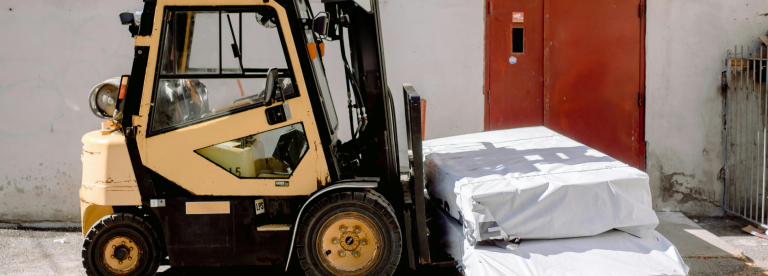
A counterbalance forklift drives up to a load and lifts it, balanced by weight at the back of the truck. A reach truck sits on two stabilising legs and pushes its mast forward to place a pallet into racking.
The forklift is the general-purpose machine; the reach truck is the narrow-aisle specialist. Sites that run both normally use the forklift outside and on the loading bay, and the reach truck inside the racking.
In stock now: Reach trucks · Enquire
- What is a reach truck?
- Is a reach truck a forklift?
- What is a counterbalance forklift?
- What is actually on Acclaim’s reach truck list
- Are reach trucks always electric?
- Where each machine wins
- Aisle width, floor and racking: check before you buy
- Thorough examination applies to both
- Operator training is machine-specific
- Costs: buying, hiring and financing
- Choosing between them: a short checklist
- Talk to us
What is a reach truck?
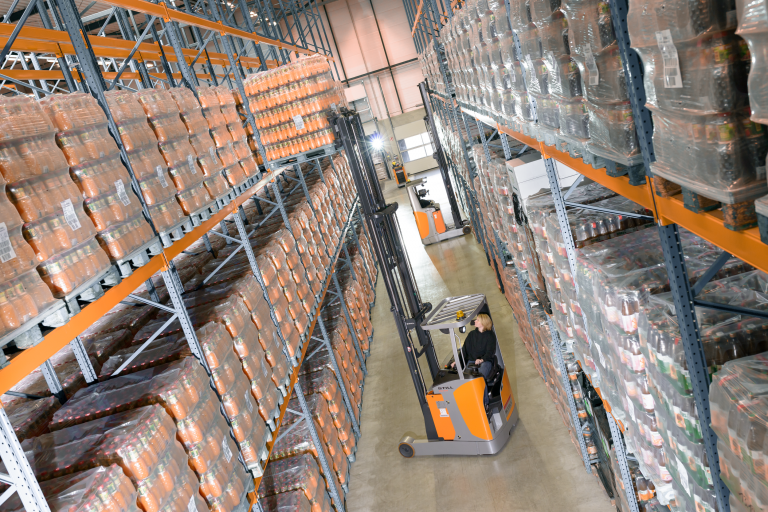
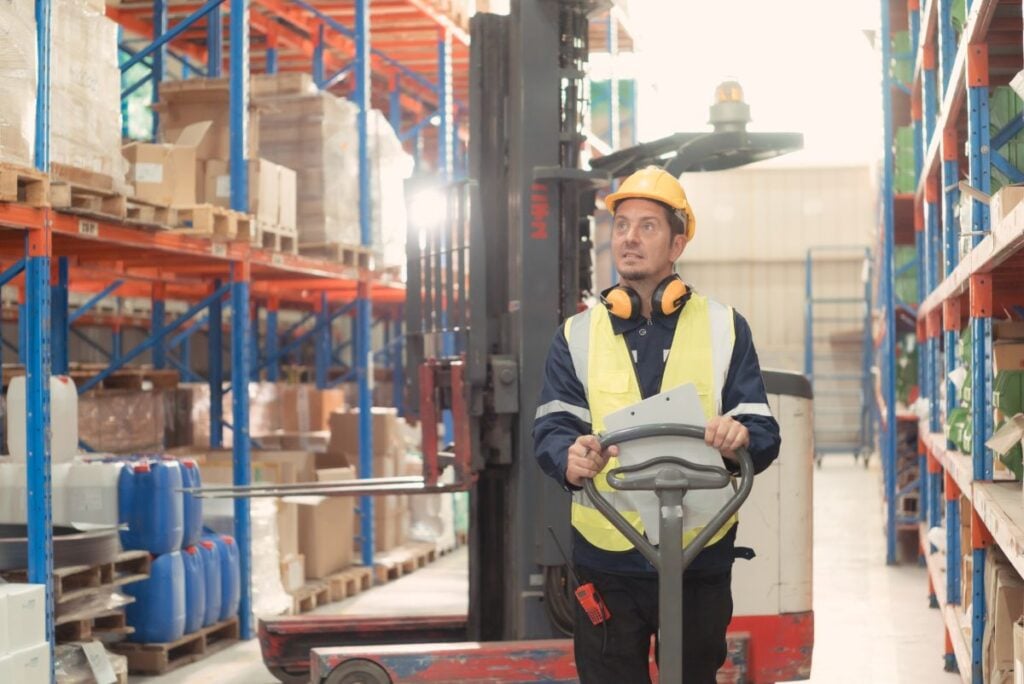
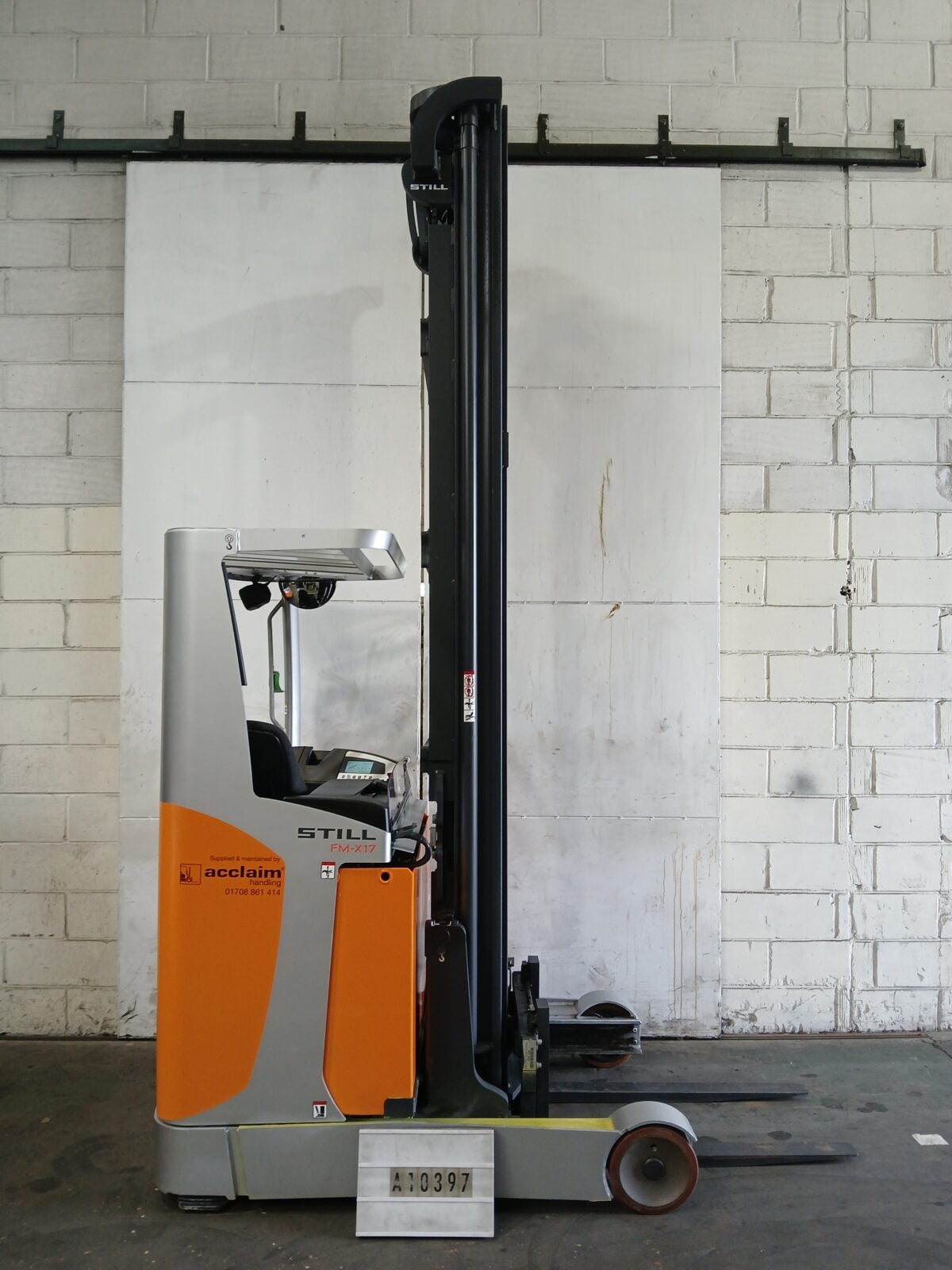
A reach truck is an electric warehouse truck built to put pallets into and take them out of racking in a narrow aisle. Instead of carrying the load out in front on a counterweighted chassis, it carries the load between two stabilising legs that run forward under the bottom beam of the racking. When the operator needs to place a pallet, the mast travels forward, over the legs and into the rack; once the pallet is placed, the mast retracts back over the wheelbase.
Because the load sits between the legs when the truck is travelling, the truck does not need a heavy rear counterweight to stay stable. That is what lets it be shorter and narrower than a counterbalance forklift of the same capacity, and work in an aisle a forklift cannot use.
Most reach trucks put the operator in a stand-in or side-seated cab rather than a forward-facing seat. It keeps the body of the truck short, and it lets the operator look along the forks and up the mast without twisting round.
Is a reach truck a forklift?
Yes. A reach truck forklift is one type of forklift truck, in the same way a side loader or an articulated truck is.
In everyday trade use, though, “forklift” on its own usually means a counterbalance truck, and “reach truck” means the narrow-aisle machine described above. When you are speccing equipment, or booking operator training, be explicit about which you mean: they are separate machine categories and they are treated separately for training.
What is a counterbalance forklift?
A counterbalance forklift carries the load on forks at the front and balances it with weight built into the rear of the truck. There are no legs and no outriggers, so it can drive straight up to a load, a pallet on the floor, or the tail of a lorry. Counterbalance trucks are available electric, diesel and LP gas, so they can work outdoors, on yard surfaces, in and out of trailers, and across a wider capacity range than a reach truck.
What is actually on Acclaim’s reach truck list
Here is what is on the reach truck list as this is written. Stock changes, so check the live page for current numbers.
- 34 reach trucks listed, across STILL, Hyundai, Atlet and Linde.
- Capacity. The model ranges span 1,000 kg to 2,500 kg. The individual machines listed sit at 1,400 kg, 1,600 kg, 1,700 kg and 2,000 kg.
- Lift height. Individual listed machines run from 5,180 mm up to 10,700 mm. Most sit between 6,200 mm and 9,050 mm.
- Mast. Every listing that states a mast type states triple.
- Named ranges. STILL FM-X, STILL FM-4W, Hyundai BRJ-9.
Acclaim is the exclusive dealer and distributor for STILL, Hyundai and Lonking, so on the reach truck side you are dealing with the dealer for two of the four makes listed, not a broker.
Are reach trucks always electric?
Every reach truck on our list is electric. They are built for indoor racking work, and an engine exhausting into a closed warehouse aisle is a problem you do not want.
That has a cost consequence. A reach truck fleet needs charging space, charging infrastructure and a battery plan. Acclaim supplies and regenerates batteries as a separate service, which is worth factoring in when you compare an electric reach truck against a diesel counterbalance.
Where each machine wins
A counterbalance forklift is the right machine when you need to: – unload lorries and containers from a yard or bay – work outdoors, on tarmac, block paving or rough ground – lift more than the 2,500 kg top of the reach truck range – move loads between buildings – run one truck across a mix of tasks
A reach truck is the right machine when you need to: – work aisles too narrow for a counterbalance truck to turn in – place pallets above the height a counterbalance mast can reach – run high-frequency put-away and retrieval from racking all shift – keep the working footprint of the truck as small as possible – operate indoors with no exhaust emissions
A reach truck is the wrong machine when: the floor is not flat enough, the work is outdoors, loads regularly exceed the capacity range above, or the truck has to leave the building. Reach trucks run on small solid wheels sized for a smooth warehouse slab.
Aisle width, floor and racking: check before you buy
The number to design around is the working aisle width, not the width on the warehouse drawing. Subtract rack overhang, pallet overhang, and the clearance the truck actually needs to complete a loading cycle.
- Floor flatness. Mast deflection at height is a function of the floor, so the slab limits the height you can usefully work at.
- Residual capacity at height. A truck’s rated capacity is not its capacity at full lift. Ask for the load chart, find your maximum working height on it, and check the figure against your heaviest real pallet, not your average one.
Acclaim offers a free site visit. Measuring the aisle, looking at the racking and watching a cycle in person is the reliable way to settle all three.
Thorough examination applies to both
A reach truck and a counterbalance forklift are both lifting equipment under LOLER. Both need a thorough examination by a competent person.
Regulation 9(3) of the Lifting Operations and Lifting Equipment Regulations 1998 provides:
“Subject to paragraph (6), every employer shall ensure that lifting equipment which is exposed to conditions causing deterioration which is liable to result in dangerous situations is: (a) thoroughly examined: (i) in the case of lifting equipment for lifting persons or an accessory for lifting, at least every 6 months; (ii) in the case of other lifting equipment, at least every 12 months; or (iii) in either case, in accordance with an examination scheme; and (iv) each time that exceptional circumstances which are liable to jeopardise the safety of the lifting equipment have occurred; and (b) if appropriate for the purpose, is inspected by a competent person at suitable intervals between thorough examinations, to ensure that health and safety conditions are maintained and that any deterioration can be detected and remedied in good time.”
Regulation 9(4) provides:
“Every employer shall ensure that no lifting equipment: (a) leaves his undertaking; or (b) if obtained from the undertaking of another person, is used in his undertaking, unless it is accompanied by physical evidence that the last thorough examination required to be carried out under this regulation has been carried out.”
Regulation 9(4) is the one that catches people out when buying used. Acclaim supplies used machines with a current thorough examination as standard, always.
Acclaim is CFTS accredited, and that accreditation is current. In practice it means one thorough examination covering the LOLER lifting duties and the PUWER duties together, with one report, rather than a lifting inspection that leaves the braking, steering and mast items to be picked up separately.
We examine machines we did not supply, we examine MEWPs and access equipment, and we examine lifting accessories such as slings, chains, forks and attachments. Thorough examinations start from £135 ex VAT.
Operator training is machine-specific
Reach truck operation is a different skill from counterbalance operation: the mast traverse, the stabilising legs, the stand-in cab position and the working height all change how the machine behaves. We run reach truck training as its own course, alongside counterbalance, very narrow aisle, multi-directional sideloader and pivot steer courses. Training is RTITB accredited, delivered by nine in-house instructors, from £360 ex VAT.
Costs: buying, hiring and financing
Hire. Reach truck hire starts from £100 per week ex VAT. There is no minimum hire period.
A machine can go out for a day, but the minimum charge is one week at the weekly rate. If a hired machine does not work you get your money back, we will send an engineer to fix it, and we will put a prop-up machine in if we judge it necessary.
That applies to every machine type we hire, not just forklifts. Hire is also the cheapest way to test a specification before you commit capital.
Buying used. Acclaim is the biggest independent supplier of used forklift trucks and materials handling equipment in the UK, and the vast majority of our used machines come off our own hire fleet, machines we have maintained ourselves. Every used machine is thoroughly inspected against our standards before it is signed off to a customer, and refurbishment is available if you want the machine brought up further.
Buying new. New to order is one of the stock options on the reach truck list.
Finance. Lease purchase, contract hire, operating lease and outright purchase are all available, on new and used machines alike. All prices quoted are ex VAT.
Running costs. Equipment servicing starts from £90 ex VAT. Comprehensive and planned maintenance contracts are both available. Budget for the thorough examination, the servicing and the battery, not just the purchase price.
Choosing between them: a short checklist
- Measure the true working aisle width, not the drawing.
- Work out your maximum lift height and your heaviest pallet at that height.
- Decide whether the truck ever needs to go outside. If yes, it is a counterbalance job.
- Check the floor. Flatness limits height.
- Count the cycles. High put-away volume justifies a dedicated reach truck; occasional racking work may not.
- Budget for charging, batteries, servicing, thorough examination and operator training, not just the machine.
- Hire before you buy if any of the above is uncertain.
Talk to us
Acclaim Handling has supplied and serviced materials handling equipment since 1982, from eight depots covering the South East, East Anglia, the East, the Midlands, the West, the South, the South Coast and Liverpool and the North. We deliver nationwide; transport is charged according to where the machine is going. Success built on quality service.
If you want a straight answer on whether your operation needs a reach truck, a counterbalance forklift or both, book a free site visit or call 01708 861 414.
Give us your racking height, your aisle width and your heaviest pallet.
Reach truck FAQs
Eight depots across the UK
Our own engineers, out of our own depots - wherever you are, service comes from us.