On this page
- Executive Summary
- What counts as maintenance cost?
- The UK maintenance environment in 2026
- Planned servicing: hours, frequency and cost drivers
- The cost of missed maintenance
- Downtime: the hidden maintenance bill
- Compliance: PUWER, LOLER and thorough examination
- What a planned forklift service cover
- Repair economics and first-visit performance
- Tyres, mast, forks and wear components
- Batteries and electric forklift maintenance
- Diesel and LPG maintenance exposure
- Maintenance contracts, hire and full-service models
- Benchmark scenarios by utilisation
- Used forklifts: maintenance reserve and due diligence
- Fleet management and maintenance KPIs
- Summary 2026 maintenance decision framework
- Sources and reference bibliography
Executive Summary
In the UK, forklift maintenance costs are better viewed as a lifecycle expense rather than as a one-off invoice. The evidence examined for this report does not back a national average figure such as “£X per truck per year”. Rather, primary sources indicate that maintenance spending is shaped by hours, duty cycle, powertrain, environment, wear items, statutory examination, and how quickly defects are identified and rectified.
Acclaim Handling currently advises that most forklifts be serviced every 250–500 operating hours, with the interval determined by the machine and the manufacturer’s schedule. At 2,000 hours per year, that means approximately four services at a 500-hour interval, or eight at a 250-hour interval. The same source notes that planned service can catch a problem when it is still a £40 part, rather than after it has become a £900 repair. That represents a 22.5× escalation between the two cited examples-not an average repair ratio, but a helpful primary-source illustration of why preventive maintenance carries economic value.
The legal baseline is distinct from routine servicing. HSE states that forklift trucks should be maintained under PUWER, and that the lifting elements covered by LOLER require thorough examination, normally every 12 months for goods lifting equipment. A thorough examination is not the same as a service. This distinction is important when comparing maintenance contracts, since a low quoted service price may exclude statutory examination, emergency repair, tyres, batteries, or other wear items.
The operational case is also significant. HSE says lift trucks are involved in roughly a quarter of workplace transport accidents. Acclaim reports that 92% of its breakdown repairs are resolved on the first visit, supported by 70+ mobile engineers and more than £1 million of forklift parts kept in UK stock. These are supplier performance statistics rather than national industry averages, yet they show the commercial value placed on first-time repair and parts availability.
For 2026, the practical benchmark is therefore a cost stack: planned service frequency + statutory examination + predictable wear + repair exposure + downtime + energy-related maintenance + fleet-management overhead. The right budget depends on utilisation. A truck used 200 hours per year and one used 2,000 hours per year should not receive the same maintenance allowance.
| 2026 BENCHMARK CONCLUSION Budget maintenance from operating hours upward. Use 250–500 hours as the Acclaim service-planning guide, then add statutory examination, wear components, batteries/tyres where applicable, repair contingency and the financial cost of downtime. |
What counts as maintenance cost?
A practical maintenance benchmark for the UK starts by determining what the denominator should be. The phrase “Maintenance cost” can mean an invoice for a scheduled service, the entire repair-and-maintenance contract, all parts and labour charges, or the wider expense of keeping the truck productive. These measures vary considerably and should not be merged.
| Cost layer | What it includes | Benchmark treatment |
| Planned servicing | Oils, filters, lubrication, diagnostics, checks and adjustments | Recurring cost linked to hours and manufacturer schedule |
| Statutory examination | Thorough examination of lifting equipment and safety-critical items | Separate compliance cost; not a substitute for service |
| Wear items | Tyres, forks, chains, rollers, brakes and similar components | Variable; rises with hours, load and environment |
| Corrective repair | Fault diagnosis, parts, labour and travel/callout | Variable; often the largest volatility |
| Battery / charging | Battery testing, regeneration/replacement, charger issues | Material for electric fleets; condition dependent |
| Downtime | Lost production, delayed deliveries, overtime, emergency hire | Indirect but commercially real |
| Fleet administration | Scheduling, records, inspections, supplier management | Often overlooked in per-truck budgets |
Acclaim’s service description clearly covers engine oil and filters for diesel/LPG machines, along with motor and controller checks for electric trucks, hydraulic systems, mast channels, rollers, chains, forks, brakes, steering, tyres, wheels, batteries/charging, lights, warning devices and diagnostics. This offers a practical definition of what a planned service visit may include.
Hyster’s maintenance offering in the UK reinforces the same distinction. Its regular maintenance contracts are built around manufacturer service schedules and may cover inspections, oil changes, lubrication, checks and adjustments. Its preventive maintenance contracts may cover parts, labour and technician services, while full-service arrangements can combine maintenance and repairs with a monthly technical fee. This means the quoted “maintenance price” depends heavily on the scope of work.
| BENCHMARK RULE Always state whether a benchmark is service-only, repair-and-maintenance, or total uptime cost. Otherwise, two apparently comparable £/truck figures can measure completely different things. |
The UK maintenance environment in 2026
The maintenance sector forms part of a vast logistics and industrial economy where safety is critical. According to HSE’s 2024/25 statistics for Great Britain, 124 workers died in work-related accidents, 680,000 workers reported a non-fatal injury through the Labour Force Survey, 59,219 employee non-fatal injuries were reported under RIDDOR, and 4.4 million working days were lost because of workplace non-fatal injuries. While these figures cover the whole economy rather than forklift-specific totals, they illustrate the scale of the workplace-risk environment in which industrial trucks are used.
Independent HSE guidance adds an operational control point: employers should ensure vehicles are suitable for their purpose, maintained in good repair, and checked by drivers at the start of each shift. This supports budgeting for operator checks and defect reporting as well as engineer visits; it does not provide a national £/truck maintenance price. [16, 17]
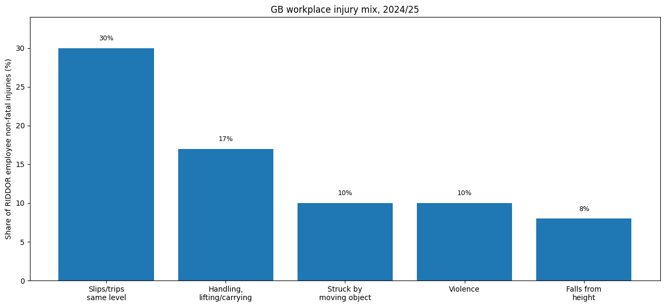 Among employee non-fatal injuries reported under RIDDOR, handling, lifting or carrying made up 17% in 2024/25, while being struck by a moving object accounted for 10%. HSE notes separately that roughly one in four workplace transport accidents involve lift trucks. For maintenance budgeting, the point is not that a specific share of maintenance spending stops accidents; the primary sources do not demonstrate that. Instead, maintenance forms one element of a wider control system encompassing equipment selection, operator training, supervision, inspections and safe systems of work.
The most recent HSE transport-and-storage figures also record 15 worker fatalities in that industry in 2024/25, against a five-year average of 13, with 27% of deaths during that period classified as struck by a moving object, including flying or falling objects. Once more, these numbers are not limited to forklifts, yet they remain pertinent to warehouses, logistics sites and distribution operations, where forklifts are widely used.
| INTERPRETATION The evidence supports a safety-led maintenance case, not a claim that maintenance alone explains or prevents a fixed share of incidents. |
Planned servicing: hours, frequency and cost drivers
Acclaim’s current UK service guidance says most forklifts should be serviced every 250–500 operating hours, with the interval determined by the machine and manufacturer’s schedule. It explicitly argues for servicing by hours rather than months because a 2,000-hour truck and a 200-hour truck do not have the same maintenance requirement.
| Annual hours | Services at 500 h | Services at 250 h | Planning implication |
| 200 | 0.4 | 0.8 | Very low utilisation; calendar/compliance still matters |
| 500 | 1.0 | 2.0 | At least one planned service at the 500 h guide |
| 1,000 | 2.0 | 4.0 | Moderate utilisation; service cadence becomes material |
| 1,500 | 3.0 | 6.0 | High utilisation; wear exposure rises |
| 2,000 | 4.0 | 8.0 | Intensive use; planned maintenance is a major budget line |
| 2,500 | 5.0 | 10.0 | Frequent intervention; scheduling efficiency matters |
| 3,000 | 6.0 | 12.0 | Very high utilisation; strong case for fleet controls |
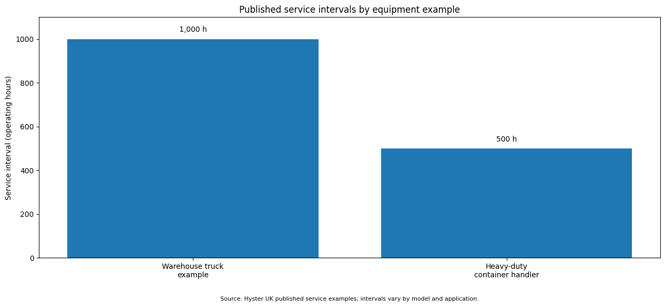
The figures presented above are mechanical conversions from the 250–500-hour guide, not a forecast of what any single truck will cost. The manufacturer’s real schedule can differ, and harsh environments might require shorter intervals. Published Hyster material also shows that service intervals vary by model: one current warehouse truck example lists a 1,000-hour service interval, while a heavy-duty container-handler example lists 500 hours.
When you budget, hours serve as the main multiplier. The other multipliers are power source, operating environment, attachment, shift pattern, tyre type, battery technology and age. The maintenance reserve should therefore rest on the truck’s actual duty cycle rather than a flat allowance applied across the entire fleet.
HSE’s general maintenance guidance similarly says planned maintenance should be regular and frequent enough to meet the manufacturer’s instructions and the realities of use. It specifically highlights brakes, steering, tyres, warning devices, hydraulic systems and lifting systems-reinforcing the need to set intervals from the machine handbook and site conditions, rather than treating 250–500 hours as a universal rule. [17]
The cost of missed maintenance
The most unambiguous primary-source indication of cost identified in the research stems from Acclaim’s maintenance guidance. It offers a practical illustration: scheduled service can spot wear while it is still a £40 part, rather than once the issue has escalated into a £900 repair, a halted shift, or an incident.
The arithmetic is simple: £900 split by £40 equals 22.5. This is not meant to suggest that preventive maintenance routinely yields savings of 22.5 times what it costs. It shows the sort of escalation that can occur when a relatively small component issue is allowed to develop into a larger repair. The benchmark figure is therefore only indicative: maintenance offers an opportunity to intervene before a defect turns into a major failure.
| Stage | Primary-source figure | Interpretation |
| Early intervention | £40 example | Small wear item detected during planned maintenance |
| Escalated repair | £900 example | Larger repair after early warning is missed |
| Difference | £860 | Incremental cost illustrated by Acclaim |
| Escalation multiple | 22.5× | £900 ÷ £40; illustrative, not an industry average |
The same source notes that a truck breakdown can lead to costs beyond the repair itself: idled loading docks or production, emergency service calls, surcharges for parts availability, substitute rentals, late deliveries, and overtime. A basic report on maintenance spending might well overlook precisely these kinds of costs.
A practical cross-check is to record defect discovery, work-order approval, parts arrival, repair completion and return-to-service times separately. HSE guidance stresses that maintenance must be properly planned and carried out safely; these timestamps help distinguish supplier repair time from internal approval or parts delays when reviewing downtime. [17]
| BUDGETING IMPLICATION A maintenance budget should track both planned spend and avoided escalation. If a fleet manager reports only service invoices, the financial effect of preventing larger repairs and downtime remains invisible. |
Downtime: the hidden maintenance bill
Downtime is the element that can increase the cost of a fleet that requires little maintenance. A forklift may have a reasonable annual service cost, but if a breakdown stops the only truck feeding a production line, the financial damage can quickly exceed the repair bill. Acclaim explicitly identifies halted work, emergency callouts, parts surcharges, substitute hire, and the knock-on effects on operations as components of what a breakdown really costs.
| Downtime cost component | What to quantify | Why it matters |
| Lost production | Units/orders not processed per hour | Direct contribution loss |
| Delayed despatch | Loads or vehicles waiting | Customer-service and scheduling impact |
| Extra labour | Overtime, redeployment, supervision | Cost of recovery |
| Emergency hire | Temporary forklift or MHE | Immediate continuity cost |
| Emergency repair | Callout/travel and urgent parts | Often higher than planned work |
| Management time | Escalation, supplier coordination, rescheduling | Hidden internal cost |
A straightforward downtime benchmark can be calculated internally as: lost contribution per hour + incremental labour + emergency hire + delivery/penalty exposure + management time. The resulting £/hour should then be multiplied by realistic downtime scenarios, rather than an annual allowance.
This is also why the 92% first-visit breakdown repair rate reported by Acclaim is commercially relevant. If 92 out of every 100 breakdown repairs are completed on the first visit, fewer jobs require a second attendance under the supplier’s reported performance measure. The remaining 8% is not necessarily free of downtime, and the statistics reflect Acclaim’s own operational performance rather than a UK industry average.
| DECISION RULE If one hour of downtime costs £500, a £2,000 difference in annual maintenance spend can be justified by preventing only four hours of downtime. Replace the £500 assumption with the site’s actual figure. |
Compliance: PUWER, LOLER and thorough examination
Maintenance and statutory examination should each be budgeted for as distinct line items. As stated by HSE, PUWER requires that work equipment be maintained in an efficient state, in efficient working order, and in good repair. Where lift trucks are concerned, LOLER applies to lifting operations and requires a thorough examination of the relevant lifting components.
| Requirement | Primary-source position | Budget effect |
| Daily/pre-use checks | HSE expects appropriate checks, including daily checks for lift trucks | Operator time; defect detection |
| PUWER maintenance | Work equipment must be maintained for safety | Planned service and repair spend |
| LOLER thorough examination | Normally every 12 months for goods lifting equipment | Separate examination cost |
| People lifting | Six-monthly examination where lifting people | Higher examination frequency |
| After exceptional events | Examination can be triggered by accident, significant change or other specified circumstances | Unplanned compliance cost |
| Records | Examination reports must be retained as required | Administration and audit trail |
HSE clearly states that routine preventive maintenance or scheduled servicing does not constitute a thorough examination. These two controls have separate purposes. Servicing keeps the machine operational, while a thorough examination establishes whether specified safety-critical lifting equipment remains safe to use. In its CFTS-accredited service offering, Acclaim says that one thorough examination can cover both LOLER and PUWER within its process, although buyers should still confirm exactly what the supplier’s certificate includes.
HSE’s dedicated lift-truck guidance confirms that thorough examination under LOLER and maintenance/inspection under PUWER serve different purposes. The written examination report should identify defects and the next due date; any defect presenting a danger must be acted on, including taking the equipment out of use where necessary. These requirements make report follow-up part of the compliance process, not merely an administrative task. [18, 19]
HSE also points out that examination intervals can be shorter when a competent person establishes a more stringent examination scheme, for instance where equipment is subject to especially heavy use or harsh conditions. This means a national annual benchmark should never be treated as an automatic maximum for every application.
| COMPLIANCE BENCHMARK A credible maintenance budget must include scheduled maintenance and statutory examination as separate lines, even if a supplier combines the visits operationally. |
What a planned forklift service cover
Acclaim’s current service description provides one of the most thorough primary-source views of the tasks included in a scheduled forklift service. The checklist addresses components unique to the powertrain, as well as hydraulics, mast and forks, running gear, safety equipment, battery systems, and diagnostics.
| Area | Typical service checks cited by Acclaim | Cost exposure if neglected |
| Diesel/LPG powertrain | Engine oil, filters, air/fuel filters | Wear, poor performance, larger repair |
| Electric drive | Motor and controller checks | Electrical faults and downtime |
| Hydraulics | Oil, rams, hoses, pipework | Leaks, loss of lift performance |
| Mast | Channels, rollers, chains, lubrication | Wear, safety and performance issues |
| Forks | Wear and cracks | Safety-critical replacement |
| Brakes/steering | Functional checks | Safety and corrective repair |
| Tyres/wheels | Condition and wear | Traction, stability and replacement |
| Battery/charging | Condition and charging | Runtime and replacement exposure |
| Safety devices | Lights, horn, beacons, seat and belt | Compliance and operator safety |
| Diagnostics | Fault codes and written report | Early warning and repair planning |
When assessing supplier quotes, the extent of this checklist plays a major role. A “service” covering just engine oil and filters is not directly comparable to a scheduled maintenance visit that includes the mast, forks, brakes, steering, tyres, battery, and diagnostics.
A separate manufacturer cross-check from Toyota Material Handling UK describes service support across full-service contracts, thorough examination and battery maintenance, and states that it services multiple makes. This is useful evidence that supplier offers can span several distinct cost categories, but the actual inclusions still need to be confirmed line by line in each quotation. [20]
Similarly, Hyster’s UK maintenance programme sets out routine inspections that involve oil changes, lubrication, checks, and adjustments, and preventive and full-service plans may additionally include repair parts and technician labour. The main point is that the scope of work needs to be documented prior to carrying out any price comparisons.
| QUOTE-COMPARISON TEST Ask every supplier to identify included labour, parts, consumables, travel/callout, examination, tyres, batteries, damage repairs and emergency response. A lower headline price may simply exclude more cost categories. |
Repair economics and first-visit performance
Corrective repair represents the most unpredictable component of maintenance spending, since failures occur irregularly. An effective benchmark must therefore account for both how often repairs are needed and how efficiently the supplier can carry them out.
| Acclaim operational indicator | Reported figure | Interpretation |
| Breakdown repairs fixed on first visit | 92% | Strong first-time-fix performance at supplier level |
| Mobile engineers | 70+ | Field-service capacity indicator |
| UK forklift parts stock | £1m+ | Parts availability indicator |
| Regional service centres | 8 | Geographic coverage indicator |
| Service interval guide | 250–500 hours | Planned-maintenance scheduling guide |
These statistics are Acclaim’s own operational figures that it has published. They should not be regarded as independent averages for the UK market. Even so, they are extremely useful when building a procurement benchmark, since repair response and parts availability influence the cost of a breakdown just as much as the nominal labour rate.
The first-visit figure can likewise serve as a fleet KPI. A fleet manager can monitor first-time-fix rate, repeat visits within 30 days, meantime to repair, meantime between failures, parts waiting time and emergency callouts per 1,000 operating hours. Such measures transform maintenance from a reactive invoice category into a system of operational performance.
| KPI RECOMMENDATION Report maintenance cost per operating hour alongside first-time-fix rate and downtime hours. Cost alone can reward under-maintenance; uptime alone can reward excessive spend. |
Tyres, mast, forks and wear components
Wear components frequently serve as the link between scheduled maintenance and significant repairs. Acclaim’s tyre guidance indicates that tyres are a wear item and clarifies that replacement should be based on the wear line and condition indicators like chunking, flat spotting, exposed cords, or an uneven stance.
| Component | Primary maintenance signal | Budget question |
| Tyres | Wear line, chunking, flat spotting, exposed cords | How many sets per 1,000 hours? |
| Forks | Wear/cracks and condition | When will replacement or inspection be required? |
| Chains | Stretch and lubrication | Are measurements recorded at service? |
| Mast rollers | Wear and adjustment | What is the replacement history? |
| Hydraulic hoses | Leaks and wear | Are hoses inspected at each service? |
| Brakes | Function and wear | How often are corrective repairs required? |
| Steering | Function, play and wear | Are recurring defects tracked? |
The financial risk goes beyond just the replacement part. Tyres that are worn can impact stability and loading on components; worn mast parts may speed up related wear; and postponing replacement can transform a planned intervention into an emergency repair. Acclaim clearly states that the cost of worn tyres may reach further than the tyre itself.
When budgeting, wear items ought to be normalised according to operating hours. A fleet can work out tyre spend per 1,000 hours, fork replacement per 10,000 hours, chain-related spend per 1,000 hours and mast-repair spend per 1,000 hours. These internal figures are more valuable than a national “average” since application intensity differs so greatly.
| BENCHMARK METHOD Track the date, hours, component, supplier, part cost, labour and downtime for every major wear-item replacement. After 12 months, the fleet has its own primary-source maintenance benchmark. |
Batteries and electric forklift maintenance
Electric forklifts alter the maintenance profile instead of removing maintenance altogether. Acclaim notes that battery condition can significantly affect the operating lifespan and worth of a used electric truck, and it provides capacity testing to establish whether a battery ought to be regenerated or replaced.
| Electric maintenance area | Why it matters | Benchmark metric |
| Battery condition | Determines runtime and remaining useful life | Capacity / test result and replacement history |
| Charging system | Compatibility and reliability | Charging faults per 1,000 hours |
| Motor/controller | Electrical drive system | Diagnostic faults and repair spend |
| Hydraulics/mast | Still present on electric trucks | Wear spend per 1,000 hours |
| Tyres/brakes/steering | Mechanical wear remains | Replacement frequency |
| Battery handling | Charging, inspection and site controls | Labour/time and compliance records |
Hyster’s existing UK documentation notes that the power source influences maintenance costs, and that operating conditions, hours, and application intensity ought to be considered when choosing a truck. Its published service examples list 1,000-hour intervals for certain warehouse equipment, showing that electric equipment may follow scheduled maintenance patterns that differ from those of combustion trucks.
Battery cost should not simply be added into annual maintenance as a fixed percentage of the purchase price. A better method is to establish a battery reserve based on measured condition, age, operating hours, and the expected timing of replacement. Acclaim’s battery service offering is particularly relevant in cases where a capacity test can tell regeneration apart from replacement.
Toyota Material Handling UK’s battery-care guidance identifies charging and watering practices, battery condition and charger support as lifecycle considerations. For budgeting, record battery type, age, measured capacity/condition, charging faults and replacement history; these are observable inputs, unlike a flat percentage of truck purchase price. This is manufacturer guidance, not an independent battery-life guarantee. [21]
When it comes to a used electric forklift, the battery report ought to be regarded as a maintenance document. A truck bought at a low price but with a battery close to replacement could carry a higher lifecycle cost than a pricier truck whose battery is in better health.
| ELECTRIC BENCHMARK Separate routine truck maintenance from battery lifecycle cost. Report both £/operating hour and battery condition so the two risks are not hidden inside one annual figure. |
Diesel and LPG maintenance exposure
Forklifts powered by combustion engines require a distinct maintenance routine. Acclaim’s service checklist covers engine oil, filters, air and fuel filters, as well as checks on the hydraulic system, mast, brakes, steering, tyres and safety systems. The maintenance budget should thus account for both engine-related tasks and the usual wear on the chassis and lifting system.
| Maintenance area | Diesel/LPG exposure | Budget driver |
| Engine oil/filters | Routine replacement | Operating hours and manufacturer schedule |
| Fuel/air system | Filters, fuel system condition | Dust, duty cycle and fuel quality |
| Cooling | Cooling-system condition | Heat, environment and load |
| Transmission | Oil, diagnostics and wear | Hours and application intensity |
| Exhaust/emissions | System condition and site rules | Powertrain, environment and regulations |
| Hydraulics/mast | Common to all powertrains | Lift cycles and load |
| Tyres/brakes/steering | Common wear systems | Surface, speed and operator behaviour |
According to Hyster’s latest UK maintenance information, maintenance contracts may be built around the manufacturer’s hourly schedule and can cover parts, labour and technician services. For diesel and LPG fleets, this matters because a straightforward annual calendar budget may underestimate how many interventions are needed when annual hours are high.
Environment should also be factored into the benchmark. HSE points out that equipment deterioration may vary with conditions of use, and Acclaim advises basing the service interval on hours and the manufacturer’s schedule instead of a generic calendar. As a result, outdoor yards, dusty settings, heavy attachments, multiple shifts and rough surfaces ought to be regarded as cost-risk multipliers rather than things considered after the fact.
| COMBUSTION BENCHMARK For diesel/LPG, split the budget into engine/transmission work and common lifting-system wear. This makes it easier to compare the maintenance profile against electric equipment on a like-for-like duty cycle. |
Maintenance contracts, hire and full-service models
A maintenance contract changes the shape of the cost curve rather than necessarily reducing the underlying lifecycle cost. Hyster describes regular maintenance, preventive maintenance and full-service maintenance models. A full-service contract can combine a technical monthly fee with parts, labour and technician services, while rental can combine equipment access with full service.
| Model | What the customer buys | Benchmark advantage | Watch-out |
| Pay-as-you-go | Individual services and repairs | Transparent job-level spend | Budget volatility |
| Planned maintenance | Scheduled service programme | Predictable intervention | Repairs may remain extra |
| Preventive maintenance contract | Scheduled work plus defined parts/labour scope | Better cost planning | Check exclusions |
| Full service | Maintenance and repair in a technical fee | Highest cost predictability | May include costs not needed by low-use fleets |
| Rental with maintenance | Access to truck plus service package | Low capital commitment | Compare total access cost |
A current Hyster UK promotion provides a useful primary-source access benchmark: selected electric forklifts were advertised from £99 per week on a 60-month term, with full repair and maintenance included and a maximum of 500 operating hours per year. £99 × 52 gives £5,148 per year, but that is an all-in rental/access figure, not a pure maintenance cost and should never be reported as such.
Public procurement data can also provide real-world scope examples. A 2025 Find a Tender notice for an electric forklift described a purchase and maintenance requirement with an estimated £25,000 excluding VAT and a possible extension. Because the published total combines the equipment and maintenance, it cannot be used to isolate a maintenance benchmark.
| COMMERCIAL TEST Compare service-only, repair-and-maintenance and rental-with-maintenance separately. The benchmark should show what is included before comparing the headline annual figure. |
Benchmark scenarios by utilisation
The most defensible benchmark is scenario-based. The table below uses Acclaim’s published 250–500-hour service guide to show how planned service frequency changes with annual utilisation. It deliberately does not invent an average service invoice.
| Scenario | Annual hours | Planned services at 500 h | Planned services at 250 h | Primary cost risks |
| Low use | 200 | 0.4 | 0.8 | Calendar compliance, battery age, deterioration |
| Standard | 500 | 1 | 2 | Routine service and wear |
| Moderate | 1,000 | 2 | 4 | Service frequency, tyres, wear |
| High | 1,500 | 3 | 6 | Wear and downtime exposure |
| Intensive | 2,000 | 4 | 8 | Major planned-maintenance budget |
| Very intensive | 3,000 | 6 | 12 | High wear, repair and scheduling exposure |
A fleet manager can convert these service counts into a local cost benchmark by inserting actual supplier prices. For example, if a site’s quoted planned service is £X, annual planned-service spend becomes X × service events. The benchmark should then add the expected annual examination, wear items, battery/charger exposure, repair reserve and downtime.
Hyster’s Match IQ tool reinforces this hours-based approach by asking users for annual operating hours, number of shifts, application intensity, surface conditions and planned ownership period before generating comparative information. The manufacturer explicitly notes that maintenance costs in its comparison are based on like-for-like service durations, labour rates and service items and that actual costs vary.
| BENCHMARK FORMULA Annual maintenance budget = planned services + statutory examination + expected wear + repair reserve + battery/charger reserve + downtime exposure. Divide the result by annual operating hours for a £/hour KPI. |
Used forklifts: maintenance reserve and due diligence
Uncertainty about a used forklift’s condition is a cost in itself, these machines require a different maintenance benchmark. At present, Acclaim reports roughly 302 used machines across every equipment category, and the great majority of its used forklifts come from its own hire fleet and are serviced by its own engineers. Acclaim states that each used machine it supplies departs with an up-to-date thorough examination certificate, and the company holds CFTS accreditation.
| Used-truck evidence | Why it affects maintenance cost | Buyer benchmark |
| Operating hours | Proxy for work completed | Compare hours to duty and service history |
| Service history | Shows whether planned work was completed | Require documented records |
| Thorough examination | Evidence of lifting-equipment examination | Check date, findings and next due date |
| Battery report | Key electric lifecycle risk | Request capacity/condition evidence |
| Tyres | Immediate wear exposure | Estimate remaining life |
| Mast/chains/forks | Safety and repair exposure | Inspect and measure condition |
| Warranty | Transfers some risk | Record exclusions and duration |
| Parts/service support | Affects downtime | Check response and parts availability |
In practical terms, buying a used forklift should come with an immediate maintenance reserve set aside. A buyer should determine what is due at the next service, which wear items are nearing replacement, whether the battery is in good health, and whether the statutory examination is up to date. That reserve can then be weighed against the price gap between competing trucks.
This matters particularly because a lower purchase price may be eaten up by first-year maintenance. The right comparison is not the purchase price by itself, but purchase price + immediate remedial work + first-year planned maintenance + likely wear + downtime exposure.
| USED-FORKLIFT RULE Treat maintenance history as part of the asset. A documented service record reduces uncertainty and makes future budgeting and resale easier. |
Fleet management and maintenance KPIs
Acclaim’s fleet-management offering itself cites uptime, first-fix rates, and expenditure per machine. A basic UK fleet dashboard could be built from these metrics.
| KPI | Formula | Why it matters |
| Maintenance £/hour | Maintenance spend ÷ operating hours | Normalises fleets with different utilisation |
| Maintenance £/truck | Annual spend ÷ active trucks | Simple management view |
| Planned vs reactive spend | Planned spend ÷ total maintenance spend | Shows maintenance strategy |
| First-time-fix rate | Repairs fixed first visit ÷ repair events | Measures service effectiveness |
| Mean time to repair | Total repair downtime ÷ repair events | Measures recovery speed |
| Downtime hours/1,000 hours | Downtime ÷ operating hours × 1,000 | Normalises uptime risk |
| Repeat repair rate | Repeat faults ÷ total repairs | Identifies recurring problems |
| Tyre spend/1,000 h | Tyre spend ÷ hours × 1,000 | Tracks wear exposure |
| Battery reserve/1,000 h | Battery provision ÷ hours × 1,000 | Tracks electric lifecycle risk |
The initial enhancement involves recording operating hours in a consistent manner. In the absence of a precise hour’s denominator, a truck with high utilisation might appear costly merely because it is worked harder. The next enhancement is to distinguish planned expenditure from reactive expenditure. A fleet that spends more on planned maintenance yet experiences less downtime could be commercially stronger than one with smaller maintenance bills and regular breakdowns.
HSE recommends that operators check relevant vehicle items at the start of each shift and report problems, while maintenance should follow the manufacturer’s handbook. A useful dashboard therefore pairs engineer-maintenance KPIs with pre-use defect rates and the proportion of defects closed before the truck returns to service. These measures help show whether routine checks are generating timely corrective action. [17]
The 92% first-visit repair rate reported by Acclaim serves as a valuable external supplier KPI. A fleet can establish its own benchmark by monitoring the same metric across every supplier. Should first-time-fix performance decline, the expense might surface later via extra travel, labour and lost operating time.
| MANAGEMENT DASHBOARD Review £/hour, downtime hours, first-time-fix rate, planned/reactive mix and major component spend monthly. Review statutory examination status separately so compliance is never hidden inside financial KPIs. |
Summary 2026 maintenance decision framework
The maintenance decision should be taken at the fleet level, while the benchmark should be applied on a truck-by-truck basis. The most robust approach is to shift from duty cycle to service schedule, and then to maintenance scope, repair exposure, and downtime.
| ◯ Duty cycle |
→ | ◯ Hours |
→ | ◯ Service scope |
→ | ◯ Risk reserve |
→ | ◯ £/hour KPI |
| Status | Typical evidence | 2026 action | ||||||
| Green – controlled | Hours known; service schedule current; examination current; low repeat repairs | Maintain planned regime; benchmark £/hour | ||||||
| Amber – investigate | High reactive spend; repeat faults; rising downtime; wear items approaching replacement | Inspect, repair, renegotiate scope or replace | ||||||
| Red – intervene | Unsafe defect; overdue examination; repeated critical failure; downtime economics unacceptable | Remove from service where required; repair or replace | ||||||
A solid maintenance budget isn’t automatically the cheapest one. The aim is to achieve the lowest sustainable cost while delivering safe, available lifting capacity. That’s why the report frames downtime and compliance as components of the economic benchmark, not as standalone topics.
Likewise, the most effective supplier comparison isn’t merely a comparison of labour rates. Look at first-time-fix performance, parts availability, engineer coverage, service intervals, included parts and labour, emergency response, examination capability and reporting. Acclaim’s eight regional service centres, more than 70 mobile engineers and over £1 million in parts stock offer one illustration of the infrastructure that can underpin a maintenance proposition.
In 2026, fleet managers should thus steer away from a fixed “maintenance allowance per forklift” unless utilisation is tightly controlled. A more appropriate policy consists of a base planned-maintenance budget measured by hours, along with a wear and repair reserve and a separate downtime-risk calculation.
| THE 2026 DECISION The right maintenance budget is the one that keeps the truck safe and available at the lowest sustainable lifecycle cost-not the one with the smallest service invoice. |
Sources and reference bibliography
[1] Health and Safety Executive (HSE), “Managing lift trucks” – lift trucks involved in about a quarter of workplace transport accidents. https://www.hse.gov.uk/workplacetransport/lift-trucks/managing-lift-trucks.htm
[2] HSE, “Thorough examinations and inspections of lifting equipment” – maintenance and examination principles; normal 6/12-month examination framework. https://www.hse.gov.uk/work-equipment-machinery/thorough-examinations-lifting-equipment.htm
[3] HSE, “Equipment and machinery FAQs” – forklift maintenance under PUWER and thorough examination of chains, forks, hoist mechanisms and attachments. https://www.hse.gov.uk/work-equipment-machinery/faqs.htm
[4] HSE, “Health and safety statistics 2025” – 124 worker fatalities, 680,000 self-reported non-fatal injuries, 59,219 RIDDOR injuries and 4.4m working days lost in 2024/25. https://www.hse.gov.uk/statistics/assets/docs/hssh2425.pdf
[5] HSE, “Transportation and storage statistics in Great Britain, 2025” – 15 worker fatalities in 2024/25 and five-year transport-sector indicators. https://www.hse.gov.uk/statistics/assets/docs/transportation.pdf
[6] Acclaim Handling, “Why Service My Forklift? Cost, Safety and Downtime” – £40 vs £900 repair example, 250–500-hour guide, service scope, £1m+ parts stock and eight depots. https://acclaimhandling.co.uk/service/why-service-my-equipment/
[7] Acclaim Handling, “Forklift Repair Services” – 92% first-visit breakdown repair rate, 70+ mobile engineers and £1m+ parts stock. https://acclaimhandling.co.uk/service/repairs/
[8] Acclaim Handling, “Forklift Servicing” – maintenance plans and 250–500-hour service guidance. https://acclaimhandling.co.uk/service/forklift-service/
[9] Acclaim Handling, “Forklift Tyre Replacement UK” – tyre wear indicators and replacement guidance. https://acclaimhandling.co.uk/service/forklift-tyres/
[10] Acclaim Handling, “Used Forklifts for Sale” – around 302 used machines, own-fleet sourcing, current examination certificates and CFTS accreditation. https://acclaimhandling.co.uk/used-equipment/
[11] Hyster, “Forklift Truck Service & Maintenance” – maintenance contract structures, service schedules, parts/labour and full-service models. https://www.hyster.com/en-gb/emea/parts-and-services/maintenance/
[12] Hyster, “Match IQ” – hours, shifts, application intensity and maintenance-cost methodology. https://www.hyster.com/en-gb/emea/match-iq/
[13] Hyster, “Outdoor electric forklifts – XTLG series” – UK promotion from £99/week with 60-month full repair and maintenance package, capped at 500 hours/year. https://www.hyster.com/en-gb/emea/promotions/uk-direct/
[14] Find a Tender Service, Notice 086577-2025 – purchase and maintenance of an electric forklift; published total value £25,000 excluding VAT with possible extension. https://www.find-tender.service.gov.uk/Notice/086577-2025/PDF
[15] HSE, “Work-related fatal injuries in Great Britain, 2025” – 124 worker fatalities in 2024/25 and industry breakdown. https://www.hse.gov.uk/statistics/assets/docs/fatalinjuries.pdf
[16] HSE, “Safe vehicles” – workplace vehicle suitability, maintenance and risk assessment. https://www.hse.gov.uk/workplacetransport/vehicles/safevehicles.htm
[17] HSE, “Inspection, maintenance and repair” – driver checks, manufacturer maintenance guidance, key vehicle systems and safe maintenance precautions. https://www.hse.gov.uk/workplacetransport/vehicles/inspection.htm
[18] HSE, “Thorough examination of industrial lift trucks” – distinction between LOLER thorough examination and PUWER maintenance/inspection. https://www.hse.gov.uk/workplacetransport/lift-trucks/thoroughexamination.htm
[19] UK Government, “Provision and Use of Work Equipment Regulations 1998”, Regulation 5 – duty to maintain work equipment in an efficient state, working order and good repair. https://www.legislation.gov.uk/uksi/1998/2306/regulation/5/made
[20] Toyota Material Handling UK, “Forklift maintenance and service solution” – service contracts, thorough examination and battery support. https://toyota-forklifts.co.uk/toyota-service/forklift-service-maintenance/
[21] Toyota Material Handling UK, “Forklift battery care” – battery and charger support, charging/watering practices and lifecycle considerations. https://toyota-forklifts.co.uk/toyota-service/battery-care/