On this page
- Executive summary
- 1. Scope, evidence and methodology
- 2. Why this sector is important
- 3. Define the footprint before choosing a solution
- 4. Cut demand for handling
- 5. Powertrains and operating conditions
- 6. Charging and energy infrastructure
- 7. Battery supply chains and circularity
- 8. Maintenance, tyres, and how long equipment lasts
- 9. People, safety, and operational governance
- 10. Illustrative whole-life decision model
- 11. A workable roadmap for 2026–2030
- 12. Risks, limitations and priorities for research
- Conclusion
- BIBLIOGRAPHY
Executive summary
Materials handling is often viewed as a small part of a warehouse or factory’s environmental footprint, overlooking how a fleet affects the site’s power source, empty travel, maintenance and replacement choices, battery charging, and end-of-service actions. Sustainability depends on the operating system, not just buying an electric forklift.
This study looks at UK operations in 2026, drawing on UK government emissions statistics and conversion factors, HSE guidance, the Greenhouse Gas Protocol, the IEA, UKMHA and relevant battery rules. It does not measure the UK industry’s total emissions, since no robust public sector-wide inventory specific to materials handling exists. It does offer a defensible method for measuring individual sites and identifying where actions matter most.
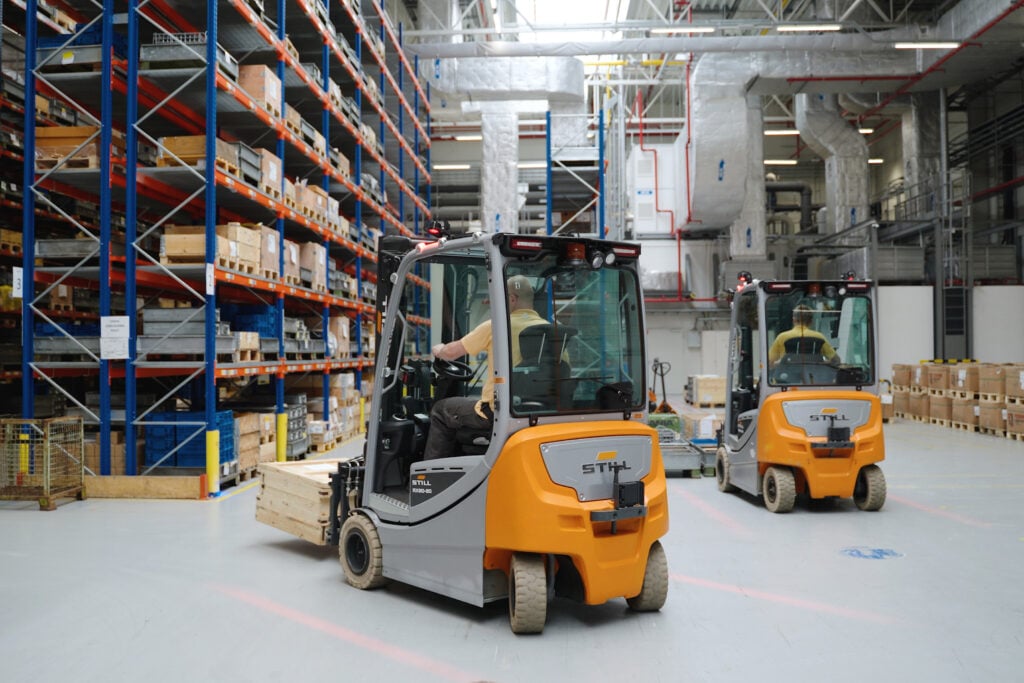
The best starting point is to cut unnecessary handling. Fewer empty journeys, the right layout, racking and truck specification will lower energy demand, whether a fleet uses diesel, LPG or electricity. Electrification suits many indoor and predictable-duty applications where charging can be planned. Its business case is site specific, shaped by battery production, electricity mix, charging losses, infrastructure, uptime and asset life. Heavier outdoor work, remote sites and unusually intensive shifts need their own trials, not a blanket recommendation.
For carbon accounting, fuel burned by an owned or controlled truck usually falls under Scope 1; purchased electricity for charging under Scope 2; and manufacture of purchased equipment, batteries, upstream energy and waste treatment may fall under relevant Scope 3 categories. Apply the 2026 UK government factors to actual activity data, recording boundaries and factor versions. The illustrative model here uses assumed inputs and is not an estimate of an average UK forklift.
The proposed route to 2030 has five priorities: set a measured baseline; remove avoidable moves; electrify suitable duty cycles; extend the safe, productive life of assets; and procure batteries and equipment with verifiable repair, traceability and end-of-life arrangements. None should compromise worker safety. The strongest programme integrates engineering, operators, finance, safety and procurement, and reports both carbon and operational results.
1. Scope, evidence and methodology
Materials handling covers the movement, storage, positioning and retrieval of goods inside buildings and across yards. This report addresses counterbalance forklifts, reach trucks, pallet trucks, order pickers and related charging and service systems. Conveyors, automated guided vehicles and automated storage systems are included where they change the handling task. Road freight and building heat appear only where they affect the decisions. The audience is UK warehouse operators, manufacturers, distributors, fleet managers and equipment suppliers.
The evidence base combines published statistics with engineering reasoning. Official emissions releases provide national context but give no separate national emissions total for forklifts. UKMHA market commentary covers orders and forecasts, not measured fleet carbon. International EV battery findings describe wider supply chains and should not be presented as forklift-specific results. Supplier performance claims require confirmation against actual duty cycles. These distinctions matter because a plausible percentage can mislead when the baseline, system boundary or operating conditions change.
Published in April 2026, the government’s provisional 2025 UK territorial emissions statistics give national context, but territorial figures differ from a company’s full value-chain footprint. The UK’s nationally determined contribution targets at least an 81% cut in greenhouse gas emissions by 2035 against 1990 levels, with the stated exclusions; its domestic net-zero target is 2050 [GOV.UK, 2026]. Neither target sets a uniform reduction rate for each forklift fleet, yet customers’ climate plans and procurement requirements increasingly value credible equipment-level data.
The 2026 government conversion factors allow calculation from litres of fuel, purchased electricity and other activity data. The Greenhouse Gas Protocol supplies the accounting structure, including guidance on purchased electricity and capital goods [GOV.UK, 2026]. In this report, a “saving” means a reduction against a clearly named baseline, under comparable output and operating conditions. Avoided purchases are assessed separately from lower annual operating emissions. Illustrative examples use round assumed figures for transparency; they are not industry benchmarks.
2. Why this sector is important
Next to the heating or freight costs of a large site, a single truck can look insignificant. Factor in truck hours across shifts, charging rooms, battery swaps, tyre wear, maintenance vans and upstream equipment production, and the choice takes on greater strategic weight. Materials handling also shapes a facility’s overall efficiency: bad slotting causes longer travel, congestion increases idling, damaged pallets create rework, and a truck that cannot reach the right height requires extra movements or building alterations.
The commercial climate underlines the need for cautious investment. UKMHA’s late-2025 market analysis reported weaker-than-expected orders in 2025 and forecast a 2026 recovery, especially in warehouse trucks [UK MHA, 2025]. A forecast is not a measured 2026 outcome, but the key insight is that renewal decisions may accelerate as investment returns, making fleet specifications and charging plans important. The key procurement question is not which truck is greenest, but which combination of process, truck and energy supply does the work require, with the least whole-life burden?
Local air quality and noise matter too. Combustion engines emit exhaust where they are used; electric trucks produce no tailpipe emissions at the vehicle. This makes electric equipment particularly appealing indoors, provided a suitable workplace assessment is done. Quieter operation can improve conditions, but it may also affect how easily pedestrians notice a truck. Any change in propulsion must be balanced against traffic separation, visibility, warning systems and operator training. A carbon benefit is not enough if a redesign creates collision or charging hazards.
3. Define the footprint before choosing a solution
 A practical inventory starts with a fleet register: truck ID, type, rated capacity, fuel or battery chemistry, purchase or lease status, age, annual operating hours, energy records, maintenance, location and disposal route. Add warehouse throughput and operating conditions to give year-to-year comparisons context. Where chargers share a circuit, install submetering or collect charger logs; do not charge the whole building’s electricity bill to the fleet. Metering is most important in fleets where multiple shifts, charging sites or battery types coexist.
The boundary should distinguish three levels. Direct operation means combustion fuel burned on site. Purchased energy means electricity for charging and related power systems within the chosen boundary. Value chain covers truck and battery production and transport, fuel extraction and distribution, outsourced repairs, parts, tyres and end-of-life processing where significant. The GHG Protocol’s Scope 3 capital-goods category covers purchased trucks, though leased asset timing and accounting may depend on the reporting arrangement [GHG, 2011]. A business should document its approach and not treat a whole-life assessment as an annual corporate inventory.
The main activity equations are simple:
Annual direct fuel emissions = litres of each fuel used × the relevant year-specific fuel factor.
Annual purchased-electricity emissions = metered charging kWh × the relevant electricity factor.
Intensity = annual emissions ÷ a stable output measure, such as completed pallet moves or tonnes handled.
Use the correct 2026 factors and units from the government’s tables for a 2026 inventory. Keep location-based and, where relevant, market-based purchased-electricity results separate under the Scope 2 Guidance [GHG, 2015]. A renewable tariff certificate does not remove the physical electricity a charger needs. Grid factors, fuel factors and contract evidence should be dated. For internal trend analysis, report absolute emissions alongside intensity: intensity may fall while total emissions rise if volume grows fast.
A metric like “emissions per operating hour” is easy to gather but may reward slow work. “Emissions per pallet move” suits the task better, though pallets vary in weight and distance. For varied operations, combine a simple headline indicator with tonnes handled, average journey distance, utilisation, damage and service level. Set definitions before gathering data. If a site’s output mix changes substantially, note the trend instead of blaming everything on a new truck.
The data hierarchy starts with measured fuel and electricity, then reliable supplier or charger records, then clearly labelled estimates. Where feasible, estimate battery manufacturing impacts with supplier-specific, independently verified life-cycle data; never apply a passenger-car battery figure uncritically to an industrial pack. Even a strong life-cycle assessment depends on assumptions about material sourcing, manufacturing energy, transport and expected lifetime. A good report gives ranges and sensitivities, not one falsely precise carbon payback date.
4. Cut demand for handling
The cleanest trip is one the site never has to make. Start with a movement map: receiving, put-away, replenishment, picking, packing, dispatch and returns. Watch for empty return journeys, double handling and repeated relocations. Record the reasons, and the journey count. An urgent replenishment may come from slotting, inventory accuracy, pallet design or scheduling; telling drivers to hurry fixes none of these.
Slot fast-moving goods nearer the next process, within safe storage and weight limits. Schedule inbound goods so storage positions and labour are ready. Consolidate compatible moves, and use backhauls where safe plus site charging points so trucks need not travel far just to charge. Redesigning racking can cut horizontal travel, though it may require a different truck, tighter aisle clearances, altered fire arrangements or building work. Assess the whole redesign, including embodied materials and safety, not just the travel saving.
Packaging and pallet standards are often overlooked. Mismatched pallet sizes, damaged loads and poorly secured products slow handling and add movements. Good packaging design can cut breakage and rework, but overpackaging shifts impacts upstream. Procurement, suppliers and warehouse teams should jointly test whether changes keep products protected while using space better. Track damage rates and load stability alongside energy use to avoid a misleading apparent saving.
A warehouse management system can improve task sequencing, inventory locations and route allocation. Its gains rely on clean master data and process adherence. Install sensors or telematics only if a team will act on the data. Fleet analytics can flag high-idle trucks and underused assets, but raw utilisation does not prove waste: spare capacity may protect continuity during demand peaks or charging. Pilot changes in one zone, compare equal work periods and keep a control where possible.
Automation deserves the same trial. Conveyors or automated vehicles can cut some repeated truck moves, but add equipment manufacture, standby electricity, maintenance and software dependencies. They can also improve accuracy and space use. Compare realistic scenarios over a shared service life, including uptime and peak demand, before calling automated handling inherently sustainable. The best answer for a steady, high-volume flow may differ from a variable, low-volume site.
5. Powertrains and operating conditions
Diesel, LPG, lead-acid battery electric and lithium-ion battery electric trucks each carry different costs and constraints. Diesel still suits demanding outdoor work and sites with weak electrical infrastructure, but on-site combustion causes direct emissions and local exhaust. LPG can add operational flexibility, but it remains a fossil fuel with direct emissions. Electric trucks shift emissions to electricity generation and equipment manufacturing; they can cut operational emissions significantly where duty cycle, charging access and supply fit the work.
The first comparison is task suitability. Record lift height, load mass and centre, attachment use, gradients, terrain, cold-store exposure, travel speed, shifts and peak duty. Nameplate capacity by itself is not sufficient. An undersized electric truck may require extra units or battery swaps, changing both cost and emissions. For a particular remote application, a properly sized combustion truck may be the better interim option. Run a site trial with real operators and representative peaks, and record energy per completed task, not just vendor range claims.
Lead-acid equipment is well established in many warehouse operations. It works well where charging and battery changes are planned, but charging space, watering and maintenance carry operational and safety implications. Lithium-ion equipment can offer flexible charging and less routine battery maintenance in suitable uses; the real value depends on battery chemistry, controls, charge rate, usable capacity, degradation, shift pattern and supplier support. Neither chemistry is automatically the lowest-carbon option in every application. Compare energy and replacement needs across the whole service period.
Hydrogen fuel-cell trucks may suit high-intensity sites where rapid refuelling and centralised infrastructure solve a genuine operational problem. The greenhouse-gas outcome depends on how hydrogen is produced, compressed and transported. Infrastructure cost and energy conversion losses must be weighed against battery charging and other options. Zero emission at the truck does not mean zero life-cycle emissions. In many conventional UK warehouses, hydrogen needs a stronger site-specific case than direct electrification; this is an analytical judgement, not a universal prohibition.
Another decision is whether to replace an older truck now or extend its life. A safe, usable unit with few annual hours may be worth keeping, since its embedded materials support continued use. An intensively used combustion truck, by contrast, may emit enough ongoing fuel emissions to justify earlier replacement. Weigh the yearly operational difference against the added production and disposal burden, factoring in realistic service life. It depends on utilisation, equipment condition and the electricity source, so apply the framework truck by truck.
6. Charging and energy infrastructure
Electrification plans can fail if the charger is chosen after the vehicle. Start with a time-based load profile: when trucks return, their energy needs, downtime, and other plant power draws. Check the site’s electrical capacity, distribution boards, cable runs, metering, ventilation, emergency access and resilience. A cheaper truck can become costly if peak charging requires a major connection upgrade.
Staggering charging and using suitable control software can cut coincident peaks. The aim is to supply enough energy before the next duty period, not to charge every truck at once at maximum power. A lower-power overnight approach may suit single-shift sites, while opportunity charging can serve a well-planned multi-shift operation. Each must respect manufacturer instructions, battery health and the site’s risk assessment. If a tariff rewards off-peak use, weigh the financial gain against any effect on staffing or readiness.
On-site solar may offset purchased electricity over a year, but output varies by season and time of day. Stationary storage batteries may cut peaks or increase use of locally generated power, yet bring their own manufacture, cost and loss impacts. Model hourly or half-hourly profiles where investment is material. State clearly whether a claimed reduction refers to purchased electricity, location-based emissions or a market-based accounting result; they use different measures.
Charging safety is part of sustainability, as an avoidable incident affects people, assets and continuity. Designated areas need suitable equipment, maintenance, access control and a response plan matched to the chemistry and charging method in use. Lead-acid charging requires hydrogen and ventilation controls; lithium-ion systems require proper electrical protection, battery management and procedures for damage or abnormal heat. Follow current manufacturer instructions and applicable HSE guidance on workplace transport and work equipment. Avoid claiming that all battery incidents share the same causes or controls.
7. Battery supply chains and circularity
Industrial batteries connect a UK warehouse to mineral extraction, refining, cell production and waste systems worldwide. The IEA documents the scale and concentration of the broader battery value chain and recycling’s rising importance, though its EV figures do not directly gauge forklift demand [IEA, 2022]. Chemistry shapes the materials used: some lithium iron phosphate packs, for example, avoid nickel and cobalt in the cathode yet still require lithium and other inputs. Less dependence on a single material does not eliminate supply-chain risk.
A responsible tender should request the battery’s chemistry, rated and usable capacity, expected cycle life under the intended duty, warranty exclusions, replacement cost, repairability, battery-management data access, transport arrangements and end-of-life pathway. Ask suppliers for the method and boundary behind the manufacturing footprint. A brochure claiming “recyclable” is weaker evidence than a documented take-back process and destination. Include spare-part availability and software support: hardware that cannot be repaired or securely controlled may be retired early.
UK waste-battery rules create producer responsibilities, including provisions for industrial batteries and take-back in specified circumstances [IEA, 2024]. Operators should confirm who owns the battery, who arranges compliant collection and what documentation is provided at end of life. Do not put industrial packs into ordinary waste streams. Reuse or second life may be possible, but only after assessing remaining health, safety, economics and suitability; it is not automatically better than direct recycling.
The EU Batteries Regulation sets a developing framework of information, sustainability and circularity requirements for relevant batteries placed on the EU market [HM GOVERNMENT, 2021]. Its application varies by battery category, capacity and phased implementing provisions. UK firms exporting equipment to, purchasing via, or supplying EU markets should get compliance advice specific to their products. Claiming that all EU rules apply automatically to every forklift battery used only in Great Britain in 2026 would be inaccurate. However, better traceability and carbon data are valuable procurement signals, formal coverage or not.
Circularity goes beyond recycling. Repair a motor or charger when safe and cost-effective; refurbish a truck for lighter second use; remanufacture suitable assemblies; standardise consumables where feasible; and require take-back at purchase. Verify that refurbishment genuinely lengthens useful life while keeping operation safe. Record replacement parts and major repairs, so low apparent purchase emissions do not come from repeated breakdowns and waste.
8. Maintenance, tyres, and how long equipment lasts
Maintenance refers to an intervention aimed at boosting the efficiency of resources. With pneumatic tyres, wrong pressure, worn components, binding brakes, badly adjusted hydraulics, and neglected chargers, energy use can rise or downtime can occur, and the scale of this varies from site to site; steer clear of suggesting a universal percentage saving. Preventive maintenance keeps a truck in the state it was designed for and lets technicians notice changes before they lead to expensive breakdowns.
Tyres serve as a good illustration of the trade off. Durability, traction, floor condition, rolling resistance, and noise should all be taken into account. Choosing a tyre for low energy use might reduce grip, or make it wear out rapidly on a surface it is not suited to. Operators ought to record tyre condition and how often replacements are made, and ask suppliers about composition, service life, and disposal. For a large fleet, battery replacement, oil, filters, and packaging can add to the material picture.
Use maintenance records to identify trucks with recurring faults or unusually high kWh / litres per task, compare them with similar equipment doing the same work, and look into the causes. A jump in energy might also point to mechanical drag, though it could just as well reflect heavier loads, new attachments, or an altered route. Telematics can help with diagnosis when operators know how to report faults and managers act on them. On its own, data cannot substitute for competent inspections.
HSE’s guidance on the Provision and Use of Work Equipment Regulations addresses maintenance, inspection, training, and competence [HSE, 2014]. Sustainability should not become an excuse to postpone essential maintenance or to keep equipment that is unsafe. A longer asset life is only worthwhile as long as the truck stays suitable, inspected, repairable, and safe. If replacement is required, note down the reasons, and consider whether refurbished equipment could handle the duty.
9. People, safety, and operational governance
Operators influence energy demand by driving smoothly, selecting routes carefully, avoiding needless idling, and reporting faults. Training ought to reinforce the work rather than assign blame to individuals when the layout is poor. A well-designed site makes performing that work straightforward. Supervisors can clarify the reason for a change, identify where the workflow causes repeated movements, and adjust schedules to match. Include maintenance and charging staff, because their expertise typically reveals constraints that a purchasing committee misses.
Workplace transport carries significant risks. HSE’s lift-truck code and workplace transport guidance address training and the organisation of safe sites. Where feasible, separate people from vehicles, check sight lines and crossings, manage reversing and speed, and revisit traffic plans whenever vehicles or layouts change. Quieter electric units, quicker acceleration, relocated chargers, and automation each justify a fresh review. The result is fewer injuries and near misses, along with lower emissions.
Governance needs to specify who owns what. Operations own movements and throughput, facilities own power and charging, engineering owns maintenance, procurement owns supplier evidence, finance owns total-cost assumptions, safety owns the risk process, and a designated sponsor settles trade-offs. Establish a modest set of measurable targets, for example fuel litres, charging kWh, absolute emissions, emissions per defined unit of output, damage, incidents, and availability. Review monthly on operational matters, and yearly for investment decisions.
Any credible sustainability claim should state its boundary. “Zero tailpipe emissions” holds for a battery electric truck during use, but “zero-carbon forklift” usually does not, once electricity supply and production are considered. When a supplier claims a percentage reduction, probe the models compared, test conditions, duty cycle, grid assumption, battery replacement schedule, and the treatment of upstream emissions. Disclose the uncertainty rather than conceal it. This safeguards customers and the industry’s credibility alike.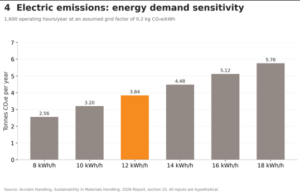
10. Illustrative whole-life decision model
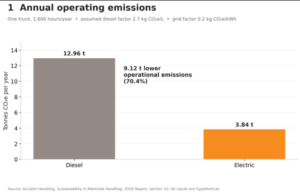
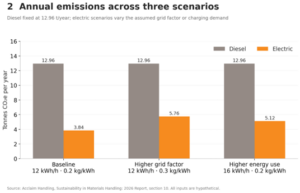
Picture a fictional UK warehouse that operates one diesel counterbalance truck for 1,600 engine hours annually. Assume it consumes 3.0 litres of diesel per engine hour, which works out to 4,800 litres per year. An electric option is put forward that draws 12 kWh of electricity at the meter per operating hour, charging losses included, totalling 19,200 kWh per year. These numbers are deliberately hypothetical – they do not describe a product specification, a measured site, or UK fleet averages.
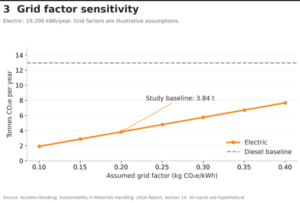
Let D stand for the applicable 2026 direct-combustion diesel factor in kg CO₂e per litre, and E for the applicable 2026 location-based grid-electricity factor in kg CO₂e per kWh. The operating comparison is 4,800 × D against 19,200 × E kg CO₂e per year. For a numerical sensitivity demonstration only, assume D = 2.7 and E = 0.2. The resulting figures are 12,960 and 3,840 kg CO₂e per year, a gap of 9,120 kg CO₂e, or roughly 9.1 tonnes. These round numbers are not asserted 2026 factors; substitute the actual published factors before making a real claim. Upstream fuel and electricity emissions can be added separately by using matching factor boundaries.
The grid sensitivity is significant. If the assumed E rises to 0.3, electric operating emissions rise to 5,760 kg CO₂e, and the difference becomes 7,200 kg. If the truck needs 16 rather than 12 kWh per hour, annual electricity reaches 25,600 kWh; with E = 0.2, operational emissions become 5,120 kg. These show why metering and realistic trials matter more than a generic marketing comparison.
Next, consider manufacture. If, purely hypothetically, the replacement truck and battery carry 12 tonnes CO₂e of incremental embodied impact compared with keeping the existing truck, dividing 12 by the 9.12-tonne annual operating difference suggests roughly 1.3 years to offset that increment under these assumptions. This is a carbon payback, not a life-cycle result. It disregards yearly maintenance variations, battery replacement, future changes to the grid, vehicle end-of-life, altered throughput, and whether the diesel truck is reassigned rather than retired. Use a range for embodied impacts, and ask whether the units offer equal service.
The financial comparison stands on its own. Determine the costs of purchase or lease, charger setup, electrical connection, energy according to tariff period, maintenance, tyres, downtime, operator hours, battery replacement, and resale or disposal value. Apply a consistent discount to future costs, and present a sensitivity analysis for fuel and electricity prices. Never exchange carbon payback for financial payback, nor the other way around. A more expensive low carbon choice can be warranted when it enhances indoor conditions, reliability, or eligibility for contracts. Such benefits ought to be identified and assessed, rather than concealed within an emissions estimate.
11. A workable roadmap for 2026–2030
The first 90 days: establish the baseline. Designate an owner, and set up the fleet register. Gather 12 months of records on fuel, electricity, hours, moves, maintenance, and incidents wherever these are available. Identify metering gaps, and record any estimates. Chart high-frequency routes, and sort each truck by duty rather than by age. Share the selected organisational boundary, factor year, and output measures across the organisation. Make sure operators and safety staff take part in the assessment.
Months 4–12: eliminate waste and conduct trials. Give priority to one or two layout or scheduling changes that have clear before-and-after measurements. Try electric alternatives on representative shifts for the duty cycles that seem most suitable. Monitor charger demand, productivity, temperature, battery performance, and downtime. Examine the charger’s electrical design, along with traffic-related risks. Request comparable information from suppliers regarding repairability and end-of-life handling. A trial succeeds when the service requirement is fulfilled safely, energy consumption is transparent, and the total cost is credible.
Years 2–3: broaden the range of suitable cases. Replace equipment at the appropriate renewal points, coordinate electricity upgrades with building projects, and build charging controls around actual schedules. Make spare parts and data access mandatory contractual terms. Train operators and engineers in how to operate the installed equipment. Retain older units (which perform well) wherever the whole-life case supports it, and decommission unsafe or inefficient ones with documented justification. Include batteries, chargers, and refurbishment within procurement rather than treating them as add-ons.
Years 4–5: improve the system. Use the journey and energy records you have collected to reassess racking, automation, and fleet size. Measure emissions against a fixed baseline and a service-normalised metric. Revisit supplier footprint data as methods evolve, and verify where end-of-life batteries and machines ultimately go. Revise targets as grid intensity, energy prices, and operating needs shift. Do not commit to a specific decarbonisation percentage without a measured starting point and a capital plan.
A useful decision gate consists of four questions: Can the option handle the task? Does it maintain or improve safety? Does its whole-life impact improve under credible assumptions? Can the site support it both technically and financially? If any answer remains unclear, gather focused evidence through a brief trial or a request to the supplier. Keeps sustainability efforts connected to operations, rather than reducing them to a purchasing label.
12. Risks, limitations and priorities for research
The most significant evidence gap is the absence of any single, transparent inventory covering materials handling emissions across the entire UK. Fleet registrations, sales, operating hours and charger data are collected for a range of purposes, and warehouse equipment is not defined consistently. A future industry study could bring together a representative sample of sites, metered duty-cycle data, and independently reviewed life-cycle inventories. Indoor and outdoor fleets ought to be reported separately, because their requirements differ substantially.
A second gap concerns real-world battery life. Manufacturer warranties, laboratory cycles and on-site performance are not interchangeable. Cold stores, heavy attachments, charging behaviour and shift patterns all have an influence on results. Independent long-term evidence would assist buyers in assessing battery replacement and embodied impact. Better disclosure of upstream battery materials and recycling would also support procurement, though commercial confidentiality and international traceability make this difficult.
Economic and environmental conditions will shift over the lifetime of any truck purchased in 2026. Grid emissions, tariffs, energy security, spare-part availability and demand could all depart from today’s assumptions. A sound plan depends on scenarios and retains flexibility: scalable charger design, repairable assets, accessible data, and contracts that make end-of-life responsibilities clear. Scenario analysis should include at least one case with higher electricity prices, lower annual utilisation, shorter battery life and delayed connection upgrade.
Finally, sustainability extends beyond carbon. Air quality, worker safety, resource extraction, repairability, waste, noise and workforce competence all matter. These effects cannot responsibly be reduced to a single score without explaining the weights and trade-offs. An organisation should identify which of its impacts are most material, and report what is measured, what is estimated, and what is unknown. Such discipline is worth more than an unsupported claim that a fleet is “green.”
Conclusion
The practical opportunity for materials handling in 2026 is evident: monitor what trucks use, move goods with fewer needless trips, electrify the tasks that are suited to it, plan charging based on the site’s real power profile, and keep equipment safely productive for as long as that makes sense. Choices regarding battery sourcing and end-of-life plans ought to be built into the purchase from the beginning. The greatest benefits will likely stem from combining process changes with well-specified equipment, rather than from any single technology.
UK operators do not have to wait for a sector-wide carbon total before they can begin. The current reporting framework and official conversion factors already allow for measurement at the site level. Pilot projects, clear boundaries, and honest handling of uncertainty can turn sustainability from a broad aspiration into a set of accountable decisions.
BIBLIOGRAPHY
BSI (2020) BS EN 1726-1:2020 Safety of industrial trucks – Self-propelled trucks up to and including 10 000 kg capacity and tractors with a drawbar pull up to and including 20 000 N – Part 1: General requirements. London: British Standards Institution.
BSI (2020) BS EN 1755:2020 Safety of industrial trucks – Self-propelled trucks up to and including 10 000 kg capacity and tractors with a drawbar pull up to and including 20 000 N – Additional requirements for operation in potentially explosive atmospheres and for use in flammable dusts. London: British Standards Institution.
Department for Energy Security and Net Zero (DESNZ) (2026) Greenhouse gas reporting: conversion factors 2026. London: GOV.UK. Available at: https://www.gov.uk/government/publications/greenhouse-gas-reporting-conversion-factors-2026 [Accessed 25 September 2026].
Department for Energy Security and Net Zero (DESNZ) (2026) 2026 Government greenhouse gas conversion factors for company reporting: Major changes to the Conversion Factors. London: GOV.UK. Available at: https://assets.publishing.service.gov.uk/media/6a2940653b15d05a7ce3202f/2026-GHG-conversion-factors-major-changes-report.pdf [Accessed 25 September 2026].
Department for Energy Security and Net Zero (DESNZ) (2026) 2026 Government greenhouse gas conversion factors for company reporting: Methodology report. London: GOV.UK. Available at: https://assets.publishing.service.gov.uk/media/6a2940543b15d05a7ce3202e/2026-GHG-conversion-factors-methodology-report.pdf [Accessed 25 September 2026].
European Union (2023) Regulation (EU) 2023/1542 of the European Parliament and of the Council of 12 July 2023 concerning batteries and waste batteries, amending Directive 2008/98/EC and Regulation (EU) 2019/1020 and repealing Directive 2006/66/EC. Official Journal of the European Union, L 191, 28 July 2023. Available at: https://eur-lex.europa.eu/eli/reg/2023/1542/oj [Accessed 25 September 2026].
GHG Protocol (2011) Corporate Value Chain (Scope 3) Accounting and Reporting Standard. Washington, DC: World Resources Institute and World Business Council for Sustainable Development. Available at: https://ghgprotocol.org/standards [Accessed 25 September 2026].
GHG Protocol (2015) Scope 2 Guidance: An amendment to the GHG Protocol Corporate Standard. Washington, DC: World Resources Institute and World Business Council for Sustainable Development. Available at: https://ghgprotocol.org/scope-2-guidance [Accessed 25 September 2026].
Health and Safety Executive (HSE) (2013) INDG457: Use lift trucks safely – advice for operators (pocket card). Sudbury: HSE Books. Available at: https://www.hse.gov.uk/pubns/indg457.pdf [Accessed 25 September 2026].
Health and Safety Executive (HSE) (2014) HSG136: A guide to workplace transport safety. 3rd edn. Sudbury: HSE Books. Available at: https://www.hse.gov.uk/pubns/books/hsg136.htm [Accessed 25 September 2026].
Health and Safety Executive (HSE) (2019) L117: Rider-operated lift trucks: Operator training and safe use (Approved Code of Practice and guidance). 4th edn. Sudbury: HSE Books.
Health and Safety Executive (HSE) (2025) Workplace transport. Available at: https://www.hse.gov.uk/workplacetransport/index.htm [Accessed 25 September 2026].
Health and Safety Executive (HSE) (2025) Lift trucks. Available at: https://www.hse.gov.uk/workplacetransport/lift-trucks/index.htm [Accessed 25 September 2026].
HM Government (2009) The Waste Batteries and Accumulators Regulations 2009 (SI 2009/890). London: The Stationery Office. Available at: https://www.legislation.gov.uk/uksi/2009/890 [Accessed 25 September 2026].
HM Government (2021) The Carbon Budgets Order 2021 (SI 2021/750). London: The Stationery Office.
IEA (International Energy Agency) (2022) Global Supply Chains of EV Batteries. Paris: IEA. Available at: https://www.iea.org/reports/global-supply-chains-of-ev-batteries [Accessed 25 September 2026].
IEA (International Energy Agency) (2024) Batteries and Secure Energy Transitions. Paris: IEA. Available at: https://www.iea.org/reports/batteries-and-secure-energy-transitions [Accessed 25 September 2026].
ISO (International Organization for Standardization) (2018) ISO 14064-1:2018 Greenhouse gases – Part 1: Specification with guidance at the organization level for quantification and reporting of greenhouse gas emissions and removals. Geneva: ISO.
ISO (International Organization for Standardization) (2018) ISO 14067:2018 Greenhouse gases – Carbon footprint of products – Requirements and guidelines for quantification. Geneva: ISO.
Office for Product Safety and Standards (OPSS) (2025) Waste batteries: producer responsibility. GOV.UK. Available at: https://www.gov.uk/guidance/waste-batteries-producer-responsibility [Accessed 25 September 2026].
Office for Product Safety and Standards (OPSS) (2025) Regulations: batteries and accumulators. GOV.UK. Available at: https://www.gov.uk/guidance/batteries [Accessed 25 September 2026].
Parliament of the United Kingdom, House of Lords, Environment and Climate Change Committee (2024) Electric vehicle infrastructure: Chapter 5 – EV end-of-life management and recycling. HL Paper 51. London: The Stationery Office. Available at: https://publications.parliament.uk/pa/ld5804/ldselect/ldenvcl/51/5108.htm [Accessed 25 September 2026].
UK Materials Handling Association (UKMHA) (2025) Market commentary and order statistics 2025–26. Birmingham: UKMHA. [Member briefing / press release – cite specific bulletin used.]
UNFCCC (United Nations Framework Convention on Climate Change) (2025) United Kingdom of Great Britain and Northern Ireland: Updated Nationally Determined Contribution. Bonn: UNFCCC Secretariat. Available at: https://unfccc.int/NDCREG [Accessed 25 September 2026].