On this page
A scissor lift is a mobile elevating work platform (MEWP) that raises people, their tools and their materials straight up on a stack of criss-crossed supports. The supports fold flat when the platform is down and open out like a pair of scissors to push it up. It gives a large, railed working deck at height, it can carry more than a cherry picker basket, and on most models it can be driven while the platform is raised.
In stock now: Scissor lifts · Enquire
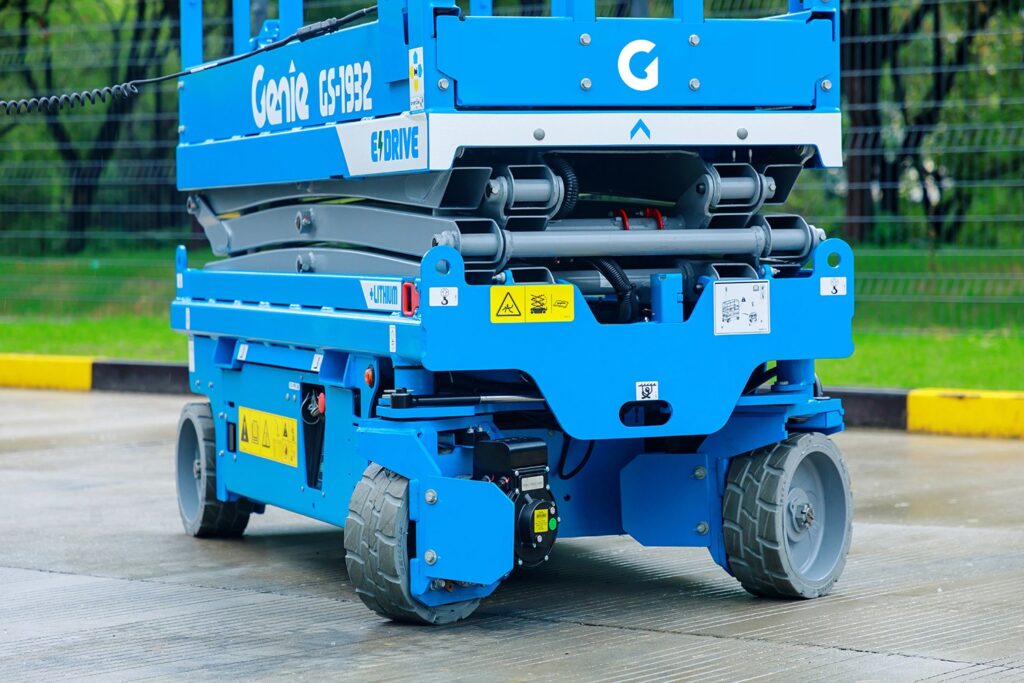
That makes it the machine for overhead work across an area rather than at one point: ceilings, lighting, ductwork, cabling, signage, racking, cleaning and decoration, indoors on a finished floor or outside on site.
How a scissor lift works
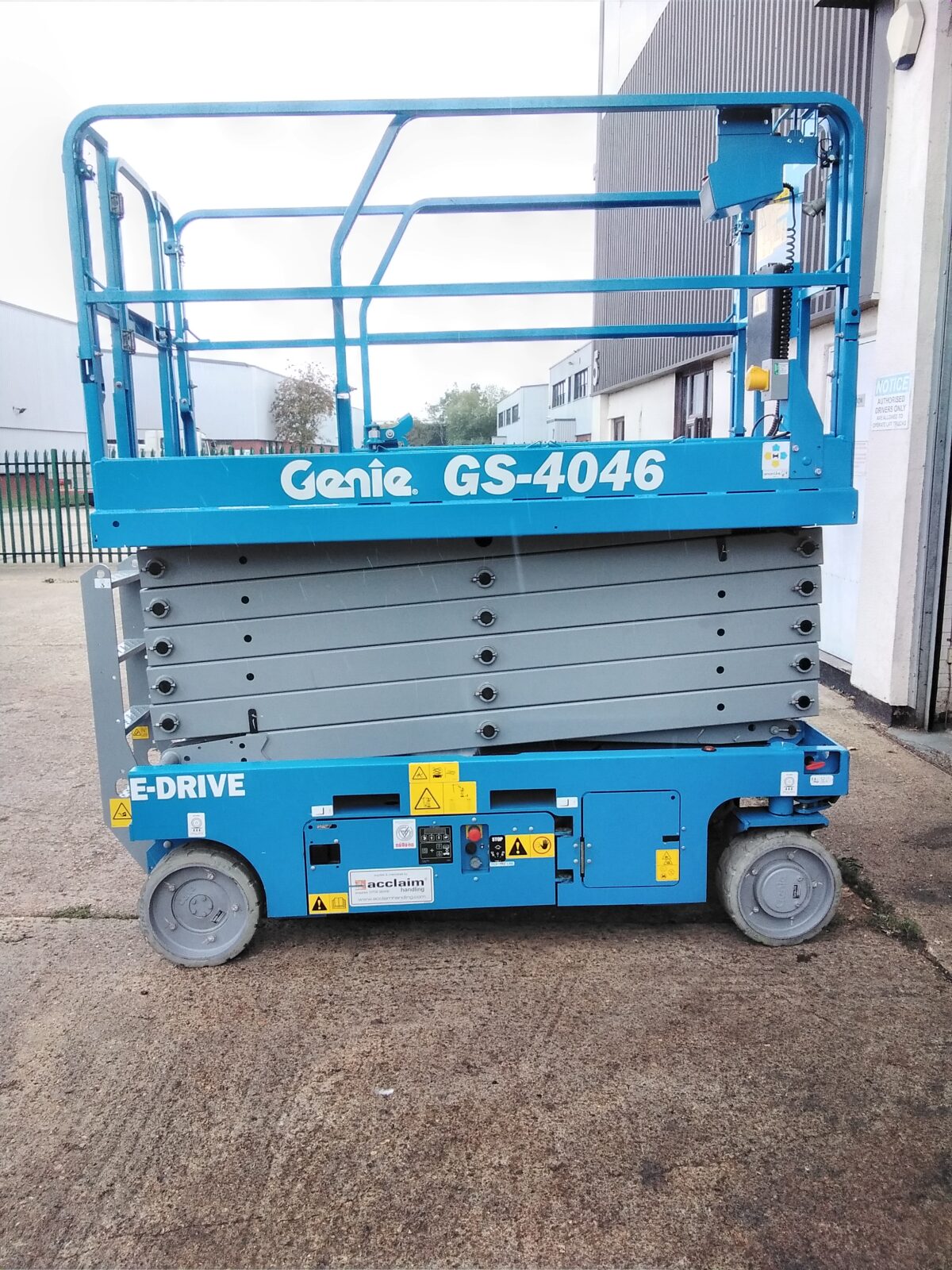
The platform sits on top of a set of linked arms, joined at the middle and pinned at each end. Hydraulic cylinders, or on all-electric models an electric actuator, push the arms apart. As they open, the platform rises vertically, with no sideways movement.
The operator drives, steers, raises and lowers the machine from a control box on the platform, so the machine can be moved along a run of work without coming down each time. A second set of controls at the base is there for setting up and for bringing the platform down in an emergency. Pothole guards drop beneath the chassis as the platform rises, and the machine limits its drive speed at height.
Scissor lifts available now
Scissor lift or cherry picker?
A scissor lift only goes straight up. In exchange it gives a bigger platform that carries more people, tools and materials, and it is steady and quick to reposition along a ceiling or a run of racking.
If the work is above, around or over something, such as plant, a parapet, a canopy or a row of racking, the job needs a boom. Articulating booms reach up and over obstacles; telescopic booms give the most horizontal outreach. See cherry picker hire, or access platform hire to compare scissor lifts, booms and mast lifts side by side.
For one person working at low level, a push-around mast lift is lighter again and wheels through a doorway where a scissor lift is too big.
Types of scissor lift
The split that matters is the ground the machine will stand on and how it is powered.
- Electric slab scissor lifts. The everyday indoor machine: battery powered, quiet, emission free and on non-marking tyres, for flat, firm, finished floors. The smaller models pass through a standard doorway and are light enough for most mezzanine and upper floors. Genie’s GS range is the example most sites know.
- E-Drive. Electric scissor lifts with an all-electric drive in place of the hydraulic drive system. Fewer hydraulic parts means less to leak and less to maintain, and more work from each charge.
- Bi-Energy (BE). Battery powered, with an on-board generator to keep the machine working, so one scissor lift can work quietly indoors and carry on outside without waiting for a charge.
- DC. Battery powered models with a wider platform, for jobs that need more room and more capacity on the deck without engine emissions.
- Rough terrain (RT). Engine powered, with four-wheel drive, high ground clearance and large platforms that carry several people with their tools and materials. Built for construction sites, sand, mud and uneven ground, and able to drive at full height.
See Genie access platforms for the full Genie range, from compact slab scissor lifts to rough terrain machines.
Working height and platform height
Two heights get quoted for a scissor lift, and it pays to know which one you are looking at.
- Platform height is how high the floor of the platform goes.
- Working height is how high a person standing on the platform can reach. It is normally the platform height plus about two metres.
Work from the height you need to reach, then choose the machine. The scissor lifts we hire run from 5,890 mm on the smallest electric slab machine to 17,950 mm on the largest rough terrain one.
Genie model numbers tell you the size at a glance. On a GS scissor lift the first two digits are the platform height in feet and the last two are the machine’s width in inches.
A GS-1932 has a 19 ft platform and is 32 in (about 0.81 m) wide, narrow enough for a standard doorway. A GS-2646 reaches 26 ft and is 46 in wide.
Capacity and platform size
Every scissor lift has a rated platform capacity: the total weight of people, tools and materials it is built to lift. On the machines we hire it runs from 227 kg on the compact electric slab models, enough for one or two people and their tools, up to 1,134 kg on the Genie GS-3390 RT, which carries a working crew with materials.
Many models have a roll-out deck extension that adds reach at one end of the platform. The capacity plate on the machine gives the limit, and on some machines a lower limit applies with the extension out or when working outdoors.
Indoors or outdoors
Indoors, on finished floors, electric is normally the requirement: no exhaust, non-marking tyres, and quiet enough for an occupied building. Check the floor will take the machine’s weight, especially on a mezzanine or an upper floor, and that it fits through the doors and lifts on the way to the job.
Outdoors, on rough or soft ground, a diesel or rough terrain machine stays usable where a slab machine would not. Wind matters too: every MEWP has a maximum wind speed for use, and many indoor-only models are not rated for outdoor use at all.
Whichever the machine, the questions that decide it are the same: the height you need to reach, what the ground is like, any slope, the ground bearing, and any overhead obstructions.
Checks and thorough examinations
A scissor lift lifts people, so LOLER requires a thorough examination at least every six months, not the twelve months that applies to equipment that lifts loads only. Alongside that, the operator carries out a pre-use check before each shift, and the machine is serviced on a regular schedule.
A service and a thorough examination are different things. A service keeps the machine working; a thorough examination is the legal check that it is safe to lift people.
Our engineers carry out both on scissor lifts, cherry pickers and mast lifts, including machines we did not supply. See MEWP servicing and LOLER inspection.
Who can operate a scissor lift?
Scissor lifts are category 3A, mobile vertical, in the MEWP categories that operator cards and certificates list. Sites often ask to see proof that an operator is trained on the category they will use. A PAL card from IPAF is one way to show it, but it is not the only one, and many sites accept other accredited training.
Our guide do I need an IPAF card? explains the PAL card, the MEWP categories and when a site will insist on one.
If you want operators trained, we run RTITB accredited scissor lift (MEWP) training at our Purfleet and Chatham centres or on your own site. A beginner course runs over three days and a refresher over one.
Buy, hire or lease
Which way to get a scissor lift depends on how often you will use it.
- Hire suits a one-off job or a project. A machine can be hired for a day, the minimum charge is one week at the weekly rate, and transport is charged separately. Hire machines come with a current thorough examination, and if one stops we send our own engineer out to it. See scissor lift hire.
- Buying suits regular use. We are an authorised Genie dealer, supplying new scissor lifts direct, and we sell used machines inspected against our own standards with a current thorough examination. See scissor lifts for sale.
- Leasing spreads the cost: lease purchase, contract hire or operating lease, on used machines as well as new. See leasing and contract hire.
If a hire runs on and starts to look permanent, we will say so, because past a certain number of months a longer agreement or buying is usually cheaper.
Talk to us
Acclaim Handling has supplied and serviced materials handling and access equipment since 1982, with our own engineers working from eight depots across the UK.
Tell us the height you need to reach, what the ground is like and whether the job is indoors or out, and we will put the right machine on it rather than the biggest one.
Call 01708 861 414 or get in touch.
Not sure which machine? Tell us the height you need to reach and what the ground is like.
Scissor lift FAQs
Eight depots across the UK
Our own engineers, out of our own depots - wherever you are, service comes from us.