On this page
- What Is a Telehandler?
- Telehandler Sizes and Lifting Capacities
- 1. Super Compact Telehandlers
- 2. Compact Telehandlers
- 3. Standard Lift Telehandlers
- 4. High Lift Telehandlers
- 5. Heavy Load Telehandlers
- Understanding Telehandler Load Capacity
- How to Choose the Correct Telehandler
- Load Weight
- Lift Height and Forward Reach
- Job Accessibility
- Telehandler Attachments and Versatility
- How Does Terrain Affect the Performance of a Telehandler?
- Can Telehandlers Be Legally Driven on Public Roads?
- Telehandler Safety and UK Regulations
- Choosing the Right Telehandler with Acclaim Handling
- Telehandler Summary Table
Telehandlers rank among the most versatile materials handling machines used in construction, agriculture and industrial settings. By combining the lifting power of a forklift with the reach of a crane, telehandlers can move and position heavy materials in places where standard forklifts typically cannot.
Even so, grasping telehandler lifting capacity is vital when picking the right machine. Models differ in lifting capacity, boom extension and working height, so some are better matched to particular jobs than others.
In this guide, Acclaim Handling looks at telehandler types, their lifting capacities and the key factors to weigh up when choosing a machine.
What Is a Telehandler?
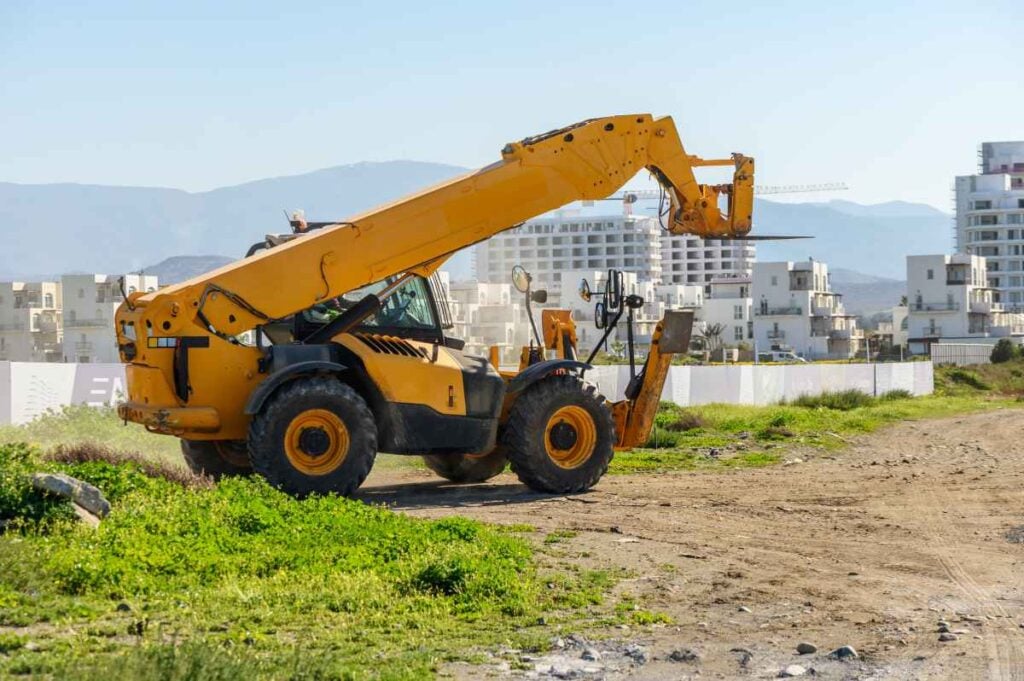
A telehandler, also known as a telescopic handler, is a versatile lifting machine built to move and position materials across a variety of working environments.
Unlike standard forklifts that rely on vertical masts, telehandlers use hydraulically driven telescopic booms that extend forwards and upwards. This lets operators place materials at heights and distances that would otherwise be hard to reach.
Telehandlers can also be equipped with various attachments, such as forklift forks, buckets and lifting hooks, so a single machine can carry out multiple tasks.
Their versatility makes them a favourite in construction, agriculture and industrial operations, where heavy materials often need to be moved over uneven ground or lifted to elevated areas.
Telehandler Sizes and Lifting Capacities
Telehandlers come in several sizes, each offering different lifting capacities, working heights and operational capabilities.
Although specifications vary between manufacturers, telehandlers usually fall into five categories.
1. Super Compact Telehandlers
Super compact telehandlers are the smallest in the range, built for jobs where manoeuvrability and accessibility matter most.
They typically lift to heights of around 3.3 to 5.6 metres, which suits smaller construction sites, agricultural buildings and tight spaces.
Even with their compact dimensions, they reach further than conventional forklifts, letting operators move and place materials efficiently.
2. Compact Telehandlers
Compact telehandlers provide a greater lifting capacity while still being relatively small in size.
Based on the model, compact telehandlers can lift loads of nearly 4 tonnes and reach heights of about 10 metres.
These machines are perfect for companies that need a combination of lifting power and manoeuvrability.
They are often used in construction and agriculture, where operators must work in tight spaces while moving heavy loads.
3. Standard Lift Telehandlers
Standard lift telehandlers are built for general-purpose materials and are commonly seen on construction sites.
Usually lifting from 6 to 11 metres, they combine capacity, reach and versatility.
Standard telehandlers are typically used to lift palletised bricks, timber, roofing materials and other supplies to elevated work areas.
Their larger size makes them ideal for businesses that require more lifting capability than compact models can offer.
4. High Lift Telehandlers
High lift telehandlers are designed for applications that need materials to be placed at significant heights.
Depending on the model, they can reach roughly 17 metres or more, and many offer maximum rated capacities of around 4 tonnes.
Their extended reach is especially useful for multi-storey construction, roofing installations and placing materials over obstacles.
However, the maximum permitted load drops at certain boom positions, so the manufacturer’s load chart must be consulted.
5. Heavy Load Telehandlers
Telehandlers built for heavy loads are engineered to handle tough jobs involving especially heavy or bulky materials.
Usually, these machines provide maximum lifting capacities of 5 to 7 tonnes, though specialised models can go beyond this range.
Lifting heights can reach roughly 10 metres or more, depending on the particular model.
Their sturdy build and strong lifting power make them well suited to construction, agriculture and industrial settings where heavy materials must be moved or positioned.
Understanding Telehandler Load Capacity
One essential factor when operating a telehandler is grasping how lifting capacity shifts with the position of the telescopic boom.
Unlike standard forklifts, telehandlers push loads forward, which alters the forces exerted on the equipment.
As the boom extends, the load moves farther from the machine’s centre of gravity, raising the risk of instability.
As a result, the maximum weight a telehandler can safely lift generally decreases as the boom extends forwards.
For instance, a telehandler rated at 4 tonnes might only manage a much lighter load at maximum forward reach.
Manufacturers supply load capacity charts that indicate the maximum permitted weight at various boom angles, extensions and lifting heights.
Before performing any lift, operators must check the relevant load chart to confirm the machine can safely handle the intended load.
How to Choose the Correct Telehandler
Choosing the right telehandler means more than just picking the machine with the highest lifting capacity.
Businesses must weigh several factors to ensure the equipment suits the intended application.
Load Weight
Start with the weight of the heaviest load that needs to be lifted or transported.
Businesses should choose a telehandler with enough rated capacity to safely handle the full load at the required boom position.
This accounts for the weight of attachments and lifting accessories.
The advertised maximum capacity of a telehandler is not always the weight it can lift at every height or extension.
Choosing equipment with the right load rating lowers the chance of instability, damage to machinery and serious accidents.
Lift Height and Forward Reach
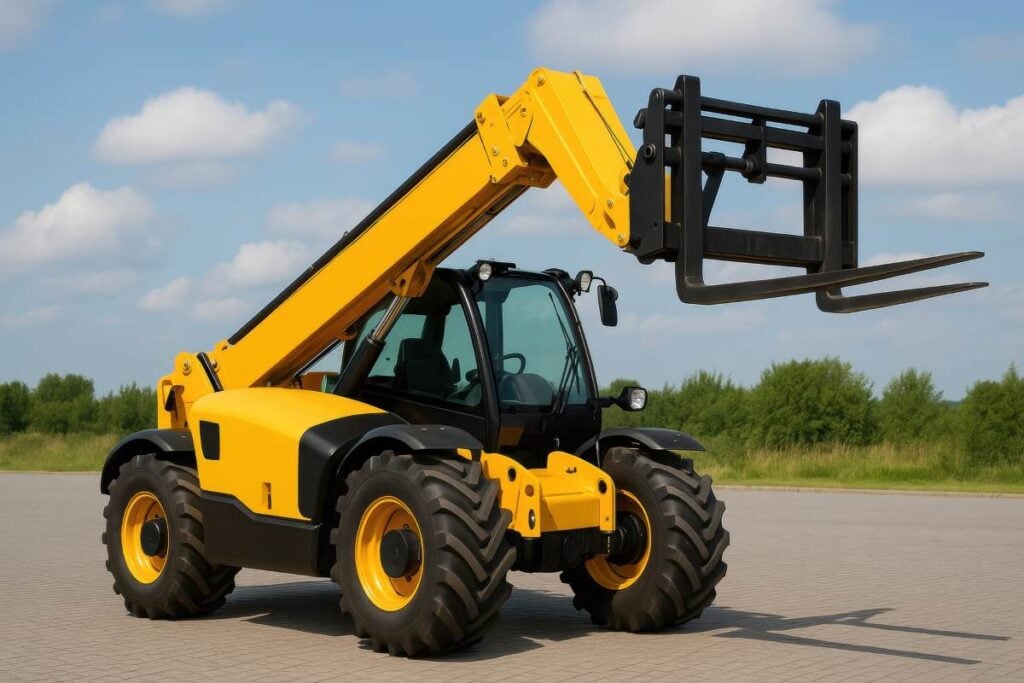
How high and how far materials must be lifted matters just as much.
A telehandler that can handle heavy loads near the machine may not cope with the same weight when its boom is fully extended.
Companies should therefore determine the maximum lifting height and forward reach their operations demand.
For instance, putting roofing materials on a multi-storey building might require a high lift telehandler, while a standard model suffices for loading pallets onto vehicles.
Job Accessibility
Accessibility is another key consideration when selecting a telehandler.
Construction sites often feature narrow access routes, uneven ground and cramped working areas.
Bigger telehandlers can lift a great deal, but their size may stop them from operating in confined spaces.
Compact telehandlers generally work better in tight spaces, whereas larger machines may be necessary where more reach or capacity is needed.
Telehandler Attachments and Versatility
A major benefit of telehandlers is that they accept different attachments, letting businesses handle various materials tasks with one machine.
Common attachments include:
- Forklift forks: For lifting and moving palletised materials such as bricks, timber and packaged supplies.
- Buckets: For loose materials like soil, sand, gravel and agricultural products.
- Lifting hooks and jibs: Approved attachments for lifting certain suspended loads.
- Personnel platforms: Approved platforms used with suitable telehandlers for some work at height, subject to applicable safety requirements.
However, attachments can affect a telehandler’s lifting capacity.
Their weight, dimensions and load centres may alter the machine’s lifting characteristics, so operators must check the manufacturer-approved capacity information.
How Does Terrain Affect the Performance of a Telehandler?
Telehandlers are often chosen because they perform well on tough outdoor sites
Many models feature four-wheel drive, large tyres and higher ground clearance, enabling them to travel across construction sites, farms and industrial yards.
Yet the state of the ground can greatly influence machine stability.
Uneven ground, soft surfaces, slopes and potholes raise the risk of a telehandler overturning, especially when loads are raised or extended.
Before any lifting operation, businesses should confirm that the ground is able to support the weight of the machine and its intended load safely.
Operators must also consider gradients, weather conditions and any limits specified by the manufacturer.
Can Telehandlers Be Legally Driven on Public Roads?
Some telehandlers can be registered and legally driven on UK public roads, as long as they meet the relevant requirements.
This is advantageous for businesses working across several nearby sites, and may lessen the need for specialist transport.
However, road use is governed by applicable registration, licensing, insurance and vehicle requirements.
Businesses should confirm that their machine meets the legal requirements before using it on public highways.
Telehandler Safety and UK Regulations
Telehandlers are powerful lifting machines, and using them incorrectly can result in serious accidents.
In the UK, telehandler operations fall under workplace safety legislation, including the Lifting Operations and Lifting Equipment Regulations 1998 (LOLER) and the Provision and Use of Work Equipment Regulations 1998 (PUWER).
LOLER requires lifting operations to be properly planned, appropriately supervised and carried out safely.
PUWER requires work equipment to be suitable, properly maintained and operated by adequately trained individuals.
Routine maintenance, pre-use inspections and following manufacturer guidance are essential for safe telehandler operations.
Choosing the Right Telehandler with Acclaim Handling
Understanding telehandler lifting capacity is essential when selecting equipment that matches your business’s operational needs.
Although maximum lifting capacity matters, businesses should also consider lifting height, forward reach, attachments, accessibility, and ground conditions.
Selecting equipment with suitable specifications boosts operational efficiency and lowers the risks that come with inappropriate lifting machinery.
At Acclaim Handling, we recognize how vital reliable materials handling equipment is, and how crucial it is to choose machinery that suits your operation.
Whether your requirements lie in construction, agriculture, or industrial applications, our team can assist you in finding the right materials handling solutions.
Contact Acclaim Handling today to discuss your equipment needs and find out how we can support your business.
Telehandler Summary Table
| Telehandler type / factor | Typical capacity or reach | Best suited to | Key consideration |
| Super compact | Approx. 3.3–5.6 m lift height | Tight sites, agricultural buildings and restricted-access work | Prioritises manoeuvrability and accessibility |
| Compact | Nearly 4 tonnes; up to about 10 m | Construction and agriculture where space is limited | Balances lifting power with a smaller footprint |
| Standard lift | Approx. 6–11 m lift height | General construction materials, pallets, timber and roofing supplies | Offers a practical mix of capacity, reach and versatility |
| High lift | Approx. 17 m or more; often around 4 tonnes maximum rated capacity | Multi-storey construction, roofing and lifting over obstacles | Permitted load reduces at some boom positions; check the load chart |
| Heavy load | Usually 5–7 tonnes; around 10 m or more lift height | Heavy or bulky materials in construction, agriculture and industry | Specialised models may exceed the typical capacity range |
| Machine selection | Depends on load weight, height and forward reach | Matching equipment to the intended lifting task and site | Include attachment weight and confirm capacity at the required boom position |
| Site and safety | Capacity varies with boom extension, terrain and attachments | All telehandler operations | Assess access and ground conditions, follow manufacturer guidance, and comply with LOLER and PUWER |