On this page
- How a pallet truck works
- Hand pallet trucks (manual pump trucks)
- Electric pallet trucks (powered pump trucks)
- Pallet truck vs pallet stacker
- Pallet truck vs forklift
- Getting the capacity right
- Do operators need training?
- Where LOLER comes in
- Buy, hire or finance?
- Keeping a pallet truck working
- Talk to us
- Pallet truck FAQs
- Eight depots across the UK
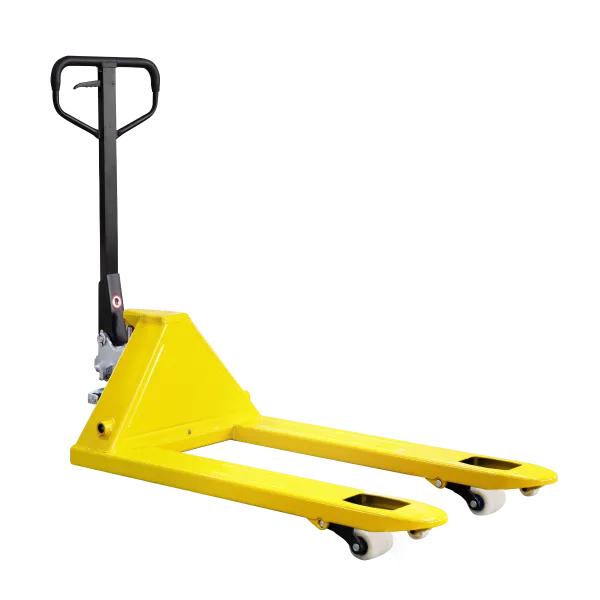
A pallet truck, also called a pump truck or pallet jack, moves a loaded pallet across a floor. Two forks slide into the pockets of the pallet, the forks lift the load clear of the ground, and the pallet rolls on wheels instead of being dragged or carried.
In stock now: Hand pallet trucks · Enquire

You will hear the same machine called a pallet jack, a pump truck or a pallet trolley. They all mean the same thing. The split that matters is not the name: it is whether the truck is hand-operated or powered, and whether you actually need something that lifts to height.
How a pallet truck works
The forks sit on load wheels at the tip and a steer wheel or wheels at the tiller end. The operator pushes the forks into the pallet, then raises them far enough to clear the floor.
On a hand pallet truck that lift comes from a hydraulic pump worked by the tiller handle. On an electric one it comes from a motor, triggered from the tiller head.
The truck steers from the tiller. A release lever lowers the forks back down when the pallet is where it needs to be.
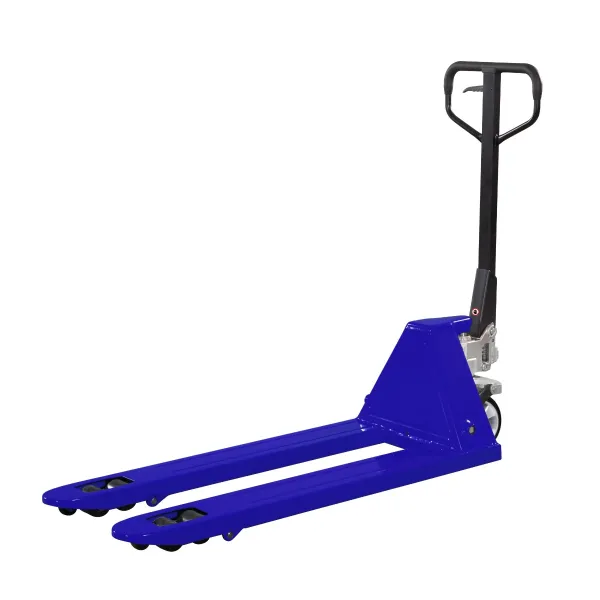
Hand pallet trucks (manual pump trucks)
A hand pallet truck is entirely operator-powered. Pump the handle to lift, push to move, squeeze the lever to lower.
STILL, for whom Acclaim is an exclusive dealer, has eleven models in its HPS and HPT hand pallet truck range at 1,000 kg, 2,000 kg, 2,500 kg and 3,000 kg rated capacity. Most lift to 115 mm; the two 1,000 kg models, the HPT 10 XM and HPT 10 XE, lift to 715 mm.
Floor condition matters more on a hand pallet truck than it does on a forklift. Broken concrete, expansion joints and steep loading-bay ramps are where hand pallet trucks struggle.
Hand pallet trucks suit low volumes, short runs, back-of-shop and van-delivery work. Acclaim lists hand pallet trucks from £180 + VAT.
All three in our shop carry 2500 kg: the Pallet Mover, with 1150 x 550 mm forks for Euro and most UK warehouse pallets; the wide Pallet Mover, with 1000 x 685 mm forks for wider pallets; and the Silent Pump Truck, which runs at under 60 dB for shops, hospitals and hotels.
Choose a hand pallet truck when: distances are short, floors are sound and level, and the truck is used a handful of times a day.
Electric pallet trucks (powered pump trucks)
We sell and hire pallet trucks.
An electric pallet truck (often searched as an electric pump truck) puts a battery, a traction motor and a hydraulic lift pump in the same basic layout. The operator walks alongside, steering from the tiller, with lift, lower, travel and horn on the tiller head. Larger models are stand-on or ride-on, so the operator travels with the machine over longer runs.
The reason to move up from manual is repetition and distance.
Acclaim’s powered pallet truck range covers STILL, Hyundai and Lonking machines.
Choose an electric pallet truck when: the same pallets move all shift, the runs are long, or you are trying to get manual handling out of a process.
Pedestrian, platform and ride-on
Powered pallet trucks come in three broad operator positions:
- Pedestrian: the operator walks beside the truck holding the tiller. Best in congested space and for short, frequent moves.
- Platform: a fold-down platform lets the operator ride standing. Suits medium runs where getting on and off repeatedly wastes more time than it saves.
- Ride-on / stand-on: a proper operator compartment for long travel distances, typically trailer loading and long-aisle replenishment.
Pallet truck vs pallet stacker
This is the question that catches people out. A pallet truck lifts the pallet clear of the floor. A pallet stacker raises it to height, so you can put it on a rack, on a mezzanine edge or on top of another pallet.
If any part of your job involves the word “up”, you need a stacker, not a pallet truck. Capacity and lift height vary model by model, so check the rating plate of the specific machine rather than assuming a stacker will take the same pallets your pump truck handles. Current machines are listed on Acclaim’s pallet stacker page.
Pallet truck vs forklift
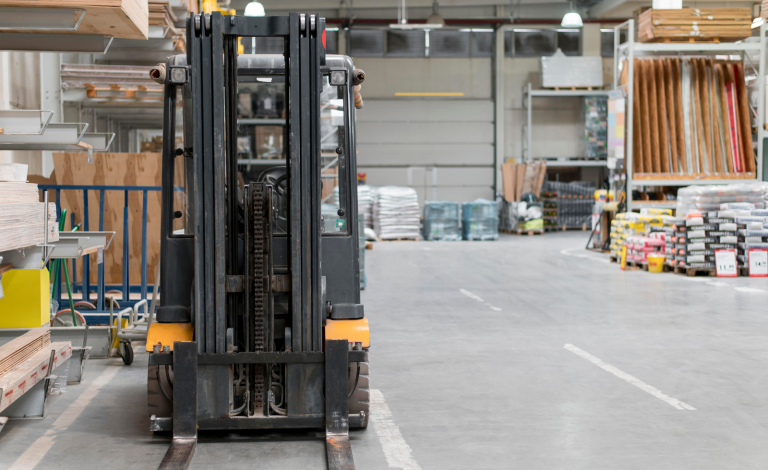
A counterbalance forklift or a reach truck is a different order of machine: higher lifts, heavier loads, a seated or stand-in operator, and a much bigger training and compliance burden.
Rough guide:
- Pallet truck: floor-to-floor movement only.
- Pallet stacker: low to medium racking, light pallets, pedestrian operation.
- Reach truck: high racking in narrow aisles, indoors, electric.
- Counterbalance forklift: yard work, lorry loading, heavy or awkward loads.
Getting the capacity right
Rated capacity is the maximum the truck is designed to lift, and it is on the machine’s rating plate. Work from the heaviest pallet you actually handle, not the average, and include the weight of the pallet itself. Read the capacity plate on the machine rather than a headline figure in a brochure.
Do operators need training?
Under the Provision and Use of Work Equipment Regulations 1998, regulation 9(1):
“Every employer shall ensure that all persons who use work equipment have received adequate training for purposes of health and safety, including training in the methods which may be adopted when using the work equipment, any risks which such use may entail and precautions to be taken.”
Regulation 9(2) extends the same duty to supervisors and managers, but only to the employer’s own staff:
“Every employer shall ensure that any of his employees who supervises or manages the use of work equipment has received adequate training for purposes of health and safety, including training in the methods which may be adopted when using the work equipment, any risks which such use may entail and precautions to be taken.”
So there is no separate “pallet truck licence” in law. PUWER places the training duty on the employer, and what it asks for is training that is adequate for the equipment and the risk.
Acclaim is RTITB accredited and runs operator training, with FLT operator certification listed from £360 + VAT per day. Courses are delivered by in-house instructors.
Where LOLER comes in
LOLER 1998 defines lifting equipment as “work equipment for lifting or lowering loads and includes its attachments used for anchoring, fixing or supporting it” (regulation 2(1)).
Whether a specific machine on your floor falls inside that is a machine-by-machine judgement for a competent person, not a blanket rule and not something a web page can settle for you.
Where thorough examination does apply, regulation 9(4) of LOLER matters most when equipment changes hands:
“Every employer shall ensure that no lifting equipment: (a) leaves his undertaking; or (b) if obtained from the undertaking of another person, is used in his undertaking, unless it is accompanied by physical evidence that the last thorough examination required to be carried out under this regulation has been carried out.”
That matters when you buy or hire second-hand. Ask for the physical evidence before the machine comes off the lorry.
Acclaim is CFTS accredited, which means one examination and one report covering the LOLER and PUWER duties together rather than two separate visits. Warehouse equipment thorough examinations are listed from £135 and warehouse equipment servicing from £90 (both ex VAT) on the thorough examinations page. Acclaim will examine machines it did not supply, and examines lifting accessories such as slings, chains, forks and attachments as well as trucks.
Buy, hire or finance?
Buying new makes sense for a truck that will be in daily use for years, or where you want a specific spec.
Buying used is where most of the value is on this class of machine. Acclaim is the biggest independent supplier of used forklift trucks and materials handling equipment in the UK.
The vast majority of used stock is ex-own-hire-fleet (machines Acclaim has maintained itself), and every used machine is supplied with a current thorough examination as standard. Machines are inspected to standard before release, and refurbishment is available.
Hiring suits seasonal peaks, contract work and cover: see pallet truck hire. There is no minimum hire period.
A machine can go out for a day, but the minimum charge is one week at the weekly rate. If a hired truck does not work you get your money back, Acclaim will send an engineer to fix it, and a stand-in machine may be provided where Acclaim judges it necessary.
Hire is available across all machine types.
Finance is available on both new and used: lease purchase, contract hire, operating lease and outright purchase.
Delivery is nationwide, charged separately, with the fee depending on location. All prices quoted above are ex VAT.
Keeping a pallet truck working
Pallet trucks are simple, but they are not maintenance-free. Load wheels wear, hydraulic seals leak, and forks get bent by being driven into pallet stringers.
Acclaim offers comprehensive and planned maintenance contracts, carries parts for STILL, Hyundai and Lonking among others, and has eight depots: South East (head office, Rainham), East Anglia, East (Pinchbeck, Spalding), Midlands, West, Southern, Liverpool/North and South Coast.
Talk to us
Acclaim Handling has supplied and serviced materials handling equipment since 1982, and is the UK’s longest-serving independent distributor of used forklifts and used warehouse equipment.
If you are not sure whether you need a hand pallet truck, a powered one or a stacker, tell us the pallet weight, the distance and the lift height and we will tell you which one fits.
Call 01708 861 414 or get in touch.
Want a hand picking one? Tell us your pallet weight and where it has to go.
Pallet truck FAQs
Eight depots across the UK
Our own engineers, out of our own depots - wherever you are, service comes from us.